











 Secure payments
Standard refund policy
Trade Assurance
Secure payments
Standard refund policy
Trade Assurance
| Model | M391A1K43BB1-CRCQ |
|---|---|
| Product Type | Memory Module |
| Compliance Standards | CE,WEEE,RoHS |
| Memory Capacity | 8 GB |
| Memory Technology | DDR4 |
| Product Voltage | 1.2V |
| RAM Speed | 2400MHz |
| RAM Standard | DDR4-2400/PC4-19200 |
| Error Identifying | ECC |
| Signal Type | Unbuffered |
| Column Access Strobe (CAS) | CL17 |
| Rank | Single Rank x8 |
| Quantity of Pins | 288-pin |
| RAM Genre | UDIMM |
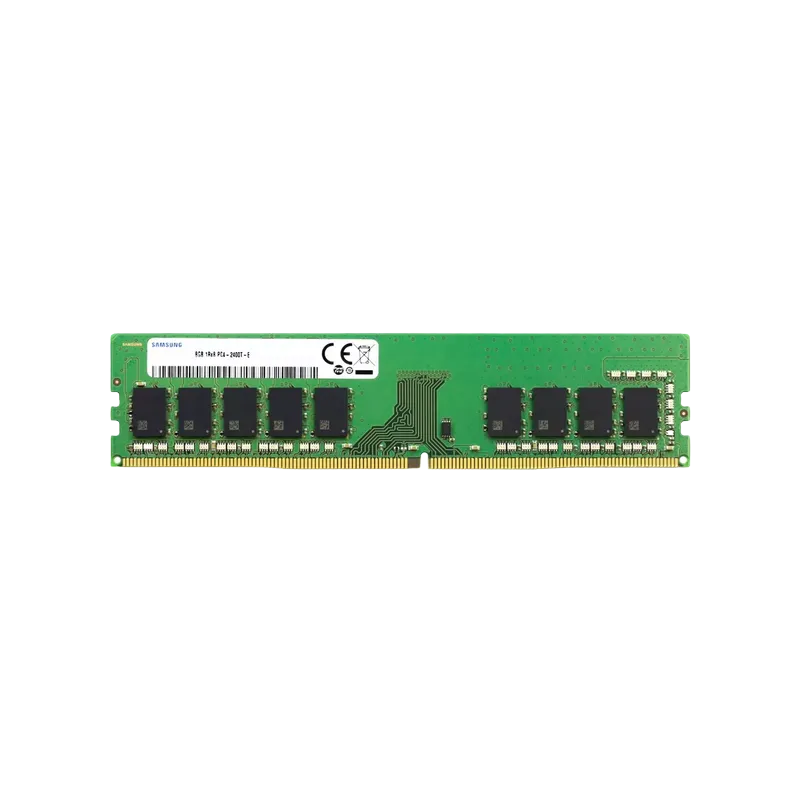
The Samsung M391A1K43BB1-CRCQ is an 8GB DDR4-2400 ECC Unbuffered DIMM purpose-built for entry-level single-socket servers and professional workstations, ideally suited for virtualization hosts, memory-centric databases, and other data-integrity-sensitive workloads. Its single-rank x8 configuration minimizes electrical loading and enhances signal stability, while the integrated ECC engine and unbuffered architecture deliver reliable single-bit error correction with low latency, ensuring continuous data accuracy in 24/7 operation.
1. ECC error correction actively detects and corrects single-bit errors, safeguarding data integrity in long-running server workloads and preventing silent data corruption in storage appliances.
2. Unbuffered architecture removes register-induced latency, delivering a direct electrical path that accelerates response times for latency-sensitive edge servers and lightweight hypervisor tasks.
3. An 8 GB capacity per module offers a cost-optimized building block for entry-level virtualized environments, enabling higher container density without exceeding tight power budgets.
4. 2400 MT/s memory bandwidth sustains simultaneous data streams across multiple cores, improving throughput consistency for concurrent web hosting and in-memory database caching.
5. CL 17 column access latency reduces read fetch delays, sharpening transactional efficiency for small to mid-size database instances that depend on rapid random access.
The Samsung M391A1K43BB1-CRCQ is an 8GB DDR4 UDIMM with ECC, immediately identifying it as a server-grade component built for workstations and entry-level servers where data integrity is non-negotiable. Its four defining characteristics directly address the real-world pressures you face in a datacenter or professional environment. First, the ECC error correction works silently in the background to detect and correct single-bit memory errors caused by cosmic radiation or electrical noise. In a virtualization cluster running multiple guest machines, this means a flipped bit will not cascade into a kernel panic that brings down a dozen services—it is the difference between planned uptime and a 3 AM emergency call. Second, the 1.2V ultra-low operating voltage significantly reduces thermal output. When you scale to hundreds of nodes for an in-memory database like Redis or SAP HANA, the cumulative power savings lower your cooling overhead and shrink your carbon footprint without compromising throughput. Third, the 2400MHz speed paired with a CL17 latency delivers responsive, predictable performance for latency-sensitive analytics, ensuring your real-time dashboards refresh with zero stutter. Finally, because this is an unbuffered UDIMM in a single-rank x8 configuration, it imposes a minimal electrical load on the memory controller, assuring broad compatibility with mainstream single-processor server boards and quiet, effortless plug-and-play deployment. You gain a reliable memory foundation that directly protects transactional data, optimizes operational expenditure, and keeps your critical workloads running cleanly.
General Virtualization
For general virtualization hosts, populate all available memory channels symmetrically with these 8GB ECC UDIMMs to maximize bandwidth while safeguarding VM data. A typical dual-socket configuration benefits from four or eight identical modules, delivering 32GB or 64GB of reliable capacity. Always install modules in matched sets to maintain balanced interleaving and avoid performance penalties during live migration or burst workloads.
In-Memory Database
In-memory databases demand maximum capacity and unwavering data integrity, making ECC essential. Fill every DIMM slot with these 8GB modules to achieve the highest possible density, such as 64GB using eight sticks on a single-socket platform. The combination of unbuffered latency and error correction ensures rapid, consistent access to large datasets without risking silent data corruption.
High-Performance Computing
HPC workloads thrive on memory bandwidth, requiring a balanced population across all memory channels. Install one 8GB ECC UDIMM per channel to sustain 2400MHz speeds and avoid clock-downs caused by mixed or asymmetrical configurations. For a six-channel platform, six modules provide 48GB of low-latency capacity, optimizing throughput for simulation, modeling, and parallel computation tasks.
Engineered for server-grade performance, validated on Dell PowerEdge T140, T150, R240, HPE ProLiant ML30 Gen10, Lenovo ThinkSystem ST50.
Q: Can I mix this M391A1K43BB1-CRCQ with other memory modules of different brands or speeds?
A: Mixing is not recommended. For reliable ECC operation, use identical modules with the same speed, timings, and part number. Mixed configurations may cause instability or disabled ECC.
Q: Is this memory compatible with my server platform (Intel/AMD)?
A: It is compatible with Intel Xeon E-2100/E-2200 and AMD Ryzen Pro or EPYC 3000 platforms that support DDR4-2400 ECC UDIMMs. Always verify your motherboard's qualified vendor list.
Q: What is the recommended DIMM population order for optimal performance?
A: For single-socket boards, populate DIMM slots starting with the channel farthest from the CPU, typically slot A1 or as specified in your server manual, to achieve balanced memory interleaving.
Q: Does this module support overclocking or XMP profiles?
A: No. As an ECC UDIMM, it strictly follows JEDEC DDR4-2400 standard. Overclocking and XMP are not supported to preserve data integrity and ensure stability in server environments.
Q: What warranty and typical failure rate can I expect?
A: This module includes a 1-year warranty. Rigorous Samsung component testing delivers an annualized failure rate (AFR) well below the industry average, typically under 0.5%.