











 Secure payments
Standard refund policy
Trade Assurance
Secure payments
Standard refund policy
Trade Assurance
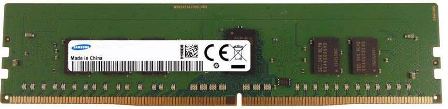
| Model | M391A1G43EB1-CRC00 |
|---|---|
| Product Type | Memory Module |
| Compliance Standards | EU RoHS,FCC |
| Memory Capacity | 8 GB |
| Memory Technology | DDR4 |
| Product Voltage | 1.2V |
| RAM Speed | 2400MHz |
| RAM Standard | DDR4-2400/PC4-19200 |
| Error Identifying | ECC |
| Signal Type | Unbuffered |
| Column Access Strobe (CAS) | CL17 |
| Rank | Dual Rank x8 |
| Quantity of Pins | 288-pin |
| RAM Genre | UDIMM |
This UDIMM with ECC is engineered for entry-level servers and workstations that require data integrity without the cost of registered memory, making it ideal for small virtualization hosts, file servers, and mission-critical productivity workloads. Its dual-rank x8 organization enhances memory bandwidth and interleaving efficiency, while on-die ECC and unbuffered signal topology ensure reliable error correction and low-latency operation at DDR4-2400 CL17.
1. ECC protection silently corrects single-bit memory errors, ensuring data integrity for financial record-keeping or virtualized database workloads that cannot afford silent data corruption.
2. Dual Rank x8 organization interleaves memory banks to saturate the memory bus, increasing throughput for multi-threaded server applications under heavy concurrent access.
3. Unbuffered design delivers lower access latency ideal for entry-level servers, providing a responsive and cost-efficient foundation for file caching or light container orchestration.
4. 2400 MT/s transfer rate supplies steady and predictable bandwidth, helping server processors handle simultaneous client requests without memory-side bottlenecks.
5. Operating at 1.2 volts reduces the overall thermal footprint in dense rack deployments, contributing to lower cooling overhead and improved long-term reliability.
Designed for entry-level servers and workstations, the Samsung M391A1G43EB1-CRC00 is an 8GB DDR4-2400 UDIMM that brings mission-critical reliability to environments where data corruption is simply not an option. Its unbuffered architecture with ECC directly answers the pain of silent bit flips that can crash a small business virtualization host or poison a financial record during memory-intensive processing. In a VMware cluster running multiple light-duty VMs, a single uncorrected error can force host restarts and bring down several services; the integrated error correction proactively scrubs and corrects single-bit error, preserving uptime and data consistency. For in-memory databases like Redis or a ZFS-based NAS, where every read and write must be exact, ECC is your insurance against gradual payload corruption. The true significance of its low 1.2V profile emerges in always-on environments—reducing thermal load inside compact 1U server chassis lowers fan speeds and ongoing cooling costs. Further, the Dual Rank x8 organization delivers the interleaved bank access essential for steady bandwidth under concurrent requests, meaning a Samba file server can saturate dual Gigabit links without stumbling when multiple users transfer large render assets simultaneously. For the IT manager, this module means turning a cost-conscious white-box server into a reliable workhorse that balances data integrity, efficiency, and responsive multi-tasking.
This is a server-grade DDR4-2400 ECC Unbuffered DIMM (8GB), designed for entry-level servers and workstations requiring data integrity. The following capacity planning guidance applies to typical server workloads.
General Virtualization
For moderate VM density, start with four modules (32GB total) to enable dual-channel operation while retaining future upgrade slots. For consolidated environments, populate all available slots with identical 8GB DIMMs—64GB or more—to provide balanced memory bandwidth and reliable ECC coverage across virtual machines.
In-Memory Database
Databases that cache entire datasets demand large, error-resilient footprints. Fill every DIMM slot on the motherboard using matched 8GB modules to reach the platform’s maximum capacity, commonly 64–128GB per socket. Symmetric population across all memory channels ensures lowest latency and prevents memory-related bottlenecks during intensive query processing.
High Performance Computing (HPC)
HPC applications thrive on channel parallelism. Install six or eight modules to leverage quad-channel architectures, maximizing sustained bandwidth for simulation or analytic codes. Although 8GB per DIMM limits per-node capacity, using identical ECC UDIMMs in every channel guarantees uniform timing and robust silent data corruption protection critical for long-running computations.
Rigorously tested server memory. Compatible with Dell PowerEdge T140, T340, R240, HPE ProLiant ML30 Gen10, and Lenovo ThinkSystem ST50.
Q: Can I mix this M391A1G43EB1-CRC00 with other memory modules of different brands or speeds?
A: Mixing is not advised for server environments. This ECC UDIMM relies on exact speed, rank, and timing matching to maintain data integrity. Mismatched modules may cause instability or unbuffered ECC errors.
Q: Is this memory compatible with my system?
A: It suits Intel Xeon E3 v5/v6 or select AMD Ryzen PRO platforms with C232/C236/C242/C246 chipsets. Ensure your board explicitly supports DDR4-2400 ECC Unbuffered DIMMs before purchasing.
Q: What is the recommended DIMM population order for optimal performance?
A: Populate slots per your motherboard manual, typically starting with blue or primary channels to enable dual-channel mode. Balanced dual-rank x8 configurations help maximize throughput on compatible server boards.
Q: Does this module support overclocking or XMP profiles?
A: No. It runs strictly at JEDEC DDR4-2400 CL17. Server ECC UDIMMs do not support XMP or overclocking to guarantee error correction and long‑term reliability in mission‑critical environments.
Q: What warranty and typical failure rate can I expect?
A: It comes with a 1-year warranty. The module is built with Samsung’s rigorous server-grade screening, resulting in an extremely low AFR. It is designed for 24/7 reliable operation.