











 Secure payments
Standard refund policy
Trade Assurance
Secure payments
Standard refund policy
Trade Assurance
| Product Type | Memory Module |
|---|---|
| Memory Capacity | 8 GB |
| Memory Technology | DDR4 |
| Product Voltage | 1.2 V |
| RAM Speed | 2400 MHz |
| RAM Standard | DDR4-2400/PC4-19200 |
| Error Identifying | ECC |
| Signal Type | Unbuffered |
| Column Access Strobe (CAS) | CL17 |
| Rank | Single Rank x8 |
| Quantity of Pins | 288-pin |
| RAM Genre | UDIMM |
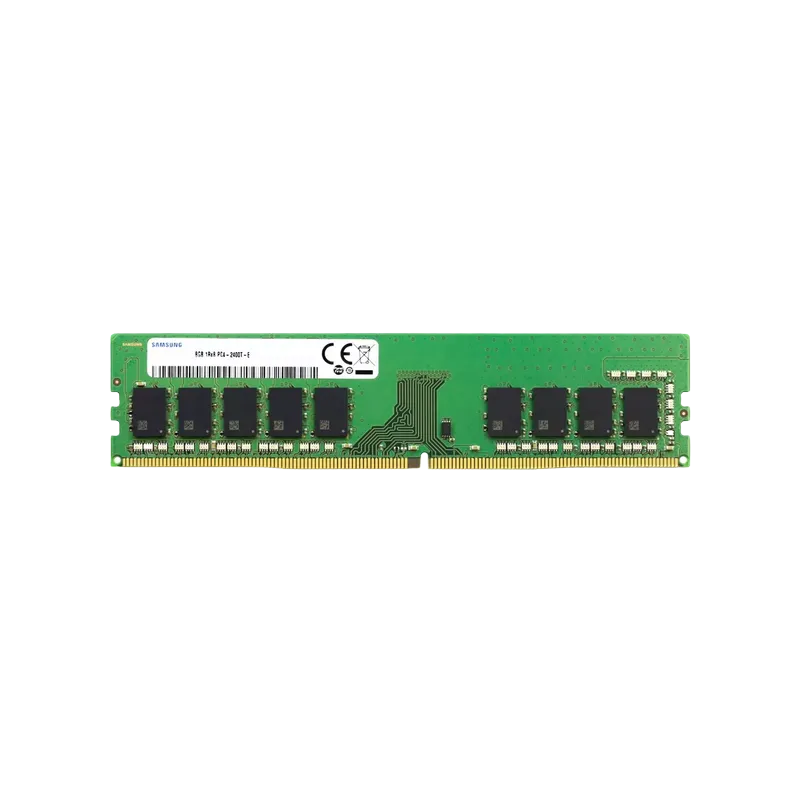
Designed for entry-level servers and workstations requiring data integrity, this Samsung DDR4-2400 UDIMM leverages ECC error correction to prevent single-bit memory errors in critical applications such as file serving and light virtualization. Its single-rank x8 organization and unbuffered signal type minimize electrical loading on the memory controller, enabling stable operation at the standard 1.2V with a modest CL17 latency for consistent, power-efficient performance.
1. ECC protection silently corrects single-bit memory errors, safeguarding transactional integrity in always-on microserver environments.
2. An 8-gigabyte footprint provides sufficient headroom for lightweight virtualization hosts and containerized workloads without excess idle power draw.
3. DDR4-2400 delivers 19.2 GB/s peak bandwidth, keeping data flowing smoothly for modest database instances and file-serving roles.
4. 1.2V operation reduces thermal waste inside compact server chassis, lowering cooling overhead in dense deployment racks.
5. Unbuffered signaling trims controller latency and cost, matching the needs of entry-level server boards where every watt and dollar counts.
When deploying a small business server or a mission-critical workstation, data integrity isn’t optional—it’s everything. The Samsung M391A1K43BB1-CRC is an 8GB DDR4-2400 Unbuffered ECC UDIMM engineered precisely for these environments, and its four defining characteristics directly counter real-world failures. First, the ECC technology actively detects and corrects single-bit memory errors caused by background radiation or cosmic rays. In a virtualized cluster running multiple VMs on a single host, one uncorrected bit-flip can silently corrupt a hypervisor table, crashing all guest workloads; ECC transforms this catastrophic risk into a transparent, logged event with zero downtime. Second, the Unbuffered architecture avoids the added latency of a register chip, giving an edge to in-memory databases like Redis where every nanosecond of response time matters. Many do not realize that Unbuffered ECC strikes an ideal balance for entry-level servers and high-end desktop workstations—it provides the data protection of ECC without the cost and power draw of registered modules, as long as the platform supports it. Third, the Single Rank x8 organization ensures broad compatibility and stable signal integrity across common dual-channel motherboard layouts, minimizing electrical reflections that plague high-density mixed-rank configurations. Finally, the strict JEDEC DDR4-2400 timing at CL17 with a low 1.2V operating voltage helps tame thermal build-up inside compact 1U chassis or a rendering workstation running overnight. In a multi-user file server, this thermal discipline means fewer fan cycles and longer hardware lifespan, while the standard voltage and speed guarantee a seamless drop-in upgrade across mixed-vendor server fleets. You are not just installing RAM—you are eliminating a silent source of data corruption, reducing latency in transactional applications, and future-proofing your infrastructure with memory that prioritizes truth over marketing histrionics.
General Virtualization
For a virtualization host, populate the server with at least four of these 8GB ECC UDIMMs to deliver 32GB of error-correcting capacity. Distribute modules evenly across memory channels to maximize bandwidth for multiple guest VMs, and leave at least two slots free for future scale-out without replacing existing DIMMs.
In-Memory Database
In-memory databases demand both reliability and low latency, so ECC is non-negotiable. Deploy a full channel population of six or eight modules to reach 48–64GB, pinning the entire dataset in fault-tolerant RAM and sustaining high query throughput with minimal page faults.
High-Performance Computing (HPC)
HPC workloads benefit from balanced bandwidth, so install identical 8GB UDIMMs in a symmetric multi-channel configuration—typically six or eight sticks for a single-socket node. The unbuffered, single-rank design reduces read latency, making it suitable for tightly coupled simulations where quick synchronization outweighs extreme capacity.
Rigorously tested 8GB DDR4 ECC UDIMM for servers: compatible with Dell PowerEdge T40, T140, HPE ProLiant MicroServer Gen10.
Q: Can I mix this M391A1K43BB1-CRC with other memory modules of different brands or speeds?
A: Mixing is possible but not recommended for server environments. Disparate modules may cause the system to downclock all memory or disable ECC, compromising stability and data integrity.
Q: Is this memory compatible with my system?
A: This ECC UDIMM supports platforms like Intel Xeon E3 v5/v6, select AMD Ryzen PRO, or server boards with DDR4 ECC support. Verify your motherboard/chipset explicitly supports unbuffered ECC modules.
Q: What is the recommended DIMM population order for optimal performance?
A: Refer to your server board manual. Typically, populate identical DIMMs in the same color or labeled slots per channel, starting farthest from the CPU, to enable dual-channel interleaving for maximum throughput.
Q: Does this module support overclocking or XMP profiles?
A: No. This is a JEDEC-standard server memory module operating at fixed timings (CL17). It does not include XMP profiles and is designed for stability, not overclocking or enthusiast tuning.
Q: What warranty and typical failure rate can I expect?
A: It includes a one-year warranty. As enterprise-grade memory, it boasts an extremely low annualized failure rate, typically well under 0.5% under proper thermal and operating conditions.