











 Secure payments
Standard refund policy
Trade Assurance
Secure payments
Standard refund policy
Trade Assurance
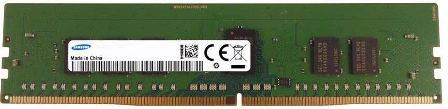
| Product Type | Memory Module |
|---|---|
| Memory Capacity | 8 GB |
| Memory Technology | DDR4 |
| Product Voltage | 1.2 V |
| RAM Speed | 2400 MHz |
| RAM Standard | DDR4-2400/PC4-19200 |
| Error Identifying | ECC |
| Signal Type | Unbuffered |
| Column Access Strobe (CAS) | CL17 |
| Rank | Dual Rank x8 |
| Quantity of Pins | 288-pin |
| RAM Genre | UDIMM |
This ECC Unbuffered DIMM (UDIMM) in DDR4-2400 is purpose-built for entry-level single-socket servers and professional workstations that demand hardware-level data integrity for error-sensitive workloads like light virtualization, file servers, and financial calculation. Its dual-rank x8 configuration boosts memory bandwidth utilization through interleaving, while the integrated ECC engine corrects single-bit errors in real time, complementing the pure signaling of unbuffered design to ensure uninterrupted reliability in 24/7 operation.
1. ECC error correction silently detects and corrects single-bit memory faults, preserving transactional integrity for mission-critical databases and eliminating costly downtime.
2. Dual Rank x8 organization boosts bank interleaving efficiency, delivering sustained bandwidth that keeps latency-sensitive virtual machines responsive under heavy consolidation.
3. Unbuffered signal topology reduces command-to-data latency, a direct advantage for real-time analytics and high-frequency trading platforms where every nanosecond translates to revenue.
4. Low voltage operation trims the thermal envelope of densely populated server racks, improving energy efficiency and long-term hardware reliability in always-on environments.
5. Standard DDR4 module capacity provides a flexible building block for cost-effective memory scaling, allowing IT teams to balance workload demand and budget across heterogeneous server fleets.
Designed as a server-grade UDIMM, the Samsung M391A1G43EB1-CRC is built for small-to-medium business servers and entry-level workstations where cost-effective reliability is non-negotiable. Its true ECC engine actively corrects single-bit memory errors, meaning your virtualized file servers and lightweight database applications stay running accurately around the clock instead of suffering silent data corruption. The unbuffered architecture deliberately avoids additional latency and power overhead, giving hypervisors like VMware ESXi a slightly faster interrupt response when multiple VMs contend for resources—critical when your invoice system and CRM coexist on one host. A dual-rank x8 organization interleaves memory banks, so during heavy multitasking or in-memory analytics, the processor sees substantially higher sustained bandwidth, preventing the stutter that plagues single-rank configs. Finally, at a mere 1.2 V, this DDR4-2400 module reduces thermal stress inside compact tower server chassis, keeping fan speeds low and energy bills predictable. For the IT manager upgrading a provisioning server or an engineer crunching CAD datasets, these four attributes translate directly to fewer mystery crashes, tighter multi-threaded performance, and a hardware platform that simply stays out of your way.
This is a DDR4-2400 ECC Unbuffered 288-pin UDIMM, server memory intended for platforms that require data integrity. Below are capacity planning recommendations for three common server workloads.
General Virtualization
Balance capacity across all memory channels. Install one 8 GB module per channel (e.g., 4 DIMMs for quad-channel) to preserve bandwidth. Scale to two modules per channel (8×8 GB) if hosting many VMs, ensuring identical dual-rank DIMMs.
In-Memory Database
Maximize capacity with fully populated channels. Populate each channel with two 8 GB ECC UDIMMs for 64–128 GB configurations depending on channel count. All modules must be identical to avoid ECC issues, allowing the dataset to reside entirely in memory.
High-Performance Computing
Prioritize symmetric, per-channel population for peak bandwidth. Install one 8 GB dual-rank DIMM in every memory channel (6 or 8 DIMMs) to keep all channels active at DDR4-2400. Add a second set only if capacity is more critical than maintaining full speed.
Rigorously tested for servers: compatible with Dell PowerEdge T340, HPE ProLiant ML30 Gen10, Lenovo ThinkSystem ST250.
Q: Can I mix this M391A1G43EB1-CRC with other memory modules of different brands or speeds?
A: We strongly advise against mixing. This is ECC UDIMM server memory; mismatched brands, speeds, or ranks can cause stability issues and disable ECC protection.
Q: Is this memory compatible with my system?
A: It is compatible with server/workstation platforms that support DDR4 ECC Unbuffered DIMMs, such as Intel Xeon E3/E-2100/2200 series or AMD Ryzen PRO with appropriate chipsets.
Q: What is the recommended DIMM population order for optimal performance?
A: Populate identical modules per channel following your server motherboard's memory population guide. Typically, fill the farthest slot from the CPU first for balanced dual-channel operation.
Q: Does this module support overclocking or XMP profiles?
A: No. This server-grade ECC UDIMM adheres strictly to JEDEC DDR4-2400 standards. It does not support overclocking or XMP profiles, as stability is prioritized.
Q: What warranty and typical failure rate can I expect?
A: This module includes a 1-year warranty. It is built to enterprise-class reliability standards, with an extremely low annualized failure rate (AFR) under normal operating conditions.