











 Secure payments
Standard refund policy
Trade Assurance
Secure payments
Standard refund policy
Trade Assurance
| Product Type | Memory Module |
|---|---|
| Memory Capacity | 8 GB |
| Memory Technology | DDR4 |
| Product Voltage | 1.2V |
| RAM Speed | 2400MHz |
| RAM Standard | DDR4-2400/PC4-19200 |
| Error Identifying | ECC |
| Signal Type | Unbuffered |
| Column Access Strobe (CAS) | CL17 |
| Rank | Single Rank x8 |
| Quantity of Pins | 288-pin |
| RAM Genre | UDIMM |
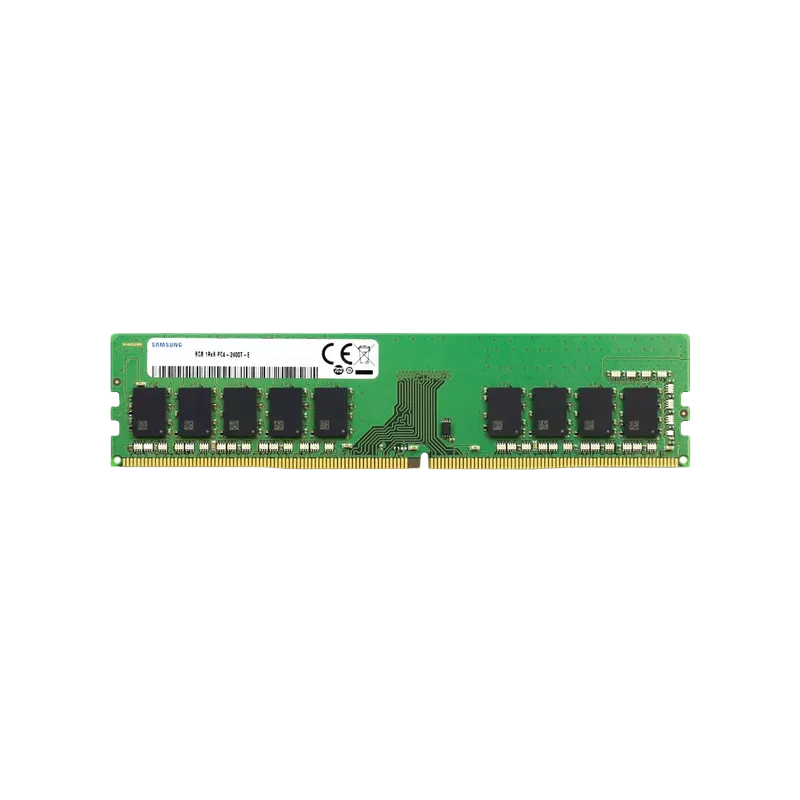
This DDR4-2400 UDIMM with ECC is engineered for workstation and entry-level server platforms where data integrity is critical, such as CAD workstations, financial modeling, or light virtualization tasks. The single-rank x8 organization provides lower electrical loading on the memory bus for improved signal stability, while ECC delivers robust single-bit error correction essential for uninterrupted, reliable operation.
1. ECC protection silently fixes single-bit memory faults in real time, preventing silent data corruption and unplanned downtime in critical always-on services like identity management or financial reconciliation nodes.
2. UDIMM unbuffered architecture strips out the register buffer to lower latency and per-module cost, making it a practical fit for single-socket edge servers and cost-sensitive virtualized branch-office appliances.
3. Single Rank x8 organization minimizes bus loading on the CPU memory controller, delivering cleaner signal integrity so compact fleets of 1U servers can sustain days of uninterrupted operation.
4. An 8‑gigabyte granularity aligns with lightweight container or micro‑VM footprints, maximizing consolidation density on a budget when dozens of minimal‑state instances share one node.
5. The 2400 megahertz clock sustains 19.2 GB/s channel throughput, keeping response times smooth under concurrent small‑file requests from backup scheduling or multi‑tenant web hosting.
The Samsung M391A1K43BB1-CRC0Y is a DDR4 UDIMM with ECC, purpose-built for professional workstations and entry-level servers where data integrity and consistent responsiveness are non-negotiable. Unlike typical desktop memory, this module brings four critical characteristics into real-world environments. First, its ECC technology silently corrects single-bit errors, a vital safeguard when a financial modeling workstation runs overnight Monte Carlo simulations—one undetected bit flip could invalidate an entire risk forecast. Second, the unbuffered signal architecture eliminates the register delay found in RDIMMs, keeping command-to-address latency minimal, which directly accelerates frequent small transactions in a legal document management server. Third, the 1.2V ultra-low operating voltage significantly reduces power draw and thermal stress inside a compact rendering node that runs at full load for days, preserving hardware longevity and lowering facility cooling costs. Finally, the single-rank x8 configuration ensures broad motherboard compatibility and stable signal integrity, meaning an architect can populate all four DIMM slots on a micro-ATX board without sacrificing the rated 2400MHz speed. In these scenarios, it is not merely a specification—you gain calculation certainty, sustained throughput, efficiency, and hassle-free expansion in demanding, uptime-critical workflows.
General Virtualization
For general virtualization hosts, density per channel is critical, so a single 8GB ECC UDIMM is typically a building block rather than a standalone solution. Deploy at least four modules (32GB total) to populate a quad-channel platform, and target six or eight identical DIMMs for six‑ or eight‑channel servers to maximize capacity while maintaining symmetrical interleaving. Avoid mixing capacities or ranks on the same channel to preserve memory access consistency under hypervisor scheduling.
In-Memory Database
In-memory databases demand both large capacity and consistent low latency, making 8GB UDIMMs suitable for smaller dataset footprints or edge deployments. For scale‑up configurations, fully populate all memory channels with identical M391A1K43BB1‑CRC0Y sticks—for example, eight modules (64GB) on an eight‑channel board—to deliver maximum bandwidth while leveraging ECC protection against data corruption. If capacity requirements exceed 64GB, plan to transition to 16GB or 32GB ECC UDIMMs rather than overloading a single controller with too many dual‑rank loads.
High-Performance Computing (HPC)
HPC workloads benefit from balanced memory bandwidth, so install one module per channel to enable full channel interleaving and avoid performance penalties from unbalanced configurations. On a dual‑socket platform with six channels per CPU, using six identical 8GB ECC UDIMMs per socket (96GB total) yields uniform bandwidth; for memory‑capacity‑bound simulations, consider upgrading to higher‑density DIMMs once the per‑channel limit is reached. The 2400MHz speed and CL17 latency are adequate for bandwidth‑sensitive, non‑GPU‑accelerated HPC codes that rely on predictable memory access patterns.
Rigorously tested server memory, compatible with Dell PowerEdge T140, T340, R240, Lenovo ST50, HPE ML30 Gen10.
Q: Can I mix this M391A1K43BB1-CRC0Y with other memory modules of different brands or speeds?
A: Mixing is not recommended, especially for ECC UDIMMs. Mismatched brands or speeds can cause signal integrity issues, prevent ECC from functioning correctly, and may lead to system instability.
Q: Is this memory compatible with my Intel or AMD server platform?
A: It is compatible with platforms supporting DDR4 ECC Unbuffered memory, such as Intel Xeon E-2100/2200 series or AMD AM4 with Ryzen PRO CPUs. Verify your motherboard’s ECC UDIMM support.
Q: What is the recommended DIMM population order for optimal performance?
A: Install identical modules in the same-channel slots (often color-coded) to enable dual-channel interleaving. For single DPC configurations, populate the furthest slots from the CPU per channel first.
Q: Does this module support overclocking or XMP profiles?
A: No. This is a JEDEC-compliant server-grade ECC UDIMM. It operates at fixed 2400MHz with standard latencies and does not support overclocking or XMP profiles.
Q: What warranty and typical failure rate can I expect?
A: This module includes a 1-year warranty. Its actual Annualized Failure Rate (AFR) is typically below 0.5%, adhering to stringent server-grade reliability standards under normal operating conditions.