











 Secure payments
Standard refund policy
Trade Assurance
Secure payments
Standard refund policy
Trade Assurance
| Product Type | Memory Module |
|---|---|
| Memory Capacity | 8 GB |
| Memory Technology | DDR4 |
| Product Voltage | 1.2V |
| RAM Speed | 2666MHz |
| RAM Standard | DDR4-2666/PC4-21300 |
| Error Identifying | ECC |
| Signal Type | Registered |
| Column Access Strobe (CAS) | CL19 |
| Rank | Single Rank x4 |
| Quantity of Pins | 288-pin |
| RAM Genre | RDIMM |
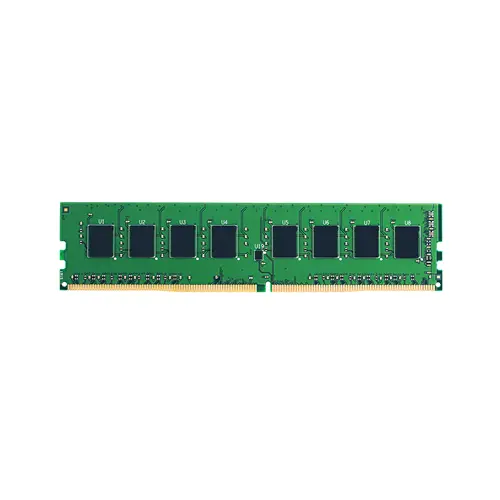
This DDR4-2666 registered ECC module is purpose-built for server platforms handling virtualization, in-memory databases, and other mission-critical workloads where data integrity is non-negotiable. Its single-rank x4 organization and registered signaling reduce bus loading and enhance signal stability, enabling reliable 2666MT/s operation at 1.2V with CL19 latency in dense multi-DIMM configurations.
1. ECC error correction autonomously detects and fixes single-bit errors, safeguarding transactional data integrity in always-on enterprise databases and virtualization hosts.
2. Registered signal buffering stabilizes command and address lines across fully populated server boards, preserving signal clarity in high-capacity memory configurations.
3. An 8 GB capacity per module provides a cost-effective building block for density-optimized virtualization, accommodating numerous lightweight containers or VMs without stranded resources.
4. 2666 MHz clock speed translates to a peak bandwidth of 21.3 GB/s, accelerating in-memory caching and real-time analytics under concurrent user loads.
5. Single Rank x4 organization streams data across four bank groups per access, reducing sequential access latency in storage servers and content delivery nodes.
The M393A1G40EB2-CTD6Q is a DDR4-2666 Registered DIMM built for the server environment, and its four defining characteristics directly address the real-world pain points of IT infrastructure. As an RDIMM with ECC, it delivers mission-critical data integrity. When you run a virtualization cluster hosting dozens of VMs, a single undetected bit flip in memory—often caused by background radiation—can silently corrupt a database record or trigger a node crash. The onboard error correction code catches and corrects these errors in real time, turning a potential outage into a non-event and safeguarding transactional consistency in memory-hungry databases like SAP HANA or Redis.
The registered buffer is equally vital. In dense 2U servers where you need massive capacity, unbuffered DIMMs heavily load the memory bus and limit how many modules you can install. This RDIMM’s register isolates the data signals, allowing a single channel to support up to three modules without sacrificing stability. That means you can fully populate all 24 DIMM slots in a dual-socket platform and feed hundreds of virtual desktops or an in-memory analytics engine with the terabytes of RAM they demand. The 1.2V operating voltage and 2666 MHz speed, coupled with a pragmatic CL19 latency and single-rank x4 organization, strike an optimal balance between bandwidth and power efficiency. In a colocation facility where every watt translates directly to cooling cost and carbon footprint, the low voltage saves thousands of dollars annually across a full rack, while the 21.3 GB/s throughput ensures that large-page memory requests clear fast enough to keep idle CPU cycles to a minimum under sustained load.
Server Memory Identified: The specifications—ECC, Registered (RDIMM), and 288-pin—clearly classify this 8GB DDR4-2666 module as server-grade memory. Capacity planning for this single-rank x4 DIMM must align with typical data center workloads.
General Virtualization
Virtualized environments thrive on balanced memory density and channel population. Deploy these 8GB RDIMMs in a fully balanced architecture—populate all memory channels identically to maximize memory bandwidth. For a dual-socket server with eight channels per CPU, installing sixteen of these modules delivers 128GB of capacity while preserving optimal interleaving for numerous virtual machines.
In-Memory Database
In-memory databases demand both capacity and resilience. While a single 8GB module seems small, populating all slots across multiple memory channels can build a 256GB or larger pool that holds entire datasets in RAM. Pair ECC Registered DIMMs with rank interleaving enabled; single-rank modules reduce electrical loading, allowing higher memory speeds even when all slots are filled, which accelerates real-time analytics.
High-Performance Computing (HPC)
HPC clusters require maximum memory bandwidth per node. Use these modules to populate all memory channels symmetrically—one DIMM per channel is ideal for pure bandwidth-sensitive workloads like computational fluid dynamics. For capacity-bound simulations, pair them in identical configurations across compute nodes to ensure consistent performance and eliminate NUMA balance issues.
Rigorously tested server memory. Compatible with Dell PowerEdge R740, HPE ProLiant DL380 Gen10, Lenovo ThinkSystem SR650, and more.
Q: Can I mix this M393A1G40EB2-CTD6Q with other memory modules of different brands or speeds?
A: Mixing RDIMMs of different brands, speeds, or ranks is not recommended. It may cause instability, force lower speeds, or prevent proper ECC operation. Always use identical modules for validated server configurations.
Q: Is this memory compatible with my system?
A: This DDR4-2666 ECC Registered DIMM is designed for server platforms using Intel Xeon Scalable, AMD EPYC, or similar processors with a C612/C621 chipset. Verify your server’s qualified vendor list (QVL) for this MPN.
Q: What is the recommended DIMM population order for optimal performance?
A: For optimal performance, populate identical DIMMs per channel starting with the slot farthest from the CPU. Balance memory across all memory controllers. Always consult your server motherboard’s population guide for exact slot sequences.
Q: Does this module support overclocking or XMP profiles?
A: No. This is a JEDEC-compliant DDR4-2666 RDIMM, built for 24/7 stability in servers. It does not support overclocking, XMP profiles, or voltage adjustments. It operates fixed at 1.2V with CL19 timings.
Q: What warranty and typical failure rate can I expect?
A: This module includes a 1-year warranty. As an enterprise-grade Samsung RDIMM using x4 DRAM components, it exhibits an extremely low annualized failure rate (AFR) when kept within specified temperature and environmental limits.