











 Secure payments
Standard refund policy
Trade Assurance
Secure payments
Standard refund policy
Trade Assurance
| Product Type | Memory Module |
|---|---|
| Memory Capacity | 8 GB |
| Memory Technology | DDR4 |
| Product Voltage | 1.2V |
| RAM Speed | 2666MHz |
| RAM Standard | DDR4-2666/PC4-21300 |
| Error Identifying | ECC |
| Signal Type | Unbuffered |
| Column Access Strobe (CAS) | CL19 |
| Rank | Single Rank x8 |
| Quantity of Pins | 288-pin |
| RAM Genre | UDIMM |
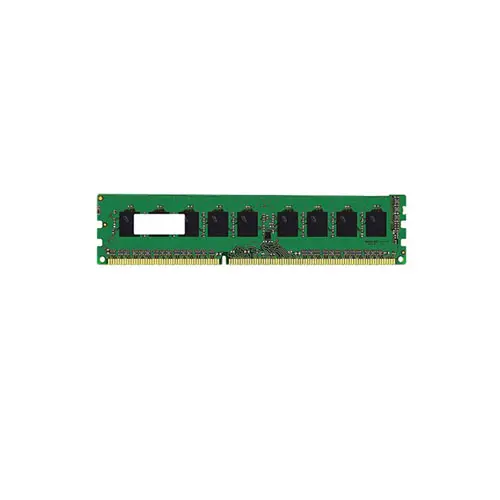
I’m classifying this module as server memory due to its ECC UDIMM configuration, and it is ideally suited for entry-level servers or workstations running virtualization, light database workloads, and file storage where data integrity is critical. Its unbuffered design with single-rank x8 organization ensures stable electrical loading and low latency operation at CL19, while the integrated ECC engine provides single-bit error correction to protect in-flight data without the additional cost of registered buffering.
1. ECC protection silently corrects single-bit memory errors, preserving data integrity for critical tasks like financial transactions or long-running scientific simulations in small-scale servers.
2. Unbuffered signal topology eliminates the latency of register chips, giving entry-level server workloads such as DNS and web hosting faster access to frequently requested data.
3. UDIMM form factor guarantees compatibility with cost-optimized server motherboards, enabling straightforward deployment and effortless field replacement without specialized tools.
4. The 1.2V operating voltage reduces overall power draw and thermal output across a rack of micro-servers, shrinking cooling overhead in dense edge-computing enclosures.
5. Single Rank x8 organization reduces the electrical load on the memory channel, allowing the entire 8GB capacity to operate stably at full speed even when all DIMM slots are populated.
Judging by the 288-pin UDIMM form factor with full ECC support, the M391A1K43DB2-CTD is engineered for entry-level servers and professional workstations where data integrity cannot be compromised. Its four defining characteristics directly answer the daily pain points of IT administrators and content professionals. The ECC error correction constantly scrubs single-bit memory errors, which means in a 24/7 virtualization cluster hosting multiple critical VMs, a cosmic-ray-induced bit flip inside a guest operating system won’t cascade into a silent data corruption event or an unexplained system crash. Because the module is unbuffered, it delivers lower command-to-response latency compared to registered alternatives, giving small in-memory databases like Redis faster response times during peak query loads. Operating at just 1.2V, the single rank x8 architecture reduces the power envelope per DIMM; across a farm of ten nodes running overnight financial reconciliations, that voltage efficiency shrinks both cooling costs and your carbon footprint. The standard 2666MHz speed with a modest CL19 latency keeps bandwidth predictable on platforms that prioritize stability over reckless overclocking. Whether you are rendering a 3D seismic model on a quiet workstation or maintaining data consistency in a lightweight virtualization host, this memory ensures that every calculation remains exactly as accurate as your code intended, free from undetected memory faults that ordinary desktop RAM would simply ignore.
General Virtualization
For a hypervisor hosting multiple virtual machines, install four of these 8 GB ECC UDIMMs (32 GB total) across all memory channels of a single-socket server. This configuration balances capacity, bandwidth, and cost while leaving two slots free for future expansion to 48 or 64 GB as VM density grows.
In-Memory Database
In-memory databases demand both capacity and data integrity. Populate all four channels with two DIMMs each (eight modules, 64 GB) to maintain peak throughput and ECC protection. For larger working sets, consider the maximum supported UDIMM configuration—typically eight 8 GB sticks—to avoid swapping and latency penalties under heavy transactional loads.
High-Performance Computing (HPC)
Memory-bandwidth-bound HPC jobs benefit from fully populated, symmetrical memory channels. Use six or eight identical 8 GB modules (48–64 GB) to enable channel interleaving and deliver consistent DDR4-2666 bandwidth. Always match DIMMs per channel and keep ECC enabled to prevent silent data corruption during long-running simulations or parallel computations.
Rigorously tested for server compatibility with Dell PowerEdge T140, T340, and HPE ProLiant ML30 Gen10.
Q: Can I mix this M391A1K43DB2-CTD with other memory modules of different brands or speeds?
A: Mixing is not recommended for server environments. Different modules may cause ECC mismatches or instability. For guaranteed reliability, populate exclusively with identical Samsung DDR4-2666 ECC UDIMMs.
Q: Is this memory compatible with my system?
A: This 288-pin DDR4 ECC UDIMM is compatible with Intel Xeon E-2100/E-2200 series platforms and AMD Ryzen Pro processors that require unbuffered ECC memory. Please verify your server board documentation.
Q: What is the recommended DIMM population order for optimal performance?
A: Follow your server motherboard manual. Typically, populate identical DIMMs in the same channel's slots first—for example, DIMM_A1 and DIMM_B1—to enable dual-channel mode and maintain data integrity.
Q: Does this module support overclocking or XMP profiles?
A: No. This is a JEDEC-compliant server memory module operating at standard DDR4-2666 timing (CL19). It does not support XMP or overclocking, prioritizing system stability and ECC functionality.
Q: What warranty and typical failure rate can I expect?
A: This Samsung module includes a 1-year warranty. Enterprise DRAM like this has an extremely low annualized failure rate (AFR), typically under 0.5%, when operated within specified environmental conditions.