











 Secure payments
Standard refund policy
Trade Assurance
Secure payments
Standard refund policy
Trade Assurance
| Product Type | Memory Module |
|---|---|
| Memory Capacity | 8 GB |
| Memory Technology | DDR4 |
| Product Voltage | 1.2 V |
| RAM Speed | 2933 MHz |
| RAM Standard | DDR4-2933/PC4-23400 |
| Error Identifying | ECC |
| Signal Type | Registered |
| Column Access Strobe (CAS) | CL21 |
| Rank | Single Rank x8 |
| Quantity of Pins | 288-pin |
| RAM Genre | RDIMM |
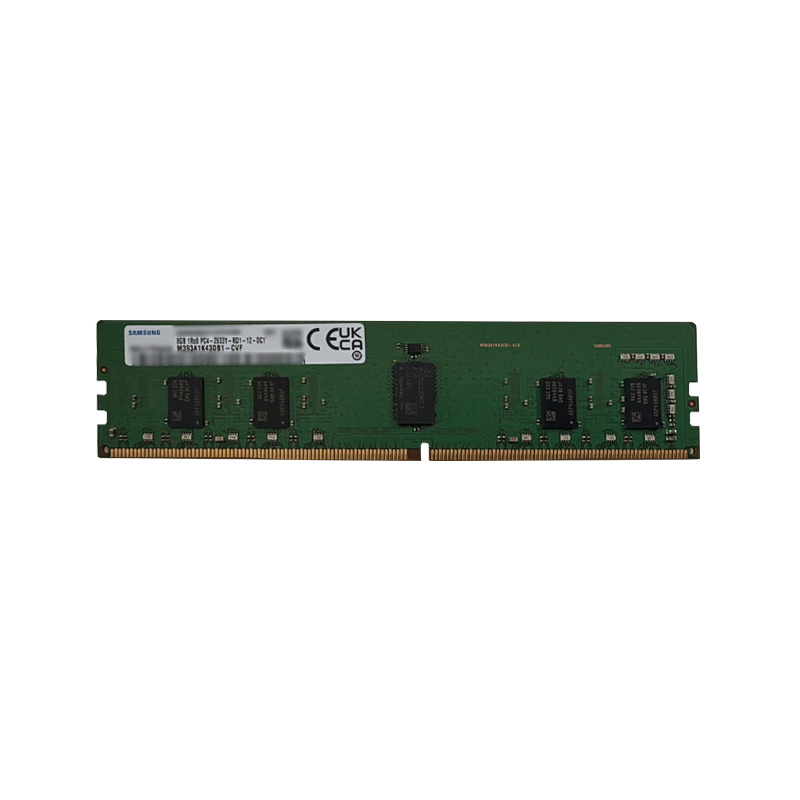
This RDIMM is engineered for enterprise server platforms, where its ECC and registered signal type ensure critical data integrity and signal stability under heavy memory populations ideal for virtualization and in-memory databases. The single-rank x8 configuration at DDR4-2933 with CL21 latency delivers a balanced combination of bandwidth and reduced bus loading, enabling consistent throughput in dense, multi-DIMM deployments.
1. ECC error correction automatically detects and repairs single-bit memory faults, preserving transactional integrity in financial databases and preventing silent data corruption that could ripple across enterprise workloads.
2. Registered signal architecture decouples the memory controller from DRAM loads, allowing dense multi-DIMM setups to scale without compromising electrical stability that virtualized environments demand.
3. RDIMM compliance guarantees compatibility with the vast majority of server motherboards, simplifying procurement and ensuring immediate deployment into existing data center infrastructure.
4. The 8GB capacity serves as an efficient baseline module for hyper-converged nodes, giving IT architects granular control over per-VM memory allocation without wasting costly resources.
5. DDR4-2933 speed delivers elevated throughput per channel, reducing hot data retrieval times in caching servers and keeping latency-sensitive telephony platforms responsive under peak call loads.
The Samsung M393A1K43DB1-CVFC0 is an 8GB DDR4-2933 Registered DIMM with ECC, purpose‑built to solve the reliability and density challenges that keep data center managers awake. Its Registered architecture buffers command and address signals, so you can populate all six or eight DIMM slots per CPU without electrical loading degradation—critical for achieving maximum memory capacity in VMware or Hyper‑V clusters where every gigabyte directly determines how many VMs you can consolidate. The single‑rank x8 design further reduces bus loading, maintaining stable 2933 MT/s operation across every slot under 24/7 load. ECC is non‑negotiable for in‑memory databases like SAP HANA or Redis: a single uncorrected bit flip can silently corrupt a financial transaction or skew real‑time analytics. This module transparently corrects such errors, preventing application crashes and silent data loss that erode trust. Its 1.2 V operation also trims power consumption inside dense rack deployments. Ultimately, this DIMM delivers predictable uptime, bulletproof data integrity, and the confidence that your infrastructure scales without hidden weaknesses.
Server Memory Capacity Planning Guide
General Virtualization
For a hypervisor hosting mixed VMs, aim for balanced density and cost. Deploy eight or more of these 8GB RDIMMs across all memory channels to achieve 64–128 GB total, leveraging multi-channel interleaving for optimal throughput. Populate identical modules in matched sets to maintain NUMA symmetry and avoid performance penalties.
In-Memory Database
Latency-sensitive in-memory databases demand maximum capacity and reliability. Fully populate all DIMM slots with these ECC modules, yielding 256 GB or more per node to hold entire datasets in RAM. Configure memory sparing or mirroring modes where data integrity is paramount, though this reduces usable capacity.
High-Performance Computing
HPC workloads favor bandwidth over sheer capacity per core. Install one DIMM per channel (1DPC) at the rated 2933 MT/s to maximize memory frequency and minimize access latency. For dual-socket nodes, a symmetric 16-module layout (128 GB total) provides sufficient headroom for most MPI jobs while keeping burst power draw manageable.
Rigorously tested, compatible with Dell PowerEdge R740, HPE ProLiant DL380 Gen10, Lenovo ThinkSystem SR650.
Q: Can I mix this M393A1K43DB1-CVFC0 with other memory modules of different brands or speeds?
A: We strongly advise against mixing. Even identical specs from different brands may cause compatibility issues. For mission‑critical servers, use identical modules to guarantee signal integrity and RDIMM timing uniformity.
Q: Is this memory compatible with my system?
A: It is compatible with servers supporting DDR4-2933 Registered ECC RDIMMs, such as Intel Xeon Scalable (2nd gen or newer) and AMD EPYC 7002 platforms. Please verify your specific server model against the manufacturer’s memory QVL.
Q: What is the recommended DIMM population order for optimal performance?
A: Follow the platform’s balanced memory configuration. Typically populate identical DIMMs per channel, starting with the farthest slot from the CPU. Always consult your server’s service guide for the exact numbering to maximize throughput.
Q: Does this module support overclocking or XMP profiles?
A: No. This is a JEDEC‑compliant enterprise RDIMM operating at fixed 1.2 V and CL21. It does not support overclocking or XMP, prioritizing stability and error‑correction reliability in 24/7 server environments.
Q: What warranty and typical failure rate can I expect?
A: This Samsung module is covered by a one‑year warranty. As a genuine Tier‑1 enterprise DIMM with rigorous testing, it exhibits an extremely low annualized failure rate (AFR), typically well below 0.5% under proper cooling.