











 Secure payments
Standard refund policy
Trade Assurance
Secure payments
Standard refund policy
Trade Assurance
| Product Type | Memory Module |
|---|---|
| Memory Capacity | 8 GB |
| Memory Technology | DDR4 |
| Product Voltage | 1.2 V |
| RAM Speed | 3200 MHz |
| RAM Standard | DDR4-3200/PC4-25600 |
| Error Identifying | ECC |
| Signal Type | Registered |
| Column Access Strobe (CAS) | CL22 |
| Rank | Single Rank x8 |
| Quantity of Pins | 288-pin |
| RAM Genre | RDIMM |
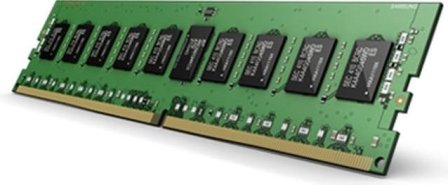
Designed for server-class platforms, this Samsung DDR4-3200 Registered DIMM (RDIMM) with ECC and a Single Rank x8 organization ensures reliable data integrity in memory-intensive workloads such as virtualization and in-memory databases. Its registered signal type provides superior electrical stability in high-density configurations, while the 1.2V efficiency and CL22 latency make it an optimal choice for scaling enterprise environments with minimal power overhead.
1. The registered buffer redrives control signals across heavily loaded server memory channels, enabling stable operation with multiple DIMMs per channel and maximizing capacity in virtualization clusters.
2. On‑die ECC corrects single‑bit errors transparently, preventing silent data corruption in transactional databases and ensuring sustained uptime for mission‑critical workloads.
3. 3200 MT/s data rate supplies 25.6 GB/s of peak bandwidth per module, sharply reducing query latency for in‑memory analytics and accelerating live VM migration.
4. Single Rank x8 organization presents a lighter electrical load on the memory bus, allowing a fully populated server to maintain maximum speed without sacrificing signal integrity.
5. 1.2 V operation lowers active power draw per DIMM, cutting overall energy and cooling costs in dense rack deployments while preserving long‑term reliability.
As a Registered DIMM with ECC, the M393A1K43DB2-CWEBY is built exclusively for server and data-center environments where reliability is non-negotiable. Its four defining characteristics translate directly into business continuity. The ECC capability silently detects and corrects single-bit memory errors—a critical safeguard in a virtualized cluster hosting dozens of VMs, where a flipped bit can cascade into service crashes or silent data corruption. Without it, multi-tenant stability becomes a gamble. The registered signal buffer lets you populate all memory channels without signal degradation, essential when scaling to hundreds of gigabytes for an in-memory database like Redis or SAP HANA; it means your analytics run on a stable, deterministic platform, not one plagued by intermittent load-related faults. The DDR4-3200 speed delivers 25.6 GB/s of bandwidth, cutting query response times during peak transactional loads. And the 1.2V low-voltage design directly reduces power draw and cooling overhead across a fleet of servers, shrinking your datacenter OPEX. For virtualization clusters and memory-driven databases alike, this module turns raw specifications into uptime, data integrity, and cost efficiency.
General Virtualization
RDIMMs with ECC support are essential for virtualized environments where data integrity and uptime are critical. A common configuration for a mid‑range hypervisor host is eight of these 8 GB modules (64 GB total), leaving room for future expansion. To maximize memory bandwidth in multi‑socket servers, populate identical modules symmetrically across all memory channels and avoid mixing ranks within a channel.
In‑Memory Database
In‑memory databases such as Redis or SAP HANA demand both capacity and reliability. Start by fully populating all memory channels with these single‑rank x8 RDIMMs to achieve the lowest latency and highest throughput. For larger datasets, replace the 8 GB modules with higher‑capacity RDIMMs, but when budget is constrained, using twenty‑four of these modules can yield a dense 192 GB configuration that still maintains ECC protection and consistent CL22 timing.
High‑Performance Computing
HPC workloads benefit from the registered ECC design that keeps signal integrity stable across many modules. Install six or eight modules per socket to balance capacity and peak memory bandwidth, keeping the configuration strictly symmetrical. Because these are single‑rank DIMMs operating at DDR4‑3200, they can deliver the low‑latency, error‑free data streams that simulation, modeling, and data‑analysis codes require under sustained full‑load conditions.
Validated for server use; rigorously tested, compatible with Dell PowerEdge R750, HPE ProLiant DL380 Gen10 Plus, Lenovo ThinkSystem SR650 V2.
Q: Can I mix this M393A1K43DB2-CWEBY with other memory modules of different brands or speeds?
A: Mixing different brands or speeds is discouraged for servers. It can force lower speeds and destabilize ECC functions. For optimal reliability, always pair identical M393A1K43DB2-CWEBY modules.
Q: Is this memory compatible with my system?
A: This DDR4-3200 Registered ECC RDIMM works with most Intel Xeon Scalable (2nd Gen+) and AMD EPYC platforms. Always confirm with your server board's Qualified Vendor List to ensure full compatibility and stability.
Q: What is the recommended DIMM population order for optimal performance?
A: For optimal performance, populate DIMMs identically across all available memory channels, typically one DIMM per channel first. Follow your server's specific population guide to maximize bandwidth and maintain balanced memory interleaving.
Q: Does this module support overclocking or XMP profiles?
A: No. This server RDIMM adheres to JEDEC standards at DDR4-3200 CL22 1.2V. XMP and overclocking are not supported, as enterprise memory prioritizes data integrity and stability over speed flexibility.
Q: What warranty and typical failure rate can I expect?
A: This module includes a 1-year warranty. It is engineered with premium components for a very low annualized failure rate (AFR), ensuring dependable operation in 24/7 server deployments under standard conditions.