











 Secure payments
Standard refund policy
Trade Assurance
Secure payments
Standard refund policy
Trade Assurance
| Product Type | Memory Module |
|---|---|
| Memory Capacity | 8 GB |
| Memory Technology | DDR4 |
| Product Voltage | 1.2 V |
| RAM Speed | 3200 MHz |
| RAM Standard | DDR4-3200/PC4-25600 |
| Error Identifying | ECC |
| Signal Type | Unbuffered |
| Column Access Strobe (CAS) | CL22 |
| Rank | Single Rank x8 |
| Quantity of Pins | 288-pin |
| RAM Genre | UDIMM |
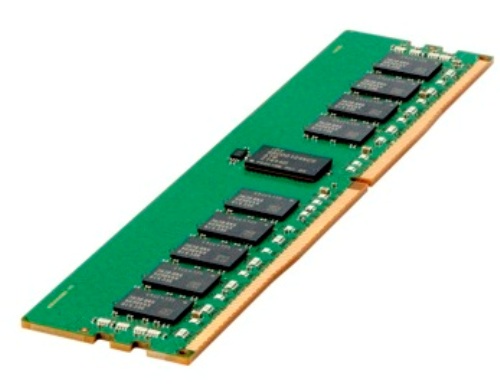
This UDIMM with ECC is engineered for entry-level servers and workstation platforms requiring data integrity, making it ideal for virtualization, memory-resident databases, and small-scale file serving. Its single-rank x8 configuration and unbuffered signal type ensure low latency command response at the native 3200MT/s speed, while ECC actively corrects single-bit errors to maintain system stability.
1. ECC protection silently corrects single-bit memory errors as they occur, preserving data integrity for always-on entry-level servers handling critical file shares or lightweight virtualized workloads.
2. Unbuffered signal type eliminates the register chip’s clock latency, giving latency-sensitive applications such as small database instances a responsive advantage inside compact server chassis.
3. DDR4 technology delivers a proven mix of high throughput and low operating power, ensuring smooth platform compatibility across widely deployed server motherboards without complex tuning.
4. A 3200 MT/s transfer rate pushes per-channel bandwidth to 25.6 GB/s, enabling faster backup jobs and snappier web serving under concurrent user requests.
5. Single-rank x8 organization reduces electrical load on the memory controller, allowing full population of DIMM slots without sacrificing clock speed in cost-conscious multi-slot server builds.
When safeguarding critical workloads, data integrity and reliability come first. The Samsung M391A1K43DB2-CWE is a DDR4-3200 ECC Unbuffered DIMM, purpose-built for entry-level servers and workstations where silent memory errors can corrupt financial transactions or compromise virtualized environments. Its error-correcting code (ECC) detects and corrects single-bit flips caused by background radiation—an absolute necessity in 24/7 virtualization clusters, because a flipped bit in a hypervisor can crash dozens of guest machines. In memory-hungry database applications like in-memory SQL processing, this single-rank x8 module at 3200 MT/s delivers low-latency CL22 access while the unbuffered architecture eliminates the extra clock cycle that registered memory imposes, directly speeding up query response times. With a cool 1.2 V operating voltage, it reduces thermal stress inside compact server chassis, helping maintain system stability during sustained loads. For IT managers running critical applications—whether a virtualized domain controller or a high-availability caching node—this memory means fewer unexplained downtimes, consistent data fidelity, and predictable performance exactly when business continuity is non-negotiable.
General Virtualization
For virtualized workloads on a single-socket UDIMM server, populate all four memory channels with one 8GB ECC UDIMM each to obtain 32GB. This balanced configuration delivers sufficient capacity for 8–10 lightweight VMs while leveraging the full DDR4-3200 bandwidth. If overcommitting RAM is expected, deploying two modules per channel (eight modules total, 64GB) provides headroom for memory-intensive guest workloads without sacrificing ECC protection.
In-Memory Database
In-memory databases require large, reliable capacity. With 8GB ECC UDIMMs, maximize the board’s two-DIMM-per-channel support by installing eight modules for 64GB. This setup suits Redis or Memcached clusters that demand low latency and data integrity. On platforms limited to four slots, use four modules (32GB) but allocate enough headroom to prevent swapping, which negates in-memory performance advantages.
High-Performance Computing
HPC applications benefit from peak memory bandwidth. Populate all available channels with one 8GB module per channel—typically four modules for a mainstream Xeon E or AMD Ryzen platform. This configuration attains 128-bit channel interleaving and ensures consistent throughput for simulation or scientific codes. If capacity demands surpass 32GB, move to dual-rank modules or a registered DIMM platform, as single-rank 8GB UDIMMs offer limited scaling on memory-bound HPC nodes.
Validated for Dell PowerEdge T150, R250, HPE DL20 Gen10 Plus; rigorously tested.
Q: Can I mix this M391A1K43DB2-CWE with other memory modules of different brands or speeds?
A: Mixing is not recommended. ECC UDIMMs require identical rank, timing, and frequency for stable error correction. Using mismatched modules may cause system instability or uncorrected errors.
Q: Is this memory compatible with my system?
A: It fits server boards with DDR4 ECC UDIMM support, like Intel Xeon E-2300/E-2100 series or AMD Ryzen Pro platforms. Verify ECC Unbuffered compatibility and check your motherboard’s qualified vendor list.
Q: What is the recommended DIMM population order for optimal performance?
A: Follow your server board manual. Typically populate the farthest slot from the CPU per channel first. For dual-socket, balance identical modules across both CPU memory channels for symmetric performance.
Q: Does this module support overclocking or XMP profiles?
A: No. It is a JEDEC-compliant DDR4-3200 ECC UDIMM running at 1.2V with fixed CL22 timings. ECC server memory does not support XMP or overclocking to ensure data integrity.
Q: What warranty and typical failure rate can I expect?
A: This Samsung module includes a 1-year warranty. Enterprise-grade DRAM typically exhibits an annualized failure rate (AFR) below 0.3%, ensuring high reliability for 24/7 operation.