











 Secure payments
Standard refund policy
Trade Assurance
Secure payments
Standard refund policy
Trade Assurance
| Product Type | Memory Module |
|---|---|
| Compliance Standards | CE |
| Memory Capacity | 8 GB |
| Memory Technology | DDR5 |
| Product Voltage | 1.1 V |
| RAM Speed | 4800 MHz |
| RAM Standard | DDR5-4800/PC5-38400 |
| Error Identifying | Non-ECC |
| Signal Type | Unbuffered |
| Column Access Strobe (CAS) | CL40 |
| Rank | Single Rank x16 |
| Quantity of Pins | 288-pin |
| RAM Genre | UDIMM |
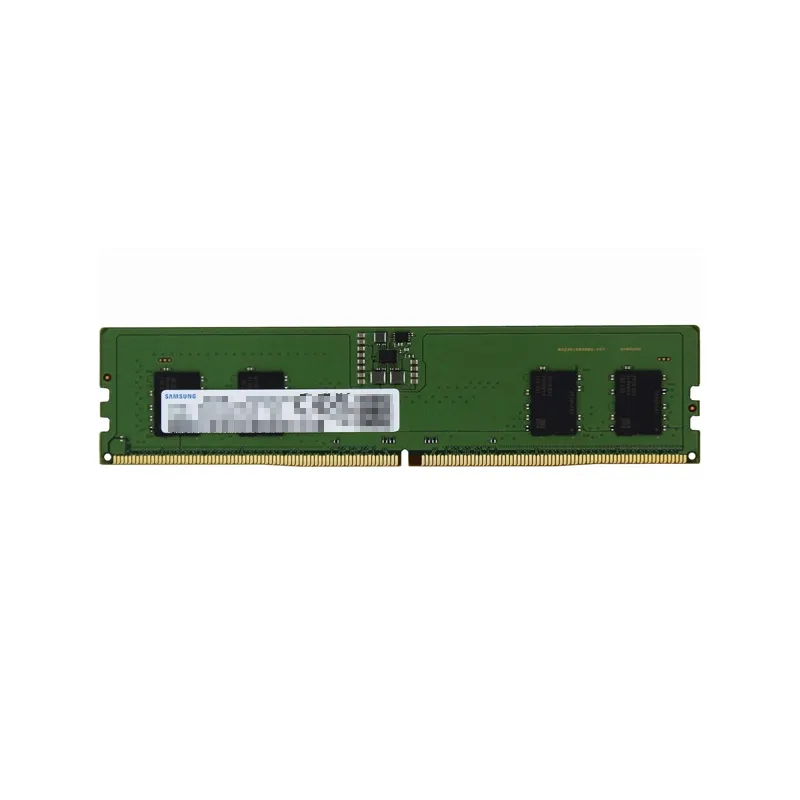
This UDIMM DDR5-4800 module with a single-rank x16 organization is optimized for mainstream desktop platforms, delivering responsive performance in gaming, content creation, and multi-tasking workloads. Its unbuffered signal type and single-rank configuration enhance signal integrity and motherboard compatibility, while the standard CL40 latency at 1.1V ensures reliable plug-and-play operation without complex tuning.
1. DDR5 technology doubles the per-core bandwidth available to modern desktop CPUs, dramatically accelerating rendering workloads and keeping frame rates smooth during high-bitrate streaming sessions.
2. 4800MT/s data rate delivers the transfer speed needed to feed multi-core processors, shrinking level-loading times in expansive open-world games and reducing timeline scrubbing lag in video editing suites.
3. 8GB capacity serves as an immediate, plug-and-play upgrade that prevents storage thrashing during multitasking, ensuring voice chat, browser tabs, and game clients coexist without micro-stutter.
4. 1.1V operating voltage minimizes DIMM heat output inside the chassis, creating cooler ambient conditions that help maintain stable GPU and CPU boost clocks under sustained gaming loads.
5. CL40 latency is balanced for the high-frequency DDR5 architecture, providing the quick initial data access that keeps mouse-to-screen responsiveness crisp in competitive esports titles.
When building or upgrading a performance desktop system, memory choice directly shapes every interaction you have. The Samsung M323R1GB4BB0-CQK is a DDR5 UDIMM purpose-built for enthusiasts and creators, and four characteristics truly define its real-world impact. First, DDR5 technology with a 4800MT/s data rate delivers a massive leap in bandwidth over previous generations, meaning your processor stays fed with data during demanding 3A gaming where textured assets stream continuously, preventing micro-stutter when you round a corner in an open world. Second, the CL40 latency, while a numeric step up, is architecturally tuned for DDR5’s burst length; in practice, it keeps frame delivery consistent during fast-paced competitive shooters. Third, the 1.1V operating voltage runs natively lower than DDR4, reducing thermal load inside your case. For a video editor rendering 4K timelines, this means sustained stability during overnight exports without throttling. Fourth, the single-rank x16 configuration optimizes signal integrity on consumer platforms, so populating two modules for dual-channel still lets your motherboard train clean memory timings, translating to quicker project scrubbing and snappier multitasking. This isn’t just a specification list—it’s the foundation of a responsive, reliable desktop experience.
Gaming Build
For a modern gaming PC, a single 8GB DDR5-4800 UDIMM is insufficient. Deploy a dual-channel kit of two identical 8GB modules (16GB total) as a minimum baseline, or opt for a 2×16GB (32GB) kit to comfortably handle game textures, streaming, and background applications. Always install matched pairs in the correct motherboard slots to enable dual-channel interleaving and maximize frame-time consistency.
Content Creation
Video editing, 3D rendering, and large photo projects demand substantially more capacity. A 64GB configuration using four 16GB DDR5 UDIMMs, or two 32GB modules if supported, prevents swapping and accelerates timeline scrubbing. Although these modules are non-ECC and unbuffered, populating all four DIMM slots may reduce achievable speeds; prioritize capacity and stability over a minor frequency drop for most creative workloads.
General Productivity
For everyday office multitasking, web browsing, and light spreadsheets, a single 8GB UDIMM is a cost-effective starting point. However, upgrading to a 2×8GB dual-channel kit yields noticeably smoother performance when toggling between numerous browser tabs and productivity suites. This affordable 16GB setup avoids early bottlenecks and represents the sweet spot for responsive, mainstream desktop use.
Rigorously tested desktop DDR5 UDIMM, compatible with Intel Z790/B760 and AMD X670E/B650 motherboards.
Q: Can I mix this M323R1GB4BB0-CQK with other memory modules of different brands or speeds?
A: Mixing modules is possible but not recommended. The system will clock all DIMMs to the slowest speed, potentially causing instability. For reliable dual-channel operation on a desktop platform, use identical kits.
Q: Is this memory compatible with my system?
A: This 288-pin DDR5 UDIMM is designed for desktop motherboards with DDR5 slots. Verify your motherboard chipset supports DDR5 (e.g., Intel 600/700 series or AMD 600 series) and unbuffered non-ECC memory.
Q: What is the recommended DIMM population order for optimal performance?
A: For a typical dual-channel desktop board with four slots, populate the second and fourth slots from the CPU first (DIMM A2 and B2). Refer to your motherboard manual for exact configuration to enable dual-channel mode.
Q: Does this module support overclocking or XMP profiles?
A: This module runs JEDEC standard DDR5-4800 at 1.1V, with no onboard XMP profile. Overclocking depends entirely on your motherboard and CPU; manual tuning may be possible, but stability is not guaranteed.
Q: What warranty and typical failure rate can I expect?
A: This product includes a one-year warranty covering manufacturing defects. Memory failure rates are extremely low when operated within standard specifications. We provide replacement for any eligible warranty claim.