











 Secure payments
Standard refund policy
Trade Assurance
Secure payments
Standard refund policy
Trade Assurance
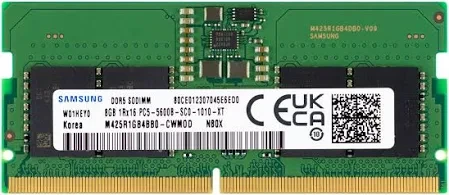
| Product Type | Memory Module |
|---|---|
| Memory Capacity | 8 GB |
| Memory Technology | DDR5 |
| RAM Speed | 5600 MHz |
| RAM Standard | DDR5-5600/PC5-44800 |
| Error Identifying | Non-ECC |
| Signal Type | Unbuffered |
| Column Access Strobe (CAS) | CL46 |
| Rank | Single Rank x16 |
| Quantity of Pins | 262-pin |
| RAM Genre | SoDIMM |
Designed as a DDR5-5600 SoDIMM, this 8GB unbuffered, non-ECC module is tailored for modern laptops and compact mobile workstations, where its single-rank x16 configuration reduces electrical loading on the memory controller to enhance signal integrity and support stable high-frequency operation. The module offers a straightforward plug-and-play upgrade path with native 5600 MT/s throughput and standard 1.1V low-power DDR5 efficiency, making it ideal for daily productivity, content creation on the go, and general multitasking in space-constrained platforms.
1. SoDIMM form factor guarantees straightforward physical compatibility and tool-free installation, letting ultrabook users upgrade memory in minutes without professional assistance.
2. 8GB capacity supplies sufficient headroom for smooth multitasking across browser tabs, office suites, and video calls, preventing slowdowns during typical on-the-go productivity.
3. DDR5 technology improves bandwidth per watt, extending battery runtime and reducing heat buildup so the laptop remains cool on laps and in compact chassis.
4. 5600MT/s transfer speed accelerates data access for everyday workloads, shortening application launch times and keeping remote collaboration tools responsive even under load.
5. Single Rank x16 configuration lowers the electrical load on the memory controller, boosting plug-and-play reliability across a wide range of notebooks while conserving energy for longer unplugged use.
The M425R1GB4BB0-CWM0D is unmistakably a notebook memory module, confirmed by its 262-pin SoDIMM form factor. For professionals upgrading an ultrathin laptop or pushing a mobile workstation, its four defining characteristics solve real frustrations. The DDR5 architecture integrates an on-module power management IC that regulates voltage with surgical precision; this translates directly into longer battery life while you edit video on a cross‑country flight. Next, the 5600MT/s speed delivers a massive bandwidth leap over previous generations. A financial analyst running multiple virtual machines and massive spreadsheets sees immediate responsiveness, and a content creator can scrub through a 4K timeline without a single stutter. The SoDIMM design ensures immediate physical compatibility across virtually all contemporary notebook platforms, making a do‑it‑yourself upgrade foolproof and instant. Finally, the single‑rank x16 configuration places a lighter burden on the CPU’s memory controller, which guarantees rock‑solid system stability and lower power consumption. This matters most when you are finalizing a client presentation on battery and cannot afford a crash. The module turns a sluggish portable system into a reliable, high‑productivity asset.
Laptop Upgrade
For most mainstream notebooks shipped with a single 8GB SO-DIMM, adding a second identical M425R1GB4BB0-CWM0D module is the simplest path to dual-channel 16GB. This configuration relieves memory bottlenecks in multitasking and improves integrated graphics performance without replacing the original stick. In slim devices with soldered memory, a single spare slot can still create an asymmetric dual-channel setup that boosts bandwidth for everyday responsiveness.
Mobile Workstation
Professional workloads demand capacity well beyond a single 8GB stick; a mobile workstation should be equipped with two high-capacity modules. Since this is a single-rank 8GB SO-DIMM, replacing it with a matched pair of 32GB or 48GB DDR5-5600 kits (for 64GB or 96GB total) ensures smooth operation in 3D rendering, CAD, and large data sets. Always verify the platform’s maximum supported memory to avoid limiting professional application performance.
Ultrabook Power Saving
Many modern thin-and-light laptops rely on soldered LPDDR5 memory to maximize battery life, but if user-replaceable SO-DIMMs are present, the M425R1GB4BB0-CWM0D can serve as an upgrade in a single-slot configuration. Because this module operates at the standard 1.1V VDD, it already offers efficient power characteristics. To extend runtime further, combine it with the laptop’s power management profiles; avoiding overclocking and retaining a single-rank x16 die helps maintain low idle current draw during light productivity sessions.
Rigorously tested for DDR5 laptops, compatible with Dell Precision 7670, Lenovo ThinkPad P16 Gen 1, HP ZBook Fury G9.
Q: Can I mix this M425R1GB4BB0-CWM0D with other memory modules of different brands or speeds?
A: Mixing modules is not recommended as it may cause instability. For reliable dual-channel operation, install identical Samsung M425R1GB4BB0-CWM0D units. Different brands or speeds often default to the lowest common specification, compromising performance.
Q: Is this memory compatible with my system?
A: It is designed for laptops supporting DDR5 SO-DIMM, such as those with Intel 12th/13th Gen Core or AMD Ryzen 6000/7000 series processors. Verify your system accepts 262-pin DDR5-5600 unbuffered non-ECC modules before purchase.
Q: What is the recommended DIMM population order for optimal performance?
A: Most laptops have two SO-DIMM slots. For dual-channel, populate both slots with identical modules. If installing a single module, consult your service manual for the primary slot (often labeled '0') to ensure proper detection and maximum bandwidth.
Q: Does this module support overclocking or XMP profiles?
A: No. This JEDEC-standard DDR5-5600 module runs at its native 5600MT/s when the platform supports it. It does not feature XMP or overclocking profiles, as laptop memory typically relies on fixed SPD timings for stability.
Q: What warranty and typical failure rate can I expect?
A: This module includes a one-year warranty. Genuine Samsung DRAM exhibits an extremely low annualized failure rate, far below the industry average, ensuring long-term reliability in mobile environments under standard operating conditions.