











 Secure payments
Standard refund policy
Trade Assurance
Secure payments
Standard refund policy
Trade Assurance
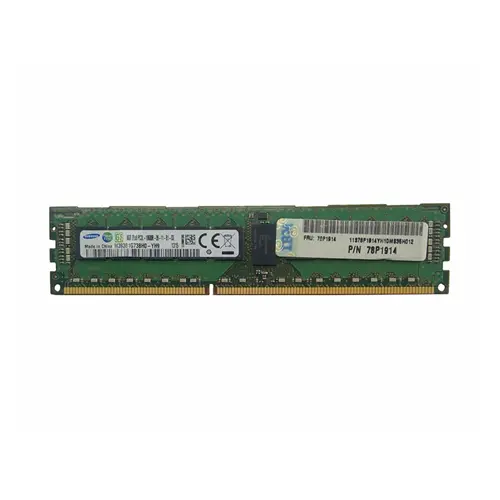
| Model | M393B1G73BH0-YH9 |
|---|---|
| Product Type | Memory Module |
| Compliance Standards | CE,WEEE,RoHS |
| Memory Capacity | 8 GB |
| Memory Technology | DDR3 |
| Product Voltage | 1.35V |
| RAM Speed | 1866MHz |
| RAM Standard | DDR3-1333/PC3-10600 |
| Error Identifying | ECC |
| Signal Type | Registered |
| Column Access Strobe (CAS) | CL9 |
| Rank | Dual Rank |
| Quantity of Pins | 240-pin |
| RAM Genre | DIMM |
Designed as a server-grade DDR3 Registered DIMM with ECC, this module is ideally suited for virtualization clusters, in-memory databases, and mission-critical enterprise workloads where data integrity is paramount. Its dual-rank architecture and low 1.35V operating voltage deliver improved interleaving performance and power efficiency at a 1866 MHz clock with CL9 latency, ensuring stable throughput under sustained memory-intensive operations.
1. ECC error correction detects and corrects single-bit memory faults, preserving data integrity around the clock for financial ledgers and transactional databases.
2. Registered signal buffering stabilizes high-density memory arrays, enabling large-scale server farms to populate more DIMM slots without sacrificing system reliability.
3. An 8-gigabyte module capacity delivers a dense memory footprint per channel, consolidating more virtual machines into each server node and reducing physical hardware sprawl.
4. Low 1.35V operation cuts energy consumption and heat output per DIMM, directly shrinking power and cooling overhead in continuously running data centers.
5. 1866 MT/s data rate provides a meaningful memory bandwidth uplift, accelerating in-memory analytics and high-concurrency content serving under sustained load.
In the demanding world of server virtualization and in-memory databases, your memory choice defines system stability and efficiency. The M393B1G73BH0-YH9, a DDR3 Registered ECC DIMM, packs four key features that directly solve real-world pain points. First, ECC protection silently corrects single-bit errors caused by background radiation, preventing random VM crashes or database corruption that could cost you hours of troubleshooting. Second, its registered buffer technology allows you to fully populate high-density servers with 24 DIMMs while maintaining clean signal integrity—essential for scaling your virtualized environment without sacrificing reliability. Third, at just 1.35V, this low-voltage module slashes energy and cooling costs across a massive server fleet, directly lowering operational expenses. Fourth, the dual-rank organization enables rank interleaving, which significantly increases bandwidth for read-heavy applications like Redis or Memcached, yielding faster response times under heavy concurrent loads. Together, these features deliver the uncompromised data integrity, massive capacity scalability, and power efficiency your critical workloads demand.
Based on the provided specifications — 8GB DDR3 ECC Registered DIMM, 1.35V, 1866MHz — this is unequivocally server memory. Below is the capacity planning guide tailored for typical data center workloads.
General Virtualization
For a conservative cluster running a moderate density of virtual machines, populate at least six of these 8GB modules per host to achieve 48GB. This allows dual-channel operation and sufficient headroom for hypervisor overhead and guest memory ballooning. Scale to 16 DIMMs (128GB) on dual-socket boards if you are packing high VM counts, balancing cost against available DDR3 slots and diminishing returns from older-generation hardware.
In-Memory Database
In-memory databases demand capacity above all else, so every DIMM slot should be utilized. Target a configuration using 16 or 24 of these 8GB sticks to reach 128–192GB, ensuring the dataset fits entirely in RAM. Registered ECC is critical here for data integrity, though 8GB per module forces dense population—consider replacing all slots with higher-capacity DIMMs if available, as this density quickly becomes a limiting factor.
High-Performance Computing
HPC workloads benefit from high memory bandwidth, so populate balanced channels (e.g., 12 identical modules across a hexa-channel platform) to maximize interleaving. A minimum of 64GB (eight DIMMs) per node is recommended for typical scientific simulations. Ensure all modules are identical—matching rank, speed, and stepping—to avoid NUMA penalties and maintain stable parallel file system I/O.
Rigorously tested and verified compatible with Dell PowerEdge R720, HPE ProLiant DL380p Gen8, IBM System x3650 M4, and other servers.
Q: Can I mix this M393B1G73BH0-YH9 with other memory modules of different brands or speeds?
A: Mixing this registered ECC module with others may cause instability or fallback to the lowest common speed. For reliable operation, we strongly recommend using identical Samsung M393B1G73BH0-YH9 modules across all populated DIMMs.
Q: Is this memory compatible with my server system?
A: This DDR3-1866 registered DIMM requires a server board supporting ECC RDIMMs, typically with Intel Xeon E5-2600 v2 or AMD Opteron 6300 series processors. Please verify your platform's memory QVL list for certified compatibility.
Q: What is the recommended DIMM population order for optimal performance?
A: Populate identical DIMMs following your server board's slot numbering guide, typically first in blue or designated primary slots per channel. Distributed population across all memory channels enables balanced interleaving and maximum bandwidth, e.g., slots A1, B1, C1, D1 first.
Q: Does this module support overclocking or XMP profiles?
A: No. This is a JEDEC-compliant registered ECC server module optimized for stability, not overclocking. It does not include XMP profiles, and running it beyond its rated 1866 MT/s is not recommended in server environments.
Q: What warranty and typical failure rate can I expect?
A: This module includes a 1-year warranty. As an enterprise-grade Samsung RDIMM, it demonstrates a typical annualized failure rate (AFR) well below 0.1%, ensuring exceptional long-term reliability in 24/7 operation.