











 Secure payments
Standard refund policy
Trade Assurance
Secure payments
Standard refund policy
Trade Assurance
| Product Type | Memory Module |
|---|---|
| Memory Capacity | 8 GB |
| Memory Technology | DDR3 |
| Product Voltage | 1.5 V |
| RAM Speed | 1333 MHz |
| RAM Standard | DDR3-1333/PC3-10600 |
| Error Identifying | ECC |
| Signal Type | Registered |
| Column Access Strobe (CAS) | CL9 |
| Rank | Dual Rank x4 |
| Quantity of Pins | 240-pin |
| RAM Genre | RDIMM |
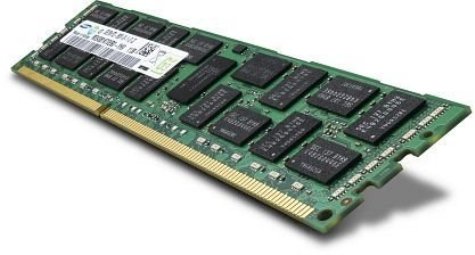
This RDIMM is engineered for server platforms requiring high data integrity, with ECC and registered signal buffering ensuring reliable operation in virtualized environments and memory-intensive databases. The dual-rank x4 configuration with CL9 latency optimizes memory bank interleaving for improved throughput, making it ideal for stabilizing 24/7 workloads where uncorrected errors are unacceptable.
1. ECC protection detects and corrects single-bit errors silently, preserving data integrity for mission-critical databases and financial transaction processing under 24/7 uptime demands.
2. Registered signal buffering stabilizes high-density memory channels, making large-scale multi-socket server deployments possible without compromising signal integrity or system reliability.
3. Dual Rank x4 organization keeps the memory controller pipeline saturated, delivering steady low-latency access that prevents performance jitter in heavily consolidated virtualization hosts.
4. An 8 GB capacity per module provides a cost-effective density sweet spot for moderate virtualization clusters, accommodating dozens of light-to-medium VMs per node while leaving room for balanced scaling.
5. DDR3-1333 speed supplies a consistent 10.6 GB/s per channel bandwidth envelope, aligning well with steady-state enterprise workloads where predictability matters more than peak burst rates.
When you are deploying a virtualization cluster or running an in-memory database like Redis on a legacy server platform, the M393B1K70CH0-CH9Q5 8GB DDR3-1333 RDIMM is far more than just a compatible part—it directly protects your uptime and data integrity. The ECC engine silently corrects single-bit errors caused by background radiation, an absolute necessity in a 24/7 environment where a flipped bit in a financial transaction or a hypervisor page table can cascade into silent data corruption and costly system crashes. With its registered signal buffer, this module stabilizes heavy DIMM populations, so your four- or eight-slot server can operate a full memory bank without the signal degradation that leads to intermittent blue screens during intense virtual machine migrations. The dual-rank x4 organization exploits interleaving to deliver higher sustained bandwidth under concurrent workloads; when multiple VMs hammer memory simultaneously, the controller alternates between ranks, reducing average latency and keeping response times predictable. Even the CL9 timing plays a role—it provides deterministic latency that benefits latencysensitive applications like an in-memory OLTP database, ensuring that high query throughput never stalls on unexpected wait states. This memory transforms aging server infrastructure into still-profitable, stable workhorses.
Memory Type Assessment
This module is an 8GB DDR3-1333 Registered ECC RDIMM (PC3-10600, CL9, Dual Rank x4). Its error correction and registered signal type categorize it strictly as server-class memory, incompatible with desktop or laptop platforms. Capacity planning must therefore address enterprise server workloads with a focus on stability, registered buffering limits, and ECC consistency.
General Virtualization
Populate all memory channels symmetrically to maximize bandwidth and leave at least one DIMM slot free per channel for future scaling. With 8GB RDIMMs, a 3-channel server can reach 48GB to comfortably host a dozen light-to-mid VMs; for heavier hypervisor overhead, target 96GB using 8 modules across balanced channels to avoid memory contention.
In-Memory Database
In-memory databases demand the lowest latency and highest capacity, so deploy the maximum number of identical 8GB RDIMMs supported by the platform, distributing them equally across all memory controllers. On a dual-socket system with 18 slots per CPU, a 144GB configuration (18 x 8GB) allows substantial dataset caching, but monitor rank-per-channel limits—two quad-rank DIMMs per channel may force speed reductions on older DDR3 systems.
High-Performance Computing
HPC favors memory bandwidth over raw capacity; install modules in multiples of the memory channel count (e.g., 6 or 12 DIMMs for triple-channel architectures) to engage full interleaving. Use identical dual-rank RDIMMs and keep all channels populated identically to avoid NUMA imbalances. An initial build of 48–96GB using 8GB sticks delivers strong throughput per core for compute-bound simulations while retaining headroom for large MPI jobs.
Rigorously tested server memory, compatible with Dell PowerEdge R720, HP ProLiant DL380p Gen8, Lenovo ThinkServer RD630.
Q: Can I mix this M393B1K70CH0-CH9Q5 with other memory modules of different brands or speeds?
A: Mixing RDIMMs of different brands or speeds is not recommended. The system may fail to boot or operate with reduced stability. For mission-critical servers, always populate with identical modules to ensure full ECC and memory interleaving.
Q: Is this memory compatible with my system?
A: This DDR3-1333 ECC Registered module is designed for servers based on Intel Xeon E5-2400/2600 v1/v2 or AMD Opteron 6300/8300 platforms. Confirm your board supports 1.5V RDIMMs via the vendor's memory QVL.
Q: What is the recommended DIMM population order for optimal performance?
A: Follow the server board manual for balanced memory configuration. Typically, populate identical RDIMMs in the first slot of each memory channel (blue slots first), filling all channels for optimal bandwidth and interleaving.
Q: Does this module support overclocking or XMP profiles?
A: No. This ECC Registered server memory adheres strictly to JEDEC DDR3-1333 standards. Overclocking or XMP is not supported, as it compromises signal integrity and the hardware-level error correction required for 24/7 operation.
Q: What warranty and typical failure rate can I expect?
A: This module includes a 1-year warranty. Built with top-tier Samsung components and stringent testing, its typical annualized failure rate (AFR) is around 0.1%–0.3%, ensuring outstanding long-term reliability in server environments.