











 Secure payments
Standard refund policy
Trade Assurance
Secure payments
Standard refund policy
Trade Assurance
| Model | M393B1K70CH0-CH9Q5T |
|---|---|
| Product Type | Memory Module |
| Compliance Standards | EU RoHS,FCC |
| Memory Capacity | 8 GB |
| Memory Technology | DDR3 |
| Product Voltage | 1.5V |
| RAM Speed | 1333MHz |
| RAM Standard | DDR3-1333/PC3-10600 |
| Error Identifying | ECC |
| Signal Type | Registered |
| Column Access Strobe (CAS) | CL9 |
| Rank | Dual Rank x4 |
| Quantity of Pins | 240-pin |
| RAM Genre | RDIMM |
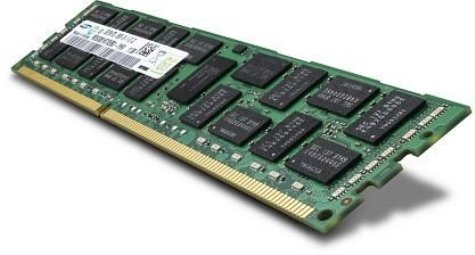
This Samsung M393B1K70CH0-CH9Q5T is a server-grade DDR3-1333 RDIMM designed for legacy enterprise platforms, making it well-suited for virtualization hosts and in-memory databases that demand uncompromising data integrity. Its registered signal architecture with ECC and dual-rank x4 organization ensures stable operation under heavy, sustained loads by minimizing electrical loading on the memory bus and providing single-bit error correction for mission-critical workloads.
1. Registered DIMM architecture buffers command and control signals, allowing servers to populate more memory channels without signal degradation — vital for maintaining stability in large-scale virtualization hosts.
2. ECC protection continuously corrects single-bit errors and detects multi-bit faults, directly preventing silent data corruption in financial transactions and long-running database operations.
3. Dual Rank x4 configuration interleaves memory accesses to keep server memory channels fully utilized, delivering consistent bandwidth for multiple virtual machines under heavy consolidation.
4. The 8 GB capacity serves as an efficient building block for entry to mid-range server nodes, offering sufficient density for foundational workloads without overprovisioning cost.
5. PC3-10600 bandwidth delivers over ten gigabytes per second of sustained throughput, ensuring responsive data access for concurrent enterprise services and file-sharing workloads.
The Samsung M393B1K70CH0-CH9Q5T is a server-grade DDR3 Registered DIMM, purpose-built for mission-critical enterprise environments where data integrity and continuous uptime are non-negotiable. Its ECC technology actively detects and corrects single-bit memory errors caused by background radiation or electrical noise—an invisible threat that, left unchecked, can silently corrupt financial transactions in an in-memory database or crash an entire virtualized host running dozens of production VMs. The registered signal buffer decouples the memory controller from the DRAM chips, allowing your server to populate all 24 DIMM slots without command signal degradation. For a heavy hypervisor cluster, this means you can confidently scale to 512 GB or more per node, running more virtual machines on the same physical hardware while maintaining rock-solid signal timing. The dual-rank x4 organization strategically interleaves accesses across internal banks, delivering noticeably higher sustained bandwidth for write-heavy caching layers or real-time analytics queries, where every millisecond of latency directly impacts user-facing response times. Combined with the 1.5V operating voltage and CL9 latency, this module strikes an optimal balance between thermal efficiency and predictable performance, reducing cooling overhead in dense 2U rack deployments and ensuring your database replication lag stays within SLA.
General Virtualization
For a general virtualization host running multiple VMs, install a minimum of six of these 8GB DDR3-1333 RDIMMs (48 GB total) populated evenly across memory channels to balance capacity and interleaving. Use a 3 DIMMs per populated channel configuration if the platform supports triple-channel architecture, leaving one slot free per channel for future expansion. This density comfortably supports 10–15 moderate VMs while registered ECC ensures data integrity.
In-Memory Database
In-memory databases like Redis or SAP HANA demand extreme capacity and fault tolerance. Fully populate all available DIMM slots with these 8GB RDIMMs—targeting 96 GB to 256 GB depending on server slot count—to maximize memory resources. Deploy identical modules in a balanced multi-rank setup (dual-rank x4) for optimal signal quality, and never mix capacities; strict population order per the vendor’s memory matrix is critical to avoid performance penalties from rank imbalances.
High-Performance Computing
HPC clusters benefit from memory bandwidth over raw capacity per node. Configure four or eight of these 8GB DIMMs symmetrically (32 GB or 64 GB) to saturate all memory channels, enabling maximum DDR3-1333 throughput. Install equal modules in each channel to maintain a uniform dual-rank configuration, which reduces electrical loading variance and delivers consistent 10.6 GB/s bandwidth per channel for memory-bandwidth-bound simulations and computational fluid dynamics workloads.
Server-grade memory rigorously tested; compatible with Dell R720/R620, HP DL380p Gen8, Lenovo x3650 M4, Cisco C220 M3.
Q: Can I mix this M393B1K70CH0-CH9Q5T with other memory modules of different brands or speeds?
A: Mixing is not advised in servers. This DDR3 Registered ECC RDIMM requires identical modules to maintain signal integrity and ECC protection. Different brands, speeds, or ranks may cause instability and data corruption.
Q: Is this memory compatible with my system?
A: It is designed for servers using Intel Xeon 5600/5500 or AMD Opteron 6100 series platforms that support DDR3-1333 Registered ECC memory. Always consult your server's qualified vendor list for this Samsung module.
Q: What is the recommended DIMM population order for optimal performance?
A: Follow your server motherboard's population guide. Generally, populate identical DIMMs in the farthest slot from the CPU per channel first, then balance across channels to enable dual-channel and maximize bandwidth.
Q: Does this module support overclocking or XMP profiles?
A: No. As an enterprise-grade Registered ECC module, it strictly meets JEDEC DDR3-1333/PC3-10600 standards. Overclocking or XMP is not supported to guarantee data integrity and long-term reliability.
Q: What warranty and typical failure rate can I expect?
A: This module includes a 1-year warranty. Samsung enterprise memory typically has an annualized failure rate below 0.5% under normal operating conditions, ensuring dependable performance for critical server workloads.