











 Secure payments
Standard refund policy
Trade Assurance
Secure payments
Standard refund policy
Trade Assurance
| Model | M393B1G70EB0-YKO |
|---|---|
| Product Type | Memory Module |
| Compliance Standards | EU RoHS,FCC |
| Memory Capacity | 8 GB |
| Memory Technology | DDR3 |
| Product Voltage | 1.35V |
| RAM Speed | 1600MHz |
| RAM Standard | DDR3-1600/PC3-12800 |
| Error Identifying | ECC |
| Signal Type | Registered |
| Column Access Strobe (CAS) | CL11 |
| Rank | Single Rank x4 |
| Quantity of Pins | 240-pin |
| RAM Genre | RDIMM |
This Samsung 8GB DDR3-1600 registered DIMM with ECC and single-rank x4 organization is purpose-built for legacy server platforms running memory-intensive virtualization, in-memory databases, and mission-critical workloads where data integrity is paramount. Its registered signal architecture and low 1.35V operating voltage deliver superior signal stability and power efficiency, while the single-rank design reduces electrical loading on the memory bus, enabling reliable operation in fully populated, high-density rack servers.
1. ECC memory actively detects and corrects single-bit errors, preserving data integrity in mission-critical databases and preventing costly silent corruption.
2. Registered signal buffering enables stable population of multiple DIMMs per channel, essential for scaling memory capacity in dense virtualization hosts.
3. Low-voltage DDR3L operation cuts per-watt energy consumption across server fleets, directly lowering electricity and cooling expenses in 24/7 datacenters.
4. 1600 megatransfers per second throughput sustains consistent bandwidth for concurrent analytics tasks, reducing response-time jitter under heavy query loads.
5. Compact module capacity serves as an economical building block for scale-out architectures, where aggregate memory grows linearly with lightweight microservice instances.
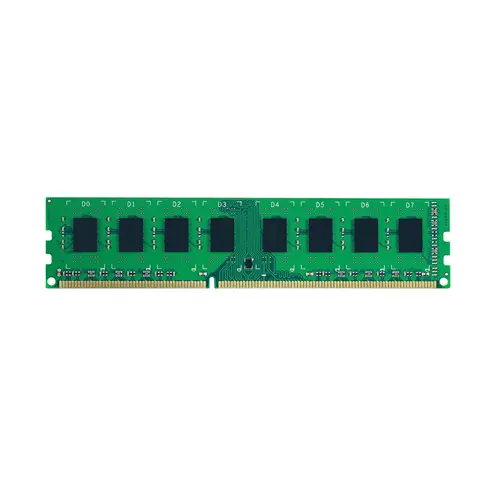
Designed specifically for server and datacenter environments, the Samsung M393B1G70EB0-YKO is an 8GB DDR3 Registered DIMM operating at 1600 MHz. Its core strength lies in how four architectural features directly solve infrastructure-critical pain points. The onboard ECC automatically detects and corrects single-bit memory errors caused by background radiation, preventing silent data corruption that could crash a virtual machine fleet or poison financial transaction logs overnight. Paired with Registered signal buffering, the module stabilizes command and address lines across fully loaded memory channels, letting you confidently populate 24 DIMMs per server without timing degradation—a non-negotiable when consolidating dozens of VMs onto one host. That stability is further tuned by the single-rank x4 organization, which reduces electrical loading and maximizes bandwidth efficiency for latency-sensitive in-memory databases like SAP HANA or Redis, delivering predictable query response even under heavy write contention. Finally, the 1.35V low-voltage operation cuts memory power draw by roughly 15% versus standard 1.5V DIMMs, directly lowering cooling overhead in dense rack deployments. For the virtualization cluster that cannot afford downtime and the real-time analytics engine that demands every clock cycle, this module converts electrical specifications into business resilience and consistent application performance.
This Samsung M393B1G70EB0-YKO is an 8GB DDR3-1600 registered ECC module operating at 1.35V. As a server-class RDIMM, it is suited for enterprise platforms requiring reliability and moderate density. The capacity planning guidance below focuses on leveraging these modules in dual-socket servers with eight memory channels.
General Virtualization
Balance bandwidth and resilience by populating all channels identically. Install one 8GB DIMM per channel for a total of 64GB; this enables ECC and supports virtual machine density for typical workloads. For increased capacity without sacrificing NUMA balance, scale to two modules per channel (128GB) and enable mirroring or sparing if the hypervisor demands fault tolerance.
In-Memory Database
In-memory databases require maximum capacity and consistent low latency. Populate two of these single-rank RDIMMs per channel, reaching 128GB across sixteen slots while keeping the bus at 1600MT/s. If the platform supports three DIMMs per channel, 192GB is achievable; validate that the memory speed does not drop below 1333MT/s under heavy loading to avoid crippling transactional performance.
High-Performance Computing
HPC nodes emphasize bandwidth over raw capacity. Equip each channel with one DIMM (64GB total) to sustain full 1600MHz frequency and minimal latency. When simulation datasets demand more memory, add a second DIMM per channel — accept a slight timing penalty in exchange for 128GB. The 1.35V operating voltage further reduces power draw in dense clusters, improving overall energy efficiency.
Rigorously tested server memory, compatible with Dell PowerEdge R720, HP ProLiant DL380p Gen8, and Lenovo ThinkServer RD630.
Q: Can I mix this M393B1G70EB0-YKO with other memory modules of different brands or speeds?
A: Mixing brands or speeds is not advised for registered server memory. Even matching specs can lead to signal integrity issues. For guaranteed stability and ECC functionality, populate all channels with identical Samsung RDIMMs of the same part number.
Q: Is this memory compatible with my system?
A: This DDR3-1600 Registered ECC module requires a server platform supporting 1.35V RDIMMs, such as Intel Xeon E5-2600 v1/v2 with C600 chipsets or AMD Opteron 6300 series. Always verify your motherboard's qualified vendor list for 8GB single-rank x4 RDIMM support.
Q: What is the recommended DIMM population order for optimal performance?
A: Populate identical DIMMs per channel, starting from the slot farthest from the CPU. For this single-rank x4 RDIMM, balanced configurations across all memory channels maximize bandwidth. Refer to your server board manual for the exact slot numbering scheme.
Q: Does this module support overclocking or XMP profiles?
A: No, server-class Registered ECC DDR3 operates exclusively at JEDEC standard timings (CL11 at 1600MT/s). It does not support overclocking or XMP profiles. Altering frequency or voltage risks ECC errors and can compromise data integrity in mission-critical environments.
Q: What warranty and typical failure rate can I expect?
A: This module includes a one-year warranty. Samsung server-grade RDIMMs exhibit an extremely low annualized failure rate (AFR) under normal operating conditions, typically below 0.2%, ensuring years of reliable operation in properly cooled server environments.