











 Secure payments
Standard refund policy
Trade Assurance
Secure payments
Standard refund policy
Trade Assurance
| Product Type | Memory Module |
|---|---|
| Compliance Standards | |
| Memory Capacity | 8 GB |
| Memory Technology | DDR3 |
| Product Voltage | 1.35 V |
| RAM Speed | 1600 MHz |
| RAM Standard | DDR3-1600/PC3-12800 |
| Error Identifying | ECC |
| Signal Type | Registered |
| Column Access Strobe (CAS) | CL11 |
| Rank | Single Rank x4 |
| Quantity of Pins | 240-pin |
| RAM Genre | RDIMM |
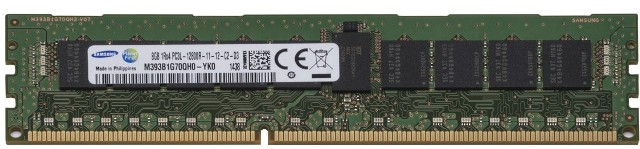
Designed for server platforms, this Samsung M393B1G70QH0-YK0 8GB DDR3-1600 Registered DIMM with ECC ensures data integrity in virtualized environments and memory-intensive databases. Its single-rank x4 organization and 1.35V low-voltage operation reduce power consumption and improve signal stability under sustained heavy loads.
1. ECC error correction detects and corrects single-bit memory faults in real time, preserving data accuracy in constant uptime environments like database servers and financial transaction systems.
2. Registered signal buffering decouples the memory controller from the electrical load of the DRAM chips, enabling stable population of all memory channels across large-scale virtualization hosts.
3. Single Rank x4 organization enhances bank-level parallelism, ensuring low latency and consistent throughput when multiple virtual machines contend for shared memory resources.
4. 1.35V low-voltage operation significantly reduces the power envelope and cooling demands of dense server racks, directly improving energy efficiency in hyperscale data centers.
5. 8GB capacity per DIMM supplies a balanced base unit for scalable memory configurations, simplifying resource allocation in clustered node deployments without sacrificing consolidation density.
The Samsung M393B1G70QH0-YK0, an 8GB DDR3L-1600 Registered ECC DIMM, integrates four critical features that transform server reliability and efficiency. ECC protection is your last line of defense against single-bit errors that can silently corrupt transactional data or crash an entire virtualized host. Its registered buffer chip isolates the memory controller from electrical load, enabling you to fully populate all DIMM slots—essential for scaling dense VMware or Hyper-V clusters without intermittent memory faults. Operating at a low 1.35V, it dramatically reduces power consumption and cooling overhead in always-on data centers, lowering TCO. The single-rank x4 configuration paired with 1600 MT/s offers exceptionally predictable latency and bandwidth, a critical advantage for in-memory databases such as Redis where microsecond-level jitter degrades user experience. For the IT architect, this module means you are not merely adding gigabytes; you are engineering a stable, energy-conscious, and error-resilient platform where virtualization density meets uncompromising data integrity.
General Virtualization
For a typical hypervisor host running multiple virtual machines, populate all available memory channels with balanced modules. Starting with six 8 GB RDIMMs per CPU (48 GB total) provides a solid foundation for moderate consolidation ratios. Configure identical DIMMs in each channel to maintain symmetric memory access and avoid NUMA performance penalties.
In-Memory Database
In-memory databases such as Redis or SAP HANA demand both capacity and fault tolerance. Deploy at least sixteen 8 GB RDIMMs (128 GB) across all channels to hold large datasets entirely in RAM. Always populate memory in multiples that match the platform’s memory interleaving rules, and leverage ECC to guard against silent data corruption.
High-Performance Computing
HPC workloads benefit from maximum memory bandwidth. Install one 8 GB RDIMM per channel to populate all channels of the processor—this yields a balanced configuration with high throughput for tightly coupled parallel tasks. If the node supports dual processors, mirror the population strategy symmetrically to avoid remote memory access latency, and consider the lowest CAS latency your budget allows.
Rigorously tested, works with Dell PowerEdge R720, HP ProLiant DL380p Gen8, IBM System x3650 M4.
Q: Can I mix this M393B1G70QH0-YK0 with other memory modules of different brands or speeds?
A: Mixing RDIMMs is not recommended, even at the same speed. Differing brands or PCB revisions can cause timing mismatches and instability in server environments. Uniformity ensures validated reliability.
Q: Is this memory compatible with my system?
A: It is a DDR3-1600 Registered ECC RDIMM for servers. Confirm your board supports 1.35V registered DDR3. It fits Intel Xeon E5-2600 v1/v2 and AMD Opteron 6300 platforms with 240-pin slots.
Q: What is the recommended DIMM population order for optimal performance?
A: Populate identical RDIMMs per channel following your server’s manual—usually blue slots first. Balance across all memory channels to enable interleaving and maximize throughput in multi-CPU configurations.
Q: Does this module support overclocking or XMP profiles?
A: No. This enterprise server RDIMM operates strictly at JEDEC DDR3-1600 with CL11. Overclocking and XMP are unsupported, as design priorities are 24/7 stability, error correction, and signal integrity.
Q: What warranty and typical failure rate can I expect?
A: This module includes a 1-year warranty. Enterprise RDIMMs like this Samsung model demonstrate sub-1% annualized failure rates under normal operating conditions, delivering long-term mission-critical reliability.