











 Secure payments
Standard refund policy
Trade Assurance
Secure payments
Standard refund policy
Trade Assurance
| Model | M393B1G70BH0-CK0Q9 |
|---|---|
| Product Type | Memory Module |
| Compliance Standards | EU RoHS,FCC |
| Memory Capacity | 8 GB |
| Memory Technology | DDR3 |
| Product Voltage | 1.5V |
| RAM Speed | 1600MHz |
| RAM Standard | DDR3-1600/PC3-12800 |
| Error Identifying | ECC |
| Signal Type | Registered |
| Column Access Strobe (CAS) | CL11 |
| Rank | Single Rank x4 |
| Quantity of Pins | 240-pin |
| RAM Genre | RDIMM |
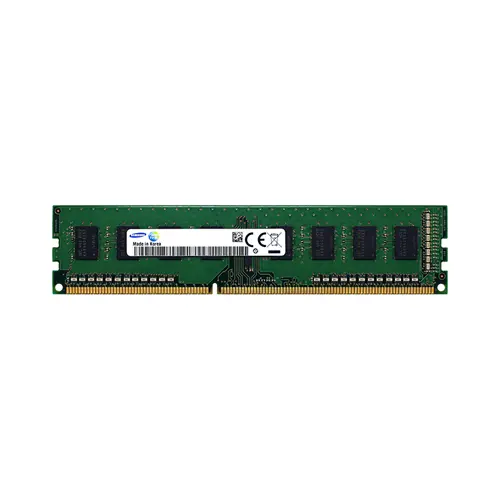
This 8GB DDR3-1600 registered ECC RDIMM (M393B1G70BH0-CK0Q9) is purposed for enterprise servers and excels in virtualization clusters and in-memory database workloads where uncompromising data integrity is required. Its registered signal type stabilizes command and address buses in dense multi-DIMM configurations, while the single-rank x4 organization reduces bus loading and the integrated ECC delivers robust single-bit error correction to maximize uptime.
1. ECC error correction detects and corrects single-bit memory faults silently, safeguarding transactional database integrity and preventing costly data corruption in always-on enterprise servers.
2. Registered DIMM architecture buffers address and command lines, preserving signal integrity across fully populated memory channels for uncompromised stability in dense virtualization hosts.
3. 1600MHz clock speed translates to PC3-12800 peak bandwidth, accelerating in-memory analytics and large-page table walks under heavy multi-tenant workloads.
4. Single-rank x4 organization minimizes electrical loading on the memory bus, allowing consistent 1600MHz operation even when all 24 DIMM slots are filled in a 2U rack server.
5. An 8-gigabyte capacity per module hits a pragmatic density sweet spot for scale-out clusters, delivering ample guest memory for containers and mid-sized VMs without overspending.
The M393B1G70BH0-CK0Q9 is a server-grade RDIMM, and its architecture directly addresses the punishing demands of modern data centers. In a virtualized cluster hosting dozens of mission-critical VMs, ECC is non-negotiable: it detects and corrects single-bit memory errors caused by cosmic radiation or silicon aging, preventing a flipped bit from silently corrupting an in-memory database like SAP HANA or causing a hypervisor to crash. The registered signal buffer allows 24 DIMM slots per host to be fully populated without electrical loading instability, so you can scale up to 768GB RAM per server safely—essential for dense private clouds. Meanwhile, the single-rank x4 organization paired with 1600MHz speed balances low latency and high sustained bandwidth, keeping transaction commit times predictable under heavy OLTP workloads. This isn’t just memory; it’s insurance for uptime and data fidelity when every workload counts.
General Virtualization
Equip dual-socket servers with at least eight of these 8GB RDIMMs (64GB total), filling all memory channels evenly to maintain full bandwidth and balanced performance for hypervisor workloads. Scale to 16 modules (128GB) when hosting a larger virtual machine density or resource-heavy applications, ensuring headroom for memory ballooning and failover.
In-Memory Database
Maximize capacity by populating every available DIMM slot with this 8GB module—commonly 16 or 24 slots in a dual-socket DDR3 system—to deliver 128GB to 192GB of low-latency memory. Keeping the entire dataset in RAM avoids disk I/O bottlenecks, and if capacity needs exceed this limit, combine with 16GB RDIMMs while retaining these modules in remaining slots.
High-Performance Computing (HPC)
Install exactly one 8GB RDIMM per memory channel (1DPC) to sustain the full 1600 MT/s speed, which is critical for bandwidth-sensitive parallel tasks. On a typical dual-socket node with four channels per CPU, this yields 64GB and avoids the clock reductions that occur when populating more than one DIMM per channel, directly protecting floating-point throughput in MPI or OpenMP workloads.
Rigorously tested DDR3 Registered ECC memory, compatible with Dell PowerEdge R720, HP DL380p Gen8, Lenovo RD430.
Q: Can I mix this M393B1G70BH0-CK0Q9 with other memory modules of different brands or speeds?
A: Mixing this registered DDR3 module with unbuffered or different-speed DIMMs is not recommended. Mismatched ranks or timings can cause system instability, especially in server platforms requiring uniform ECC and signal integrity.
Q: Is this memory compatible with my system?
A: This RDIMM is designed for dual-processor Intel Xeon E5-2600 v1/v2 or AMD Opteron 6300 series servers using C600/890FX chipsets. Verify your board supports 1.5V DDR3-1600 registered ECC 240-pin modules before purchasing.
Q: What is the recommended DIMM population order for optimal performance?
A: Populate identical DIMMs per channel starting with the slot farthest from the CPU. On multi-CPU servers, balance memory equally across all processors. Follow your server’s memory-configuration guide to maintain balanced interleaving and maximum throughput.
Q: Does this module support overclocking or XMP profiles?
A: No, server-grade registered ECC modules operate strictly at JEDEC standard speeds for data integrity and 24/7 stability. Overclocking and XMP profiles are not supported, as mission-critical workloads require reliable, deterministic performance.
Q: What warranty and typical failure rate can I expect?
A: This module carries a one-year warranty. With a DRAM AFR below 0.3% under normal server conditions, it offers high reliability. Failures are rare when operated within specified voltage and thermal limits.