











 Secure payments
Standard refund policy
Trade Assurance
Secure payments
Standard refund policy
Trade Assurance
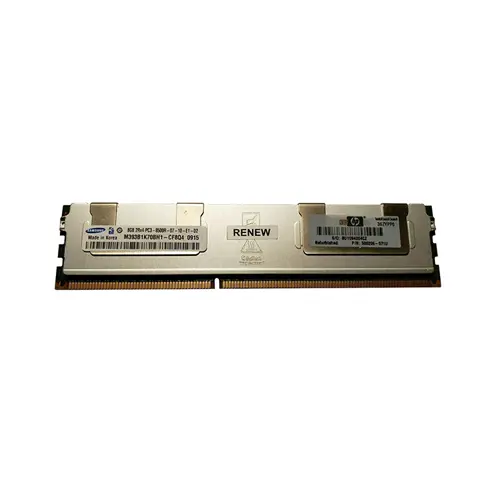
| Model | M393B1K70BH1-CF8Q4 |
|---|---|
| Product Type | Memory Module |
| Compliance Standards | EU RoHS,FCC |
| Memory Capacity | 8 GB |
| Memory Technology | DDR3 |
| Product Voltage | 1.5V |
| RAM Speed | 1066MHz |
| RAM Standard | DDR3-1066/PC3-8500 |
| Error Identifying | ECC |
| Signal Type | Registered |
| Column Access Strobe (CAS) | CL7 |
| Rank | Dual Rank x4 |
| Quantity of Pins | 240-pin |
| RAM Genre | RDIMM |
This is a server-grade DDR3 RDIMM designed for legacy enterprise platforms, where its ECC and registered signal architecture ensure data integrity and system stability ideal for memory-intensive workloads like virtualization and in-memory databases. The dual-rank x4 configuration combined with low CL7 latency optimizes interleaving and bank-access parallelism, effectively boosting throughput in multi-DIMM server deployments.
1. Eight-gigabyte capacity per module gives legacy servers enough headroom to run multiple virtual machines or memory-resident databases, improving consolidation ratios on constrained DDR3 platforms.
2. ECC protection corrects single-bit errors in real time, preventing silent data corruption that would otherwise jeopardize financial transactions or long-running scientific computations.
3. Registered signal buffering keeps command buses clean under fully populated ranks, eliminating instability in 24/7 database servers where memory density directly impacts uptime.
4. Dual rank x4 architecture interleaves access across internal banks, sustaining near-peak bandwidth for many-core CPUs handling parallel virtualization workloads.
5. CL7 low column access latency reduces time-to-first-word, delivering faster read responses that accelerate in-memory caches and latency-sensitive OLTP queries.
The M393B1K70BH1-CF8Q4 8GB DDR3-1066 RDIMM leverages four essential server-focused technologies: ECC, registered buffering, dual-rank x4 architecture, and CL7 latency. In a virtualized cluster, a single uncorrected bit error can collapse the hypervisor and every guest it hosts. ECC silently corrects these errors, directly preventing unplanned outages for business-critical applications. Registered buffering maintains clean command signals when every DIMM slot is populated, so you can scale memory capacity for high VM density without stability degradation. For in-memory databases like Redis or real-time analytics, the dual-rank design interleaves banks to double the data pathways available, boosting effective bandwidth under mixed workloads. Combined with a low CL7 response, this slashes the time to fetch hot data. In a high-frequency trading platform where microseconds dictate profit, or a VDI farm enduring login storms, these traits deliver concrete mission assurance, higher consolidation ratios, and consistent low-latency performance.
Based on the specifications — DDR3 Registered ECC RDIMM, 8GB capacity, 1066MHz speed — this is server-grade memory intended for stability-focused, multi-slot platforms. Below is the capacity planning guide for typical server workloads.
General Virtualization
Virtualized hosts are often memory-bound before CPU. Populate all memory channels symmetrically to maximize bandwidth and leave headroom for VM failover. A common starting point is 6 to 8 of these 8GB modules (48–64GB total), balancing cost per guest with consolidation ratio. Increase to 16 modules (128GB) for medium-density clusters.
In-Memory Database
In-memory databases like Redis or SAP HANA demand low latency and large absolute capacity. Fill every DIMM slot with these 8GB RDIMMs, aiming for the platform maximum (often 128–256GB). Dual-rank x4 modules improve signal integrity at high capacities. Plan for 2 DIMMs per channel to sustain adequate bandwidth while prioritizing dataset residency entirely in RAM.
High Performance Computing
HPC codes are sensitive to memory bandwidth. Install identical modules in a balanced configuration — typically 1 DIMM per channel — to enable full channel interleaving. For a dual-socket system with three channels each, 6 modules (48GB) often suffice for node-level tasks, while memory-bound CFD or weather models may require 12 modules (96GB) to avoid swapping. Keep all modules identical to the given CL7 speed grade.
Rigorously tested server memory, compatible with Dell PowerEdge R710, HP DL380 G7, IBM x3650 M3, and more.
Q: Can I mix this M393B1K70BH1-CF8Q4 with other memory modules of different brands or speeds?
A: Mixing different brands or speeds is not recommended for server environments. To maintain ECC integrity and system stability, use identical modules with the same part number and specifications.
Q: Is this memory compatible with my system?
A: This RDIMM targets servers with Intel Xeon E5-2600 v1/v2 or AMD Opteron platforms supporting DDR3-1066 Registered ECC memory. Verify your server’s memory QVL for precise compatibility.
Q: What is the recommended DIMM population order for optimal performance?
A: For optimal performance, populate identical DIMMs in balanced channels following the server’s user manual. Typically, start with the slots farthest from the CPU to ensure proper multi-channel ECC operation.
Q: Does this module support overclocking or XMP profiles?
A: No. As an ECC Registered server module, it strictly adheres to JEDEC DDR3-1066 standards. Overclocking and XMP are not supported, prioritizing data integrity and system stability over speed.
Q: What warranty and typical failure rate can I expect?
A: This module includes a one-year warranty. Samsung's stringent manufacturing ensures an extremely low annualized failure rate, typically under 0.5%, delivering enterprise-grade reliability and minimal downtime.