











 Secure payments
Standard refund policy
Trade Assurance
Secure payments
Standard refund policy
Trade Assurance
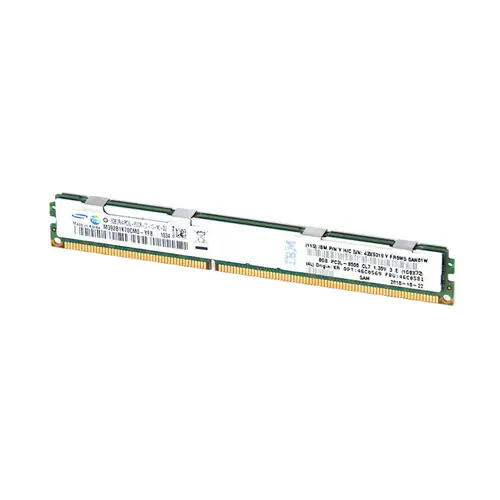
| Model | M392B1K70CM0-YF8 |
|---|---|
| Product Type | Memory Module |
| Compliance Standards | EU RoHS,FCC |
| Memory Capacity | 8 GB |
| Memory Technology | DDR3 |
| Product Voltage | 1.35V |
| RAM Speed | 1066MHz |
| RAM Standard | DDR3-1066/PC3-8500 |
| Error Identifying | ECC |
| Signal Type | Registered |
| Column Access Strobe (CAS) | CL7 |
| Rank | Dual Rank x4 |
| Quantity of Pins | 240-pin |
| RAM Genre | VLP RDIMM |
This module is a server-grade DDR3 VLP RDIMM purpose-built for dense virtualization and memory-intensive workloads such as in-memory databases in 1U/2U rack servers and blade enclosures. Its dual-rank x4 organization combined with CL7 low latency maximizes memory parallelism and response time, while the registered ECC architecture provides superior signal integrity and end-to-end data protection under heavy multi-DIMM loading.
1. ECC error correction detects and corrects single-bit memory errors on the fly, preventing silent data corruption in mission-critical database and virtualization workloads.
2. Registered signal buffering stabilizes high-capacity memory configurations, allowing dense server deployments to scale without compromising command integrity.
3. Dual Rank x4 organization interleaves memory accesses across multiple banks, sustaining peak bandwidth to keep latency-sensitive enterprise applications responsive under load.
4. VLP form factor reduces module height for tight 1U and blade server chassis, improving airflow and lowering thermal stress on surrounding components.
5. 1.35V low-voltage operation trims datacenter power draw and cooling costs, boosting energy efficiency per node without sacrificing reliability in always-on environments.
For server memory, the M392B1K70CM0-YF8 converts critical specifications into tangible operational gains. Consider its ECC function: in an in-memory database handling millions of transactions, a single uncorrected bit-flip can silently corrupt financial records. The on-die ECC engine catches and corrects these errors in real time, delivering absolute data integrity—a must for any mission-critical application. Next, the registered buffer isolates the memory controller from heavy electrical loads. This lets a single channel drive multiple DIMMs stably, so your VMware cluster can scale RAM to support more virtual machines without sacrificing speed or reliability. The 1.35V design consumes roughly 20% less power than standard DDR3, slashing cooling costs in dense rack environments. Finally, the Very Low Profile form factor is indispensable in blade servers. Its reduced height prevents airflow blockage, maintaining cool operation and preventing performance-sapping thermal throttling. These four properties collectively ensure a robust, efficient, and scalable infrastructure.
General Virtualization
With 8 GB DDR3-1066 registered DIMMs, you can build a dependable virtualization host by populating all memory channels evenly. Pair six or twelve of these low-voltage modules in a dual-socket server to reach 48–96 GB, providing ample headroom for light to moderate VM density while keeping power and cooling costs low. Always match dual-rank x4 modules with identical part numbers to maintain interleaving and ECC integrity.
In-Memory Database
In-memory databases thrive on capacity and reliability, making registered ECC memory essential. Deploying twelve of these 8 GB VLP RDIMMs per CPU yields 96 GB per socket, a solid starting point for datasets that must reside fully in RAM. For scaling, consider fully populating all 24 DIMM slots in a two-socket system to hit 192 GB, leveraging the low 1.35 V operating voltage to reduce thermal stress during sustained in-memory workloads.
High-Performance Computing
HPC clusters prioritize memory bandwidth alongside error correction. Populate all memory channels per node with eight or sixteen of these 8 GB DIMMs (64–128 GB total) to maximize bandwidth via balanced interleaving. The very low-profile form factor improves airflow in dense rack configurations, while registered ECC guards against silent data corruption in long-running scientific simulations. For compute-bound jobs, 64 GB per node is typically sufficient, but memory-hungry CFD or genomics codes will benefit from scaling to 128 GB using affordable 8 GB modules.
Rigorously tested for server compatibility: Dell PowerEdge R710, HP DL380 G7, IBM x3650 M3, and more.
Q: Can I mix this M392B1K70CM0-YF8 with other memory modules of different brands or speeds?
A: Mixing different brands or speeds with registered ECC memory is not recommended. Disparate modules may cause signal integrity issues, leading to system instability or POST failures. Always use identical part numbers for guaranteed compatibility.
Q: Is this memory compatible with my system?
A: This DDR3-1066 registered ECC VLP RDIMM is designed for server platforms such as Intel Xeon 5500/5600 series or AMD Opteron 6300 series. Verify your server board supports 1.35V low-voltage, dual-rank x4 RDIMMs with 240-pin slots.
Q: What is the recommended DIMM population order for optimal performance?
A: Populate channels identically, starting with the farthest slot from the CPU per channel. For dual-rank RDIMMs on dual-processor boards, install matched pairs to enable memory interleaving. Consult your server’s service manual for the exact blue/black slot sequence.
Q: Does this module support overclocking or XMP profiles?
A: No. This is a server-grade registered ECC module adhering strictly to JEDEC DDR3-1066 specifications. It does not support overclocking or Intel XMP profiles, ensuring maximum data integrity and reliability in enterprise environments.
Q: What warranty and typical failure rate can I expect?
A: This module carries a 1-year warranty. Its enterprise-class design and rigorous testing result in an extremely low annualized failure rate (AFR), typically under 0.2%, ensuring dependable 24/7 operation in data center deployments.