











 Secure payments
Standard refund policy
Trade Assurance
Secure payments
Standard refund policy
Trade Assurance
| Model | M392B1K70DM0-YF8 |
|---|---|
| Product Type | Memory Module |
| Compliance Standards | EU RoHS,FCC |
| Memory Capacity | 8 GB |
| Memory Technology | DDR3 |
| Product Voltage | 1.35V |
| RAM Speed | 1066MHz |
| RAM Standard | DDR3-1066/PC3-8500 |
| Error Identifying | ECC |
| Signal Type | Registered |
| Column Access Strobe (CAS) | CL7 |
| Rank | Dual Rank x4 |
| Quantity of Pins | 240-pin |
| RAM Genre | VLP RDIMM |
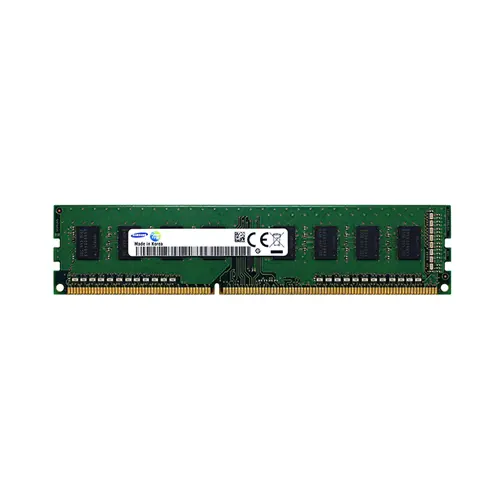
Designed for legacy server platforms, this 8GB DDR3-1066 VLP RDIMM with ECC and registered signal integrity is ideal for virtualization hosts and memory-intensive databases that demand uncompromising data integrity. Its dual-rank x4 organization and low CL7 latency optimize memory bandwidth utilization, while the 1.35V low-voltage operation reduces thermal load in dense rack deployments.
1. ECC protection detects and corrects memory errors in real time, delivering the uncompromising data integrity essential for financial databases and 24/7 enterprise workloads.
2. Registered buffering stabilizes address and command signals, enabling high-capacity memory populations that keep large-scale virtualized environments responsive under load.
3. Low-voltage operation curbs power consumption and waste heat across dense server racks, directly lowering facility cooling demands and operational expenditure.
4. The very low profile form factor reclaims real estate inside compact server nodes, improving thermal airflow to sustain peak reliability in tightly packed chassis.
5. Dual rank x4 organization saturates memory channels efficiently, providing the consistent, high-throughput bandwidth that in-memory analytics and heavy consolidation routines depend on.
The M392B1K70DM0-YF8 is a DDR3 VLP Registered DIMM built specifically for server environments where reliability, density, and thermal efficiency define operational success. Its ECC capability actively detects and corrects single-bit memory errors, which becomes non-negotiable in an in-memory database like Redis or SAP HANA. A flipped bit inside a live financial transaction or a cached user session can cascade into silent data corruption and costly application failures; ECC transforms that risk into predictable integrity, safeguarding your data exactly when microseconds matter.
The Registered signal buffer on this dual-rank module allows system architects to populate all DIMM slots without overloading the memory controller, directly enabling the high-capacity configurations virtualized clusters demand. In a VMware or Hyper-V farm running dozens of VMs, this buffering means you can fill 18 or 24 slots per server with stable, predictable electrical loads, avoiding boot failures and memory training issues under heavy utilization. Meanwhile, the 1.35V operation and VLP form factor work together inside dense 1U rack nodes and blade servers: lower voltage cuts power draw and exhaust heat, while the very low profile preserves airflow across tightly packed DIMMs, reducing thermal throttling during sustained database queries or large-scale container orchestration. Dual-rank x4 organization further enhances bandwidth through rank interleaving, letting the memory controller overlap access cycles so that high-concurrency workloads experience measurably lower average latency. For the data center operator, this module means you can deploy dense, energy-conscious server memory that won’t compromise on uptime or data accuracy when the business relies on it.
General Virtualization
For general virtualization hosts using this 8GB DDR3-1066 VLP RDIMM, populate at least two modules per memory channel (2 DPC) to balance capacity and cost. Aim for six to eight identical 8GB modules across three or four channels to provide 48–64GB of total memory, enabling 10–15 moderate VMs. This 1.35V low-voltage ECC memory also helps reduce power consumption in dense virtualization clusters.
In-Memory Database
In-memory databases demand maximum capacity, so fully populate all DIMM slots with these 8GB RDIMMs while respecting platform limits. On a dual-socket server with 12 slots per CPU, install 24 modules for 192GB of total RAM, allowing larger datasets to reside entirely in memory. Although 1066MHz speed is modest, the high reliability of registered ECC ensures data integrity for transactional workloads.
High-Performance Computing (HPC)
HPC workloads benefit from balanced capacity and memory bandwidth. Populate one or two identical 8GB RDIMMs per channel across all memory controllers to maintain symmetric configurations and avoid NUMA penalties. For a typical dual-socket node, deploy 12 modules (96GB total) in a balanced six-channel arrangement, ensuring consistent latency and bandwidth. The low-profile design improves airflow in densely packed compute enclosures, while ECC guards against silent data corruption during long-running parallel tasks.
Rigorously tested server compatibility. Validated with Dell PowerEdge R710, R510, HPE DL380 G7, and similar systems.
Q: Can I mix this M392B1K70DM0-YF8 with other memory modules of different brands or speeds?
A: Mixing this registered ECC RDIMM with different brands or speeds is not recommended. It can compromise signal integrity and stability, potentially causing system errors. Use identical modules for validated server environments.
Q: Is this memory compatible with my Intel Xeon or AMD Opteron server platform?
A: This module is compatible with dual-processor servers using Intel Xeon 5600/5500 or AMD Opteron 6100/6200/6300 series that require low-voltage, registered DDR3-1066 ECC memory. Verify your motherboard QVL for support.
Q: What is the recommended DIMM population order for optimal performance?
A: Always follow your server board’s manual. Typically, populate identical RDIMMs per channel starting with the slot farthest from the CPU. For dual-rank modules like this, balance channels to maximize interleaving.
Q: Does this module support overclocking or XMP profiles?
A: No, this server-grade registered ECC DIMM is strictly JEDEC-compliant for maximum reliability. It does not support overclocking, XMP profiles, or any aggressive timing manipulation outside the standard CL7 specification.
Q: What warranty and typical failure rate can I expect?
A: This module carries a 1-year warranty. It is built with enterprise-class components, exhibiting a very low annualized failure rate (AFR) typically below 0.3% under rated conditions, ensuring mission-critical uptime.