











 Secure payments
Standard refund policy
Trade Assurance
Secure payments
Standard refund policy
Trade Assurance
| Product Type | Memory Module |
|---|---|
| Memory Capacity | 8 GB |
| Memory Technology | DDR3 |
| Product Voltage | 1.35 V |
| RAM Speed | 1066 MHz |
| RAM Standard | DDR3-1066/PC3-8500 |
| Error Identifying | ECC |
| Signal Type | Registered |
| Column Access Strobe (CAS) | CL7 |
| Rank | Quad Rank x8 |
| Quantity of Pins | 240-pin |
| RAM Genre | RDIMM |
This is a server-class DDR3L-1066 Registered ECC memory module, ideally suited for legacy virtualization hosts and memory-intensive database applications where data integrity is paramount. Its Quad Rank x8 configuration enables high-density memory configurations, while the low 1.35V operating voltage and CL7 latency enhance power efficiency and responsiveness in 24/7 operating environments.
1. ECC protection continuously corrects single-bit errors in real time, safeguarding transactional databases and mission-critical workloads against silent data corruption.
2. Registered buffering strengthens signal integrity across fully loaded memory buses, enabling stable operation in high-capacity server nodes that demand uncompromising reliability.
3. Quad rank x8 organization maximizes memory density per slot, allowing virtualization hosts to support more virtual machines without sacrificing channel balance.
4. Low-voltage operation trims overall power consumption and thermal output, directly reducing energy costs in dense data center deployments.
5. Tight CAS latency accelerates small-random-access performance, giving in-memory caches and database engines the responsiveness needed for latency-sensitive services.
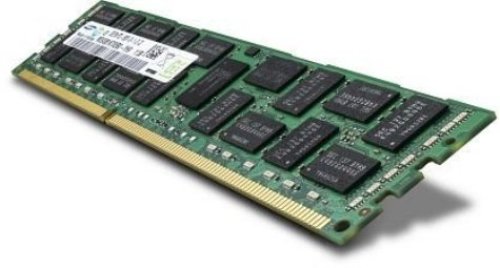
Designed specifically for server environments, the Samsung M393B1K73CHD-YF8 RDIMM is engineered to address the critical demands of enterprise computing where downtime is not an option. Its integrated ECC technology continuously detects and corrects single-bit memory errors, directly preventing silent data corruption in scenarios like a financial transaction database or a virtualized server cluster running multiple mission-critical guests. The registered buffer built into this module stabilizes the signal path from the CPU to the memory chips, meaning that when you populate all channels for maximum capacity in a VMware ESXi host, you avoid signal degradation that could otherwise cause unpredictable system crashes. Operating at a low 1.35V, it reduces thermal load across an entire rack of servers, lowering data center cooling costs and improving long-term energy efficiency. Additionally, the quad-rank x8 organization provides dense 8GB capacity per stick while maintaining balanced bandwidth utilization, essential for memory-intensive applications such as in-memory databases like Redis or SAP HANA, where large datasets must reside entirely in RAM for real-time analysis without bottlenecking the memory controller.
General Virtualization
For virtualized environments, populate these 8GB DDR3L-1066 RDIMMs uniformly across all memory channels to maximize bandwidth and reduce contention. A typical dual-socket server with three DIMMs per channel provides 48GB per CPU, offering a solid margin for moderate VM density. The 1.35V low-voltage operation helps contain power and cooling costs in 24/7 deployments.
In-Memory Database
In-memory databases demand large capacities and absolute data integrity. Leverage the quad-rank, registered ECC design to densely populate all channels, aiming for 256–512GB on supported platforms. Be aware that running many quad-rank DIMMs may limit speed to 1066 MT/s, but the reliability of ECC and the capacity density outweigh the reduced frequency for transactional consistency.
High-Performance Computing (HPC)
HPC nodes benefit from balanced rank interleaving and full channel population. Install one or two quad-rank modules per channel to sustain DDR3-1066 speed while achieving 64–128GB per node, ideal for bandwidth-sensitive simulations. The lower 1.35V voltage aids thermal stability in dense clusters, and the registered buffer ensures signal integrity across multiple DIMMs, critical for iterative, long-running calculations.
Tested server memory; compatible with Dell R710/R720, HP DL380 G7/G8, IBM x3650 M3.
Q: Can I mix this M393B1K73CHD-YF8 with other memory modules of different brands or speeds?
A: Mixing registered ECC memory is not recommended. This module requires identical part numbers, ranks, and timings for stable multi-DIMM operation. Mixing can cause POST failures or signal integrity issues in server platforms.
Q: Is this memory compatible with my system?
A: This DDR3-1066 RDIMM is designed for server platforms using Intel Xeon 5500/5600 series or AMD Opteron 6100 series chipsets. Verify your motherboard supports quad-rank x8 registered ECC DIMMs at 1.35V.
Q: What is the recommended DIMM population order for optimal performance?
A: Follow your server board's population guide, balancing channels per CPU. For quad-rank DIMMs like this one, you may need to limit to two DIMMs per channel to maintain 1066MHz speed; otherwise speed may drop to 800MHz.
Q: Does this module support overclocking or XMP profiles?
A: No. This is a standard JEDEC-compliant server RDIMM without XMP or overclocking support. It operates solely at its rated 1066MHz with CL7 latency to ensure mission-critical stability.
Q: What warranty and typical failure rate can I expect?
A: This module includes a one-year warranty. As a server-grade Samsung RDIMM, it offers high reliability with an annualized failure rate well below 0.5% under normal operating conditions.