











 Secure payments
Standard refund policy
Trade Assurance
Secure payments
Standard refund policy
Trade Assurance
| Model | M393B1K73CH0-YF8 |
|---|---|
| Product Type | Memory Module |
| Compliance Standards | CE,WEEE,RoHS |
| Memory Capacity | 8 GB |
| Memory Technology | DDR3 |
| Product Voltage | 1.35V |
| RAM Speed | 1066MHz |
| RAM Standard | DDR3-1066/PC3-8500 |
| Error Identifying | ECC |
| Signal Type | Registered |
| Column Access Strobe (CAS) | CL7 |
| Rank | Quad Rank x8 |
| Quantity of Pins | 240-pin |
| RAM Genre | RDIMM |
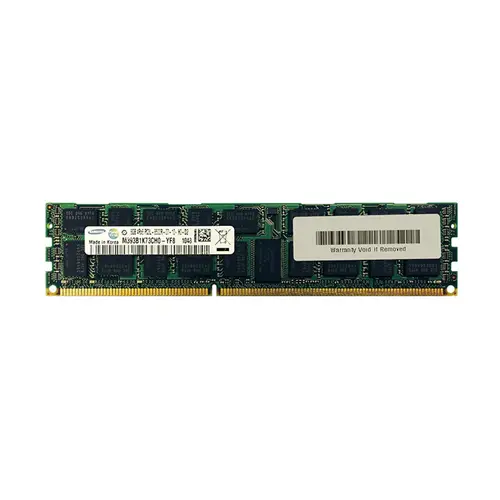
Designed for legacy server platforms, this Samsung M393B1K73CH0-YF8 8GB DDR3-1066 RDIMM operates at a low 1.35V and features registered ECC with a fast CL7 latency, ensuring robust data integrity for virtualization and memory-intensive database workloads. Its quad-rank x8 configuration doubles the DRAM devices per channel to maximize capacity density in dual-socket servers, making it an optimal choice for cost-effective consolidation of older enterprise infrastructure.
1. ECC protection silently corrects single-bit memory errors in real time, safeguarding financial transactions and virtualized databases from data corruption without downtime.
2. Registered signal buffering reduces electrical load on the memory controller, allowing fully populated server nodes to scale up RAM capacity for dense virtual machine farms.
3. Quad Rank x8 layout packs more DRAM devices per module, enabling high memory footprints in limited DIMM slots to support memory-hungry enterprise applications.
4. Eight-gigabyte module density provides the right building block for balanced memory configurations, optimizing caching layers without oversubscription waste.
5. Low-voltage operation slashes datacenter power draw and thermal output across racks, delivering consistent energy savings in 24/7 cloud environments.
As a server memory module, the Samsung M393B1K73CH0-YF8 integrates ECC, registered buffering, low-voltage operation, and a quad-rank organization to directly address the toughest data-center demands. In a virtualized cluster, a silent bit-flip in the hypervisor can cascade into corrupted VMs and unplanned downtime. The onboard ECC actively detects and corrects single-bit errors, preserving data integrity and keeping your mission-critical services online without manual intervention. The registered buffer then regenerates command and address signals, so you can fully populate every memory channel with stable signal quality. This is indispensable when you need large, consolidated memory pools for VMware or container hosts, because it eliminates the signal degradation that would otherwise cause random crashes under heavy load. Operating at 1.35V instead of the standard 1.5V lowers power consumption measurably, reducing both cooling overhead and electricity costs across a rack full of servers. Meanwhile, the quad-rank design enables rank interleaving, allowing the memory controller to overlap multiple access requests. For an in-memory database like Redis or SAP HANA, this parallel processing dramatically lifts throughput and delivers the real-time responsiveness your users demand, even when data sets are massive and queries are concurrency-heavy.
Memory Type Identification
The M393B1K73CH0-YF8 is a server-grade DDR3-1066 Registered ECC DIMM with 1.35V low-voltage operation and quad-rank organization. Its ECC and registered signaling are exclusively suited for server platforms requiring data integrity and large memory capacities.
General Virtualization
Populate all memory channels identically to balance load and maximize throughput for hypervisor-managed workloads. Given the 8GB module size, start with six to eight modules (48–64GB) per host to support a moderate number of virtual machines. Leverage the low 1.35V voltage to reduce power consumption in dense virtualized environments without sacrificing reliability.
In-Memory Database
Maximize total capacity by filling every available DIMM slot, as in-memory datasets demand the largest possible RAM footprint. Use a minimum of 16 modules (128GB) to sustain real-time analytics, and keep spare modules on hand because the quad-rank design can stress the memory controller and may require manual rank interleaving tuning. Always deploy identical kits to guarantee ECC multi-bit error correction across all ranks.
High Performance Computing
While the 1066MHz speed is modest for HPC, ensure symmetric population across all memory channels to avoid bandwidth bottlenecks. A typical 8-socket configuration with 16 modules yields 128GB—sufficient for many parallel batch jobs. If your workload is latency-sensitive, test rank interleaving settings, as quad-rank DIMMs can slightly increase access latency but provide higher capacity per channel.
Rigorously tested. Compatible with Dell PowerEdge R710, HP DL380 G7, IBM x3650 M3 server systems.
Q: Can I mix this M393B1K73CH0-YF8 with other memory modules of different brands or speeds?
A: Mixing Registered ECC DIMMs is not recommended. Different brands, speeds, or ranks may cause signal integrity issues and system instability. For server environments, always install identical modules to ensure validated performance and reliability.
Q: Is this memory compatible with my Intel Xeon E5-2600 v2 series server board?
A: This DDR3-1066 Registered ECC RDIMM is designed for servers using Intel Xeon E5/E7 or AMD Opteron platforms with C600/8000 series chipsets. Verify your board accepts 1.35V low-voltage dual-rank DIMMs and supports quad-rank loading requirements.
Q: What is the recommended DIMM population order for optimal performance?
A: Populate identical DIMMs starting with the farthest slots from the CPU per channel. For dual-socket servers, balance memory across all memory channels for each processor. Always consult your system service guide for slot numbering and population rules.
Q: Does this module support overclocking or XMP profiles?
A: No. This is an enterprise-grade RDIMM adhering strictly to JEDEC DDR3-1066 (PC3-8500) standards at CL7. Overclocking and XMP profiles are not supported; its operation is fixed for mission-critical stability and error-free ECC functionality.
Q: What warranty and typical failure rate can I expect?
A: This Samsung module carries a 1-year warranty. Typical annualized failure rates (AFR) for such qualified RDIMMs are below 0.2% in controlled server environments. Proper thermal management helps maintain long-term reliability within the specified 1.35V operating range.