











 Secure payments
Standard refund policy
Trade Assurance
Secure payments
Standard refund policy
Trade Assurance
| Model | M3931G73BH0-CH9 |
|---|---|
| Product Type | Memory Module |
| Compliance Standards | EU RoHS,FCC |
| Memory Capacity | 8 GB |
| Memory Technology | DDR3 |
| Product Voltage | 1.5V |
| RAM Speed | 1333MHz |
| RAM Standard | DDR3-1333/PC3-10600 |
| Error Identifying | ECC |
| Signal Type | Unbuffered |
| Column Access Strobe (CAS) | CL9 |
| Rank | Dual Rank x8 |
| Quantity of Pins | 240-pin |
| RAM Genre | UDIMM |
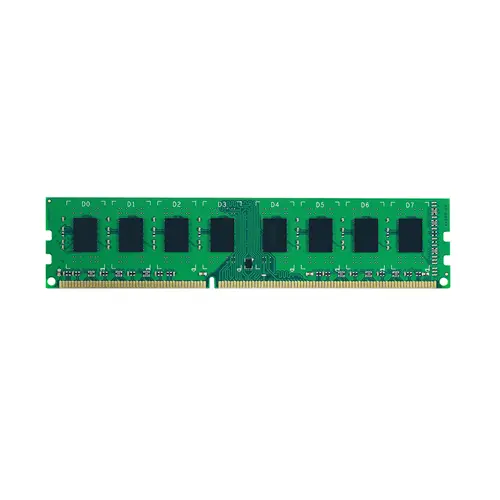
This is an entry-level server and workstation memory module, utilizing ECC Unbuffered UDIMM technology to ensure data integrity in single-processor systems. The dual-rank x8 organization with CL9 latency delivers reliable 1333MHz performance for light virtualization, file serving, and memory-sensitive applications where error correction is critical.
1. ECC protection corrects single-bit errors in real time, safeguarding transactional data integrity in always-on server environments where even minor memory faults can corrupt critical workloads.
2. Unbuffered architecture reduces access latency for the CPU, improving responsiveness in lightweight virtualized applications and entry-level database servers that benefit from direct memory control.
3. Eight-GB capacity per module provides sufficient headroom for moderate virtualization hosts, enabling more simultaneous containers or VMs without immediate hardware expansion.
4. Dual Rank x8 organization interleaves memory bank accesses, boosting throughput in memory-intensive server tasks such as in-memory caching and data analytics processing.
5. Running at a moderate clock speed with CL9 latency balances power consumption and bandwidth, which helps maintain thermal stability in dense rack deployments while still delivering reliable performance for standard enterprise workloads.
The Samsung M3931G73BH0-CH9 is a server-grade DDR3 UDIMM engineered for platforms where data integrity and cost-effective reliability intersect. In virtualized clusters running multiple VMs, this module’s ECC automatically detects and corrects single-bit memory errors—failures that cosmic rays or electrical noise can silently introduce. Without ECC, a flipped bit inside a guest OS can corrupt file systems or crash a hypervisor; with this DIMM, your consolidation strategy stays stable, reducing unplanned downtime and expensive troubleshooting. Its dual-rank x8 organization and 1333 MHz speed also matter in real time: when pairing with a memory-intensive database like Redis or an in-memory analytics engine, dual rank delivers superior interleaving and bandwidth per channel compared to single-rank alternatives, letting you serve more queries per second under load. The unbuffered design keeps latency at CL9, which is ideal for microservers and small departmental databases where every nanosecond of access time counts. Built with 1.5 V operation and RoHS compliance, the module runs cool in dense 1U enclosures, lowering thermal stress and long-term energy costs. For IT managers balancing budget against uptime, this 8 GB stick is not just a generic DIMM—it is targeted insurance against silent data corruption and a plug-in performance lift for demanding memory-bound workloads.
Based on the module’s ECC, Unbuffered, 240-pin UDIMM characteristics, this is server memory aimed at single-socket servers and entry-level workstations. Capacity planning with these 8GB DDR3-1333 modules centres on populating available slots symmetrically for optimal reliability and throughput.
General Virtualization
Virtual hosts demand ample, error-resilient memory. Populate all four DIMM slots on a typical single-socket server with identical 8GB modules to reach 32 GB, providing comfortable headroom for multiple VMs while ECC guards against in-memory corruption. If the board offers only two slots, a 16 GB (2×8 GB) kit serves as a cost-effective baseline.
In-Memory Database
Low-latency capacity is critical for Redis or Memcached. Install four matched 8GB ECC UDIMMs (32 GB total) to maximise density while maintaining balanced channel utilisation and uniform CL9 latency. Avoid mixing dissimilar sticks to prevent stability issues and performance penalties under heavy cache workloads.
High-Performance Computing (HPC)
HPC workloads thrive on bandwidth and data integrity. Configure at least a dual-channel pair (16 GB) to double memory throughput; if budget permits, a four-module 32 GB kit further scales capacity while preserving symmetric channel population. ECC ensures long-running simulations remain accurate.
Rigorously tested, this server ECC UDIMM ensures compatibility with Dell PowerEdge R210, R310, T110 II, HP MicroServer Gen8.
Q: Can I mix this M3931G73BH0-CH9 with other memory modules of different brands or speeds?
A: Mixing is not recommended for server environments. Mismatched modules may cause stability issues or disable ECC. For reliability, populate with identical M3931G73BH0-CH9 DIMMs only.
Q: Is this memory compatible with my system? Which server platforms support it?
A: It is designed for Intel Xeon E3/E5 (Sandy/Ivy Bridge) and select AMD Opteron platforms requiring DDR3 ECC UDIMMs. Verify your motherboard supports 8GB Dual Rank x8, 1333MHz, 1.5V, 240-pin UDIMM ECC. Consult the board’s QVL.
Q: What is the recommended DIMM population order for optimal performance?
A: Populate identical DIMMs in matched-channel slots first (e.g., blue slots) to enable dual-channel interleaving. For dual rank modules, install one DIMM per channel before adding second DIMMs. Always follow your server’s manual.
Q: Does this module support overclocking or XMP profiles?
A: No. This is a JEDEC-standard server DIMM with no XMP or overclocking support. It operates strictly at DDR3-1333 CL9 for maximum data integrity and 24/7 stability in mission-critical environments.
Q: What warranty and typical failure rate can I expect?
A: It carries a one-year warranty. The typical annualized failure rate (AFR) is below 0.5% under specified operating conditions, backed by rigorous component screening and production testing for enterprise-grade reliability.