











 Secure payments
Standard refund policy
Trade Assurance
Secure payments
Standard refund policy
Trade Assurance
| Product Type | Memory Module |
|---|---|
| Memory Capacity | 96 GB |
| Memory Technology | DDR5 |
| Product Voltage | 1.1 V |
| RAM Speed | 4800 MHz |
| RAM Standard | DDR5-4800/PC5-38400 |
| Error Identifying | ECC |
| Signal Type | Registered |
| Column Access Strobe (CAS) | CL40 |
| Rank | Dual Rank x4 |
| Quantity of Pins | 288-pin |
| RAM Genre | RDIMM |
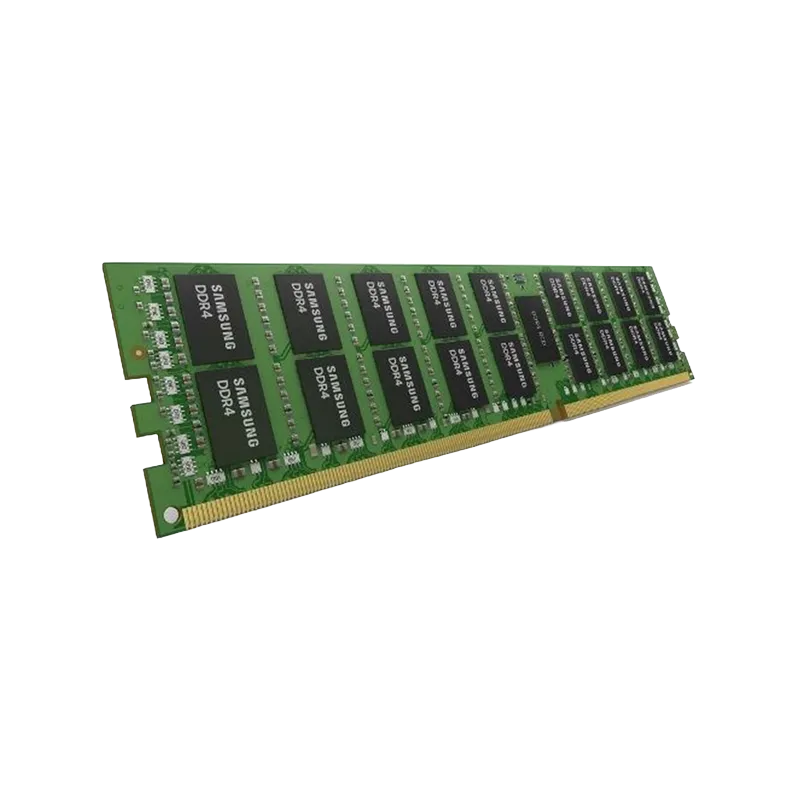
This 96GB DDR5-4800 Registered ECC module is designed for enterprise servers and workstations, excelling in memory-intensive workloads such as virtualization, in-memory databases, and large-scale data analytics where data integrity is paramount. Its dual-rank x4 configuration with ECC and registered signaling ensures robust signal stability and error correction across dense memory populations, while the high capacity per module maximizes throughput in multi-DIMM configurations.
1. 96GB capacity enables significantly higher virtual machine density per server node, directly reducing hardware footprint and total cost of ownership in cloud and enterprise data centers.
2. ECC protection continuously detects and corrects single-bit memory errors in real time, safeguarding transactional and analytical workloads from silent data corruption that could otherwise cause costly downtime.
3. Registered signal buffering isolates the memory controller from the electrical load of the DRAM chips, allowing fully populated multi-DIMM configurations that are essential for scaling up memory capacity without compromising system stability.
4. DDR5-4800 bandwidth delivers up to 38.4 GB/s per module, ensuring rapid data throughput for memory-hungry applications like in-memory databases and real-time big data analytics.
5. Dual Rank x4 organization maximizes command and data bus utilization by interleaving accesses across internal ranks, keeping memory channels fully saturated for consistent VM responsiveness during heavy consolidation.
The M321RYGA0BB0-CQKZH is a 96GB DDR5 Registered ECC DIMM purpose-built for servers, and its four key attributes directly address critical IT pain points. ECC memory catches and corrects single-bit errors in real time — in a virtualization cluster, a cosmic-ray-induced bit-flip could silently corrupt a VM’s kernel or a financial database record; ECC prevents that, safeguarding transactional integrity. Registered buffering stabilizes command/address signals, allowing you to fully populate memory channels for massive 1TB+ footprints without signal timing issues, vital for dense virtualization hosts. The dual-rank x4 architecture leverages bank interleaving to serve concurrent read/write operations faster, reducing latency spikes in in-memory databases like Redis during peak loads. Finally, the 96GB capacity on a single stick using DDR5’s efficient 1.1V supply maximizes system memory within limited DIMM slots while keeping power and cooling costs predictable. This translates to fewer servers doing more work — virtual machines launch faster, databases respond quicker, and your infrastructure stays reliable always.
General Virtualization
For general virtualization, deploy eight 96 GB RDIMMs in a dual‑socket server—one per memory channel—yielding 768 GB total. This one‑DIMM‑per‑channel (1DPC) configuration sustains the full DDR5‑4800 speed, delivering consistent performance for hundreds of mixed VMs. It strikes an optimal balance between cost, density, and bandwidth.
In‑Memory Database
For large‑memory analytics platforms, install two 96 GB RDIMMs per channel on a dual‑socket eight‑channel system (32 modules, 3 TB total). The 2DPC layout reduces speed to approximately 4400 MT/s but provides the immense capacity needed to hold entire databases in RAM. Pair this with NUMA interleaving and huge‑page support to maximize throughput.
High‑Performance Computing
HPC nodes demand maximum bandwidth; populate all 16 memory channels with a single 96 GB module each (1.5 TB at 4800 MT/s). This 1DPC population avoids any frequency penalty, delivering peak throughput for simulation and AI training. Switch to 2DPC only when dataset size exceeds 1.5 TB, fully aware of the bandwidth trade‑off.
Proven compatible with Dell PowerEdge R760, HPE ProLiant DL380 Gen11, and Lenovo ThinkSystem SR650 V3 after rigorous validation.
Q: Can I mix this M321RYGA0BB0-CQKZH with other memory modules of different brands or speeds?
A: Mixing RDIMMs with different brands or speeds is not recommended. It may cause instability, forced lower speed, or system failure. For reliable 24/7 server operation, we strongly advise using identical modules across all channels.
Q: Is this memory compatible with my Intel or AMD server platform?
A: This DDR5-4800 ECC RDIMM supports current-gen Intel Xeon Scalable (Sapphire Rapids) and AMD EPYC 9004 Series processors. Please verify your motherboard’s qualified vendor list (QVL) for this specific 96GB dual‑rank x4 module to ensure full compatibility.
Q: What is the recommended DIMM population order for optimal performance?
A: Populate one DIMM per memory channel first, alternating slots to balance load. For dual-processor boards, install equally across CPU memory banks. Refer to your server manual for exact slot numbering; typically, fill blue slots first for best performance.
Q: Does this module support overclocking or XMP profiles?
A: No. This is an industry‑standard JEDEC DDR5-4800 registered DIMM. It does not support XMP profiles or overclocking. It operates reliably at its specified 1.1V, CL40 timings to ensure data integrity in enterprise environments.
Q: What warranty and typical failure rate can I expect?
A: This module includes a 1‑year warranty. Typical annualized failure rate (AFR) for enterprise-grade RDIMMs is very low, generally under 0.5%, when operated within specified conditions. Actual reliability depends on adequate cooling and proper platform validation.