











 Secure payments
Standard refund policy
Trade Assurance
Secure payments
Standard refund policy
Trade Assurance
| Product Type | Memory Module |
|---|---|
| Memory Capacity | 96 GB |
| Memory Technology | DDR5 |
| Product Voltage | 1.1 V |
| RAM Speed | 5600 MHz |
| RAM Standard | DDR5-5600/PC5-44800 |
| Error Identifying | ECC |
| Signal Type | Registered |
| Column Access Strobe (CAS) | CL40 |
| Rank | Dual Rank |
| Quantity of Pins | 288-pin |
| RAM Genre | RDIMM |
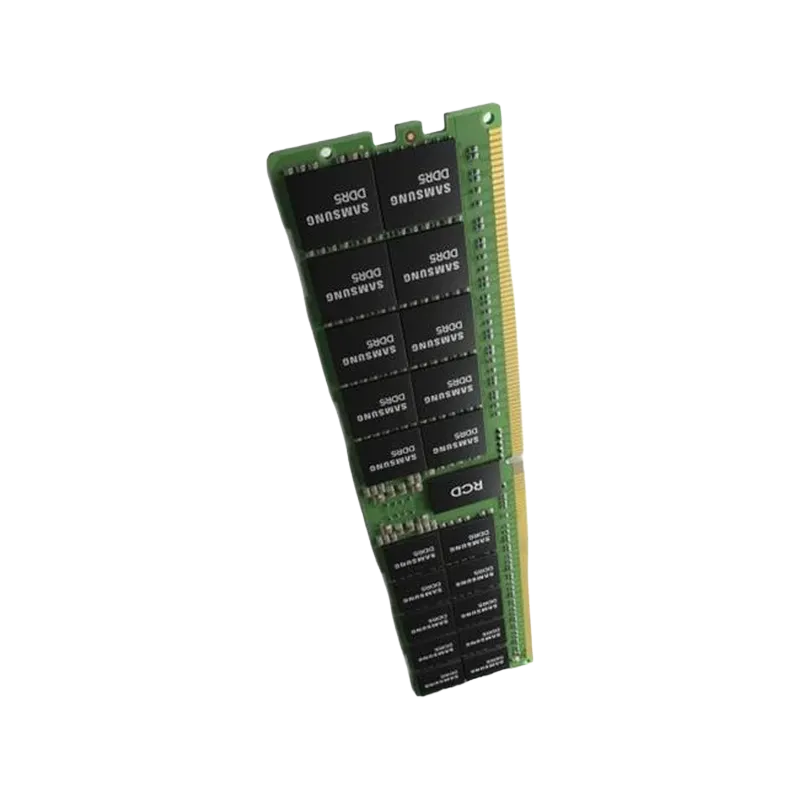
This 96GB DDR5-5600 Registered ECC RDIMM is engineered for enterprise servers and excels in memory-intensive, data-critical workloads such as virtualization, in-memory databases, and large-scale analytics. The dual-rank configuration maximizes memory interleaving for higher sustained bandwidth, while the registered signal type and ECC ensure rock-solid signal integrity and silent data corruption protection across high-density deployments.
1. ECC safeguards transactional data integrity by detecting and correcting single-bit errors in real time, a non-negotiable defense against silent corruption in financial processing or hyper-scale database clusters.
2. Registered signal type buffers command and address lines to maintain clean multi-DIMM bus signaling, enabling fully populated server nodes that maximize memory capacity without sacrificing reliability.
3. Dual Rank interleaving doubles the page-hit potential across a channel, sustaining peak bandwidth under concurrent virtual machine thrashing and reducing latency spikes for memory-intensive SaaS workloads.
4. A huge per-module capacity allows dense server configurations to deliver terabytes of in-memory working set, directly raising VM consolidation ratios and accelerating large in-memory caches for real-time analytics.
5. Aggressive transfer speed feeds hungry multi-core compute pipelines, dramatically cutting data staging time for AI inference engines and high-throughput media transcoding hosted in scale-out deployments.
The M321RYGA0PB0-CWMXH is a server-class DDR5 RDIMM engineered for mission-critical data centers where downtime is not an option. For virtualized clusters running dozens of VMs per node, its Registered architecture with ECC corrects single-bit errors on the fly, preventing silent data corruption that could cascade into transaction failures in a financial database. That integrity layer means your hypervisor keeps all tenants healthy without invisible bit flips turning into overnight forensic nightmares.
In dense consolidation scenarios, the 96 GB capacity on a single stick lets you pack 768 GB into a 1U dual-socket server using only 8 of 16 slots, preserving room for future growth without sacrificing dual‑rank interleaving. Dual Rank and DDR5‑5600 bandwidth deliver the concurrency needed by in‑memory databases like Redis or SAP HANA: the Memory Controller exploits alternating rank access to hide refresh gaps, so microsecond-sensitive queries never stall waiting for a bank to become available. Meanwhile, the 1.1 V operating voltage keeps thermal load in check across fully populated racks, preventing throttling during sustained OLAP workloads. This RDIMM turns theoretical performance into tangible uptime, lower TCO, and predictable latency under real multi‑tenant pressure.
General Virtualization
For dense VM consolidation, deploy this 96 GB RDIMM in balanced quantities across all memory channels—typically one or two DIMMs per channel on a dual‑socket platform. This minimizes latency while delivering the high capacity needed to overcommit memory safely. A configuration of 2 modules per server (192 GB total) suits small clusters, while 8 or 12 modules per host (768 GB–1.15 TB) underpin enterprise hypervisor farms.
In-Memory Database
With ECC and registered dual‑rank design, the module is ideal for in‑memory workloads like Redis or SAP HANA. Install at least two identical DIMMs per CPU to leverage mirroring or sparing modes for maximum data integrity. For large datasets, populate six or eight channels with a single DIMM per channel—this maintains the platform’s peak 5600 MT/s speed while scaling to 576 GB or 768 GB of fault‑tolerant, low‑latency memory.
High-Performance Computing
In HPC clusters, memory bandwidth is critical. Fill every available channel with one 96 GB RDIMM—running 8 or 12 modules per node in a 1‑DIMM‑per‑channel configuration sustains the rated DDR5‑5600 speed and avoids rank‑based downclocking. For dual‑CPU nodes, match populations symmetrically. This yields half a terabyte to over 1 TB of high‑bandwidth capacity per node, well‑suited for simulation, CAE, and large‑scale modeling jobs that demand both speed and scale.
Proven compatible with Dell PowerEdge R760, HPE ProLiant DL380 Gen11, Lenovo ThinkSystem SR650 V3, and more. Rigorously tested.
Q: Can I mix this M321RYGA0PB0-CWMXH with other memory modules of different brands or speeds?
A: We strongly advise against mixing. Registered ECC RDIMMs require matched ranks, timings, and loading. Mismatched modules compromise signal integrity and may disable error correction, risking data integrity and system stability.
Q: Is this memory compatible with my system?
A: This 96GB DDR5-5600 RDIMM targets 4th Gen Intel Xeon Scalable and AMD EPYC 9004 platforms. Confirm your motherboard supports 288-pin registered ECC DDR5 and that 5600MT/s is within the processor's official speed rating.
Q: What is the recommended DIMM population order for optimal performance?
A: Populate all per-channel slots identically, starting with the farthest slot from the CPU. For dual-socket servers, balance memory across both processors and channels to enable interleaving and maximize throughput. Always consult the server's technical manual.
Q: Does this module support overclocking or XMP profiles?
A: No. This JEDEC-standard RDIMM does not support XMP or overclocking. It operates only at its validated 5600MT/s with strict server-grade signal requirements to ensure error-free operation in 24/7 enterprise environments.
Q: What warranty and typical failure rate can I expect?
A: This module carries a 1-year warranty. Enterprise RDIMMs manufactured to rigorous standards typically exhibit an annualized failure rate (AFR) well under 0.5% when operated within specified environmental and workload conditions.