











 Secure payments
Standard refund policy
Trade Assurance
Secure payments
Standard refund policy
Trade Assurance
| Model | M312L2828ET0-CB0 |
|---|---|
| Product Type | Memory Module |
| Compliance Standards | EU RoHS,FCC |
| Memory Capacity | 1 GB |
| Memory Technology | DDR |
| Product Voltage | 2.5V |
| RAM Speed | 266MHz |
| RAM Standard | DDR-266/PC-2100 |
| Error Identifying | ECC |
| Signal Type | Registered |
| Column Access Strobe (CAS) | CL2.5 |
| Rank | Single Rank x4 |
| Quantity of Pins | 184-pin |
| RAM Genre | RDIMM |
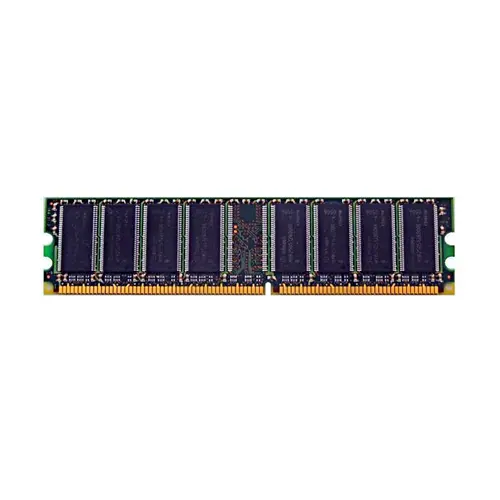
The M312L2828ET0-CB0 is a legacy server-grade DDR-266 Registered DIMM designed for vintage server platforms where data integrity is critical, making it suitable for lightweight memory-resident databases or small-scale virtualization tasks on era-appropriate systems. Its combination of ECC error correction, registered signal buffering for stable multi-module operation, and a low CAS latency of CL2.5 ensures reliable data delivery and improved responsiveness in mission-critical 24/7 environments.
1. ECC error correction silently detects and fixes single-bit memory errors in real time, preserving data integrity for financial ledgers and database transactions without interrupting service.
2. Registered buffering isolates the memory controller from electrical loading on the command path, enabling fully populated server racks to scale capacity for heavier virtual machine consolidation without signal drift.
3. Single Rank x4 organization balances low access latency with per-chip error resilience, giving hypervisors predictable memory response during container orchestration while supporting advanced chip-kill protection.
4. The tight column access latency shrinks the wait between a memory request and data handoff, directly reducing transaction tail latencies in latency-sensitive OLTP and caching workloads.
5. Purpose-fit capacity dedicates just enough memory for headless embedded services and edge routing instances, conserving power and thermal overhead in always-on infrastructure nodes.
The Samsung M312L2828ET0-CB0 is a server-grade Registered ECC DDR module, purpose-built for mission-critical enterprise infrastructure where data integrity and uptime are non-negotiable. In a virtualized cluster running dozens of production VMs, a single bit flip in memory can cascade into catastrophic host failures or silent data corruption. This module’s ECC and registered signal architecture actively detects and corrects single-bit errors, effectively eliminating that risk and ensuring that your hypervisor estate remains stable even under sustained heavy load. For in-memory databases like Redis or SAP HANA, where terabytes of transactional data reside entirely in RAM, the registered clock driver buffers and re-drives address signals, enabling large-scale deployments across multiple DIMMs without signal degradation. That translates directly into faster query responses and zero data loss. The single-rank x4 organization and CL2.5 latency, operating at 266MHz, deliver predictable, low-latency access patterns that prevent I/O bottlenecks during simultaneous VM migration or real-time analytics. Simply put, this memory turns your 24/7 reliability requirements into a baseline reality rather than a constant worry, keeping your database consistent, your virtual machines responsive, and your service-level agreements intact.
This DDR-266 Registered ECC module is server memory. Capacity planning for common server roles:
General Virtualization
Populate memory channels symmetrically to engage interleaving for virtualized hosts. A baseline of 8 DIMMs (8GB) per CPU socket serves a few light VMs; increase to 16 DIMMs (16GB) for moderate consolidation. Use identical modules in pairs or quads to maintain registered signal integrity and minimize electrical loading.
In-Memory Database
In-memory databases demand large, error-free capacities. Maximize installed modules—24 to 32 of these 1GB DIMMs create a 24–32GB footprint, sufficient for small Redis, Memcached, or embedded in-memory engines. Rely on ECC and consider memory mirroring or sparing for higher availability. Always test full population stability.
HPC
HPC farms require peak memory bandwidth. Place these single-rank x4 1GB DIMMs evenly across all memory channels to achieve two- or four-way interleaving. A dual-socket node typically deploys 16–32 modules to saturate bandwidth while ECC guards bit flips. Balance DIMMs identically across channel banks.
This server memory is rigorously tested and compatible with Dell PE2650, HP DL360 G2, IBM x335.
Q: Can I mix this M312L2828ET0-CB0 with other memory modules of different brands or speeds?
A: Mixing is not recommended for this registered ECC module. Different brands or speeds may cause signal integrity issues and system instability on server platforms. Always install identical modules.
Q: Is this memory compatible with my system?
A: This is a 184-pin DDR-266 Registered ECC DIMM for servers. It requires a server board with an Intel E7500/E7520 series chipset or equivalent AMD platform that explicitly supports registered DDR memory.
Q: What is the recommended DIMM population order for optimal performance?
A: Populate matching DIMMs in pairs per memory channel, following the server board's manual. Typically, fill slots starting from the CPU in a balanced configuration to enable ECC and registered operation.
Q: Does this module support overclocking or XMP profiles?
A: No. This is a JEDEC-compliant registered server memory module running at 266MHz with CL2.5. It does not support overclocking or XMP profiles, prioritizing data integrity and stability.
Q: What warranty and typical failure rate can I expect?
A: This module comes with a 1-year warranty. As an enterprise-grade product, it exhibits extremely low failure rates under normal operating conditions, ensuring high reliability for mission-critical server workloads.