











 Secure payments
Standard refund policy
Trade Assurance
Secure payments
Standard refund policy
Trade Assurance
| Model | M312L2920CZ3-CCCQ0 |
|---|---|
| Product Type | Memory Module |
| Compliance Standards | EU RoHS,FCC |
| Memory Capacity | 1 GB |
| Memory Technology | DDR |
| Product Voltage | 2.5V |
| RAM Speed | 400MHz |
| RAM Standard | DDR-400/PC-3200 |
| Error Identifying | ECC |
| Signal Type | Registered |
| Column Access Strobe (CAS) | CL3 |
| Rank | Single Rank x4 |
| Quantity of Pins | 184-pin |
| RAM Genre | RDIMM |
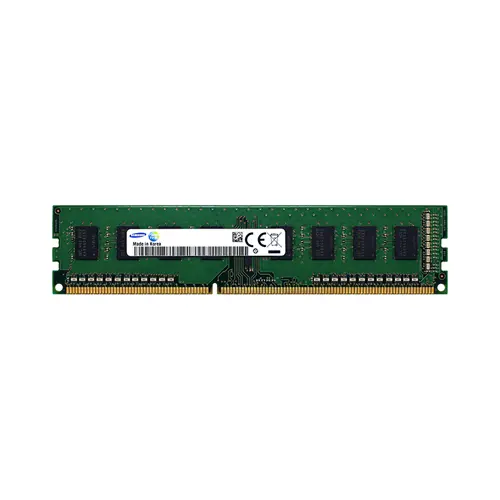
This is a legacy server-grade DDR-400 RDIMM with ECC, ideally suited for aging enterprise platforms running memory-intensive virtualization or small in-memory databases where data integrity is non-negotiable. Its registered signal topology and Single Rank x4 organization reduce bus loading and improve signal stability, while ECC protection ensures single-bit error correction in mission-critical environments.
1. Registered signal buffering decouples the electrical load from the system memory bus, enabling stable operation even in fully populated server configurations that demand maximum capacity.
2. ECC protection detects and corrects single-bit memory errors in real time, preserving long-duration computational integrity for critical enterprise workloads and database transactions.
3. Single Rank x4 organization allows the memory controller to leverage per-chip error granularity, strengthening the system’s resilience against chip-level failures in always-on server environments.
4. PC-3200 bandwidth delivers consistent throughput for memory-intensive virtualization hosts, ensuring predictable performance when juggling multiple concurrent guest instances.
5. The 2.5V operating voltage aligns with legacy DDR server power envelopes, maintaining reliable signal integrity and manageable thermal profiles in dense rack deployments.
When deploying mission-critical infrastructure, the true cost of memory is measured in uptime and data accuracy, not just gigabytes. The Samsung M312L2920CZ3-CCCQ0 is a server-grade DDR-400 Registered ECC DIMM purpose-built to eliminate those hidden risks. Its ECC engine continuously detects and corrects single-bit errors—a silent threat that can corrupt financial transactions or Hypervisor state in a virtualized cluster, turning a minor cosmic-ray flip into a system crash. Equally vital, the Registered buffer offloads the electrical loading from the memory controller, so you can populate all available slots in a rack-scale environment without signal degradation, enabling stable consolidation of multiple VMs on a single node. The single-rank x4 organization on this 184-pin module delivers consistent bandwidth and thermal behavior, critical for in-memory databases like Redis or SAP HANA where latency jitter under heavy OLTP workloads directly impacts client response times. At a true 400MHz with CL3 latency, it feeds the CPU predictably, ensuring your spreadsheet-sized dataset stays resident and instantly accessible. This isn’t just insurance—it’s the foundation for zero-touch uptime and transactional integrity across your virtualized farm.
Capacity Planning for DDR-400 Registered ECC Server Memory
The module M312L2920CZ3-CCCQ0 is a legacy DDR-400 RDIMM with ECC, designed for older server platforms. Its 1 GB capacity per stick and 184-pin form factor strictly limit scalability, so planning must maximize every slot in vintage systems.
General Virtualization
Start with at least four identical modules to enable dual-channel interleaving on older dual-socket boards, providing 4 GB total for a lightweight hypervisor and a handful of idle VMs. Populate all available banks in matched pairs to preserve memory mirroring or sparing options; avoid mixing different ranks or CAS latencies to prevent POST failures.
In-Memory Database
Aim for the maximum supported density by filling every DIMM slot with identical 1 GB sticks—many servers of this era top out at 8 GB. Use the lowest CAS (CL3) and ensure the memory is configured for full ECC scrubbing to guard against bit-flip corruption in cache-sensitive datasets.
High-Performance Computing
Deploy the largest rank-count possible, typically 8–12 identical DIMMs, to saturate memory channels and sustain streaming bandwidth for MPI workloads. Tune BIOS settings for 1T command rate if stability allows, and enable node interleaving on NUMA systems to flatten latency across sockets, turning every available module into a unified pool.
Rigorously tested server memory, compatible with Dell PowerEdge 2850, HP ProLiant DL380 G4, IBM x346, and similar.
Q: Can I mix this M312L2920CZ3-CCCQ0 with other memory modules of different brands or speeds?
A: Mixing is not recommended. This is a registered ECC DDR-400 module requiring matched pairs for stable server operation. Mixed brands or speeds may cause signal integrity issues, forcing the system to downclock or become unstable.
Q: Is this memory compatible with my system?
A: This module is designed for legacy server platforms (e.g., Intel E7500/E7520 chipsets or AMD-8000 series) requiring 184-pin registered ECC DDR-400. Verify your server board explicitly supports 1GB PC-3200 RDIMMs at 2.5V.
Q: What is the recommended DIMM population order for optimal performance?
A: Populate identical modules in matched banks according to your server board manual, typically filling the farthest slots from the CPU first. For this single-rank x4 RDIMM, install pairs symmetrically across memory channels.
Q: Does this module support overclocking or XMP profiles?
A: No. As a server-grade registered ECC DDR-400 DIMM, it adheres strictly to JEDEC standards (CL3) for reliability. Overclocking or XMP is not supported and would compromise data integrity in mission-critical environments.
Q: What warranty and typical failure rate can I expect?
A: This module includes a one-year warranty. Being a mature DDR-400 design built to server-grade specifications, it demonstrates very low annualized failure rates under normal operating conditions, typically below 0.5%.