











 Secure payments
Standard refund policy
Trade Assurance
Secure payments
Standard refund policy
Trade Assurance
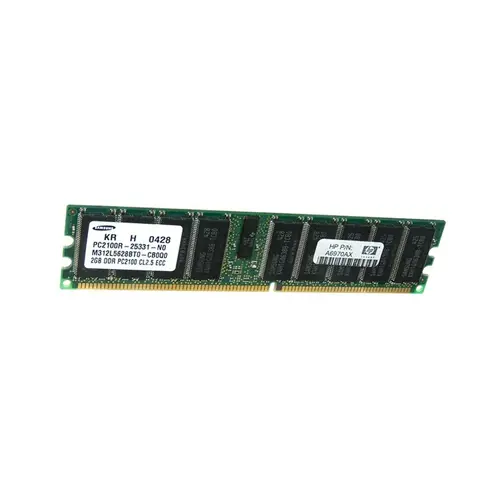
| Model | M312L5628BT0-CB0Q0 |
|---|---|
| Product Type | Memory Module |
| Compliance Standards | EU RoHS,FCC |
| Memory Capacity | 2 GB |
| Memory Technology | DDR |
| Product Voltage | 2.5V |
| RAM Speed | 266MHz |
| RAM Standard | DDR-266/PC-2100 |
| Error Identifying | ECC |
| Signal Type | Registered |
| Column Access Strobe (CAS) | CL2.5 |
| Rank | Dual Rank x4 |
| Quantity of Pins | 184-pin |
| RAM Genre | RDIMM |
The M312L5628BT0-CB0Q0 is a legacy DDR-266 registered ECC server module tailored for enterprise platforms running memory-intensive workloads like virtualization or in-memory databases, where data integrity and uptime are paramount. Its dual-rank x4 configuration paired with a registered signal type ensures stable command/address management across high-density deployments, while ECC protection at CL2.5 latency delivers reliable single-bit error correction critical for transactional consistency.
1. ECC protection actively corrects single-bit errors, safeguarding long-running server processes from data corruption and unexpected downtime.
2. Registered logic reduces electrical load on the memory controller, enabling large memory populations needed for dense virtualization hosts.
3. A modest per-module capacity fits cost-sensitive deployments where multiple lightweight instances run concurrently without wasting resources.
4. Dual Rank x4 design provides increased bank concurrency, accelerating database lookups and virtual machine memory access under mixed workloads.
5. The standard server-class frequency ensures broad compatibility with enterprise platforms, prioritizing stable operations over aggressive clock speeds.
When deploying mission-critical server infrastructure, the M312L5628BT0-CB0Q0 RDIMM delivers resilience where it matters most. Its ECC technology continuously detects and corrects single-bit memory errors—a vital safeguard for financial transaction databases and virtualization clusters, where an uncorrected bit flip could silently corrupt a virtual machine’s state or an in-flight payment, leading to costly downtime or data inconsistency. The registered design buffers command and address signals, dramatically reducing electrical load on the memory controller. In a dense 24-DIMM server running multiple hypervisors, this means you can populate all banks with stable, synchronous operation instead of sacrificing capacity for signal integrity—a direct answer to the pain of unexplained kernel panics under heavy consolidation. Dual-rank x4 organization with CAS 2.5 latency further boosts throughput by enabling interleaved access, which becomes tangible when an in-memory analytics cache is serving thousands of concurrent queries; the module overlaps subsequent requests, cutting effective latency in half under load. Together, these features transform a modest 2GB DDR-266 stick into a deterministic building block for platforms where every clock cycle and every bit must be trusted.
General Virtualization
For lightweight hypervisors on legacy DDR1 servers, populate all available DIMM slots with these 2 GB RDIMMs to reach the platform’s maximum supported capacity. A 4-socket system with 8 slots per board can provide up to 64 GB, sufficient for a small number of low-resource virtual machines. Avoid overcommitting memory; limit active VMs to keep contention low due to the 266 MHz bandwidth.
In-Memory Database
A 2 GB module is undersized for modern in-memory datasets. If the platform is unavoidable, install the maximum quantity supported—typically 16 or 32 modules in high-end servers of that era—to squeeze out 32–64 GB total. Use interleaved memory banks to reduce latency, but expect severe limitations; this configuration fits only tiny test databases or caching tiers, not production analytical workloads.
High Performance Computing
Maximize memory channels by fully populating identical 2 GB RDIMMs across all memory risers, aiming for 16–32 uniform modules. The ECC and registered design provides stability for long-running parallel jobs on older clusters. Given the PC-2100 speed, focus on memory capacity per node rather than bandwidth; cluster scale-out will partially compensate, but replace nodes if contemporary HPC throughput is required.
Rigorously tested server memory, compatible with Dell PowerEdge 2650, HP DL380 G3, IBM x345.
Q: Can I mix this M312L5628BT0-CB0Q0 with other memory modules of different brands or speeds?
A: Mixing is strongly discouraged. Registered ECC modules must match speed, rank, and timings precisely to maintain server stability. Dissimilar modules may cause POST failures or silent data corruption.
Q: Is this memory compatible with my system?
A: It is compatible with server platforms supporting PC-2100 (DDR-266) Registered ECC SDRAM. Verify your Intel Xeon or AMD Opteron board requires 2.5V, 184-pin RDIMMs with ECC and a supported 2GB DRAM density.
Q: What is the recommended DIMM population order for optimal performance?
A: Follow your server motherboard manual precisely. Typically, populate identical DIMMs in matched pairs across memory channels, starting with the slots farthest from the CPU. Balanced interleaving ensures best throughput and ECC coverage.
Q: Does this module support overclocking or XMP profiles?
A: No. This is a JEDEC-compliant server RDIMM operating at a fixed DDR-266 speed. It does not support overclocking, XMP, or any end-user speed profiles, as server reliability demands strict timing adherence.
Q: What warranty and typical failure rate can I expect?
A: This module includes a one-year warranty. Typical annualized failure rate (AFR) for Samsung OEM-grade server RDIMMs is below 0.2%, ensuring long-term operational reliability under 24/7 workloads.