











 Secure payments
Standard refund policy
Trade Assurance
Secure payments
Standard refund policy
Trade Assurance
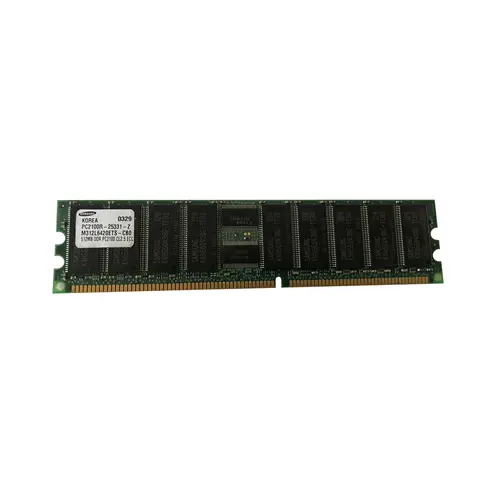
| Model | M312L6420ETS-CB0 |
|---|---|
| Product Type | Memory Module |
| Compliance Standards | EU RoHS,FCC |
| Memory Capacity | 512 MB |
| Memory Technology | DDR |
| Product Voltage | 2.5V |
| RAM Speed | 266MHz |
| RAM Standard | DDR-266/PC-2100 |
| Error Identifying | ECC |
| Signal Type | Registered |
| Column Access Strobe (CAS) | CL2.5 |
| Rank | Single Rank x4 |
| Quantity of Pins | 184-pin |
| RAM Genre | RDIMM |
This is a server-grade Registered ECC DDR module (RDIMM) specifically engineered for legacy enterprise platforms that demand uncompromising data integrity in memory-intensive workloads like virtualization and in-memory databases. Its single-rank x4 organization combined with a low CL2.5 CAS latency minimizes access delay, while the registered signal type and ECC ensure robust signal stability and error correction in fully populated multi-DIMM configurations.
1. ECC protection detects and corrects single-bit errors in real time, preserving data integrity for mission-critical database transactions and reducing costly server downtime.
2. Registered signal buffering stabilizes command and address lines across fully loaded memory channels, essential for maintaining peak reliability in dense multi-socket server configurations.
3. The modest half-gigabyte capacity per module suits dedicated lightweight appliances or embedded server nodes where deterministic, power-efficient operation outweighs raw density.
4. A 266 MHz clock drives consistent PC-2100 throughput, delivering predictable bandwidth that keeps legacy enterprise workloads streaming without unexpected I/O stalls.
5. Single Rank x4 organization minimizes bus contention and electrical load, providing the clean signal margins required for error-free operation in always-on service environments.
Targeting legacy server platforms that still demand uncompromising reliability, the M312L6420ETS-CB0 is a DDR-266 Registered DIMM with ECC, and its four defining characteristics directly address the operational pain points of IT environments where data integrity and continuous uptime are non-negotiable.
First, Error Correcting Code (ECC) is the silent safeguard in memory-intensive virtualization clusters. When a hypervisor runs dozens of VMs on a single physical host, even a single bit flip caused by background radiation can silently corrupt a database transaction or kernel data. This module’s ECC engine detects and corrects such single-bit errors in real time, literally transforming a potential catastrophic crash into a routine, logged event—meaning your virtualized services stay up and financial records remain accurate. Second, the Registered buffer is not just a specification; it decouples the memory chips from the memory controller’s electrical load. In a dense 2U server fully populated with DIMMs to run an in-memory database like Redis or an old SAP instance, unbuffered modules would suffer signal degradation, causing intermittent failures. The register re-drives clean signals across all ranks, enabling stable operation at full capacity so your mission-critical data caches don’t evaporate mid-query. Third, the CL2.5 low latency directly translates into faster column access, shaving cycles off every data retrieval sequence. For a latency-sensitive application such as a high-frequency trading database engine, this consistent low-latency response translates into quicker transaction closure and a measurable competitive advantage. Finally, the Single Rank x4 organization optimizes command bus loading, reducing electrical contention on the channel. This means even at the modest 512 MB density, the module delivers predictable bandwidth without contention spikes, preventing the jitter that can delay real-time analytics jobs. Together, these features don’t just store data—they preserve the economic value of every byte your aging infrastructure processes, ensuring your legacy investment remains operationally sound while sidestepping the hidden costs of silent data corruption and unplanned downtime.
General Virtualization
This legacy DDR-266 RDIMM provides only 512 MB per module, severely limiting guest density. For light hypervisor deployments (e.g., VMware ESX 2.x era), install modules in matched pairs per CPU socket to enable interleaved memory for reliability. Six or more modules per node (3 GB total) is the practical minimum for hosting two to three lightweight VMs. Always populate identical modules to maintain ECC scrubbing and registered signaling integrity.
In-Memory Database
A 512 MB single-rank module constrains in-memory datasets to small lookup tables or caching layers. Clustered configurations with four modules per board (2 GB total) can serve very narrow workloads like session stores, but real-time analytics platforms demand far more capacity. Deploy the maximum socket population supported by the chipset (often four to six slots) to squeeze every megabyte, and expect to swap frequently if data exceeds physical memory.
High-Performance Computing (HPC)
HPC clusters of the DDR-266 era valued low-latency access over capacity. Populate all memory channels with identical RDIMMs to achieve optimal bank interleaving and sustained bandwidth. A typical compute node would host four to eight modules (2–4 GB) for MPI workloads; the CL2.5 latency offered a minor edge in bursty floating-point operations. Pair with dual-processor boards and balance DIMMs across both memory risers to avoid NUMA penalties, but acknowledge that node count—not per-node RAM—was the scaling lever.
Rigorously tested server DIMM; compatible with Dell PowerEdge 2650, HP DL360 G2, IBM x345.
Q: Can I mix this M312L6420ETS-CB0 with other memory modules of different brands or speeds?
A: Mixing Registered ECC modules with unbuffered or non-ECC memory is not recommended and may prevent booting. For server stability, always use identical modules with the same speed, rank, and timings.
Q: Is this memory compatible with my system?
A: This module is designed for server platforms based on Intel E7500/E7501 or AMD-760MPX chipsets. Verify that your board supports 184-pin DDR Registered ECC (RDIMM) at PC-2100 before purchase.
Q: What is the recommended DIMM population order for optimal performance?
A: Populate identical modules in matched pairs per channel, starting with the slots furthest from the CPU. Always consult your server board's manual to follow its registered DIMM population sequence for balanced interleaving.
Q: Does this module support overclocking or XMP profiles?
A: No. This is an enterprise-grade Registered ECC module designed for 24/7 stability at JEDEC standard DDR-266 (PC-2100) speeds. It does not support overclocking or XMP profiles.
Q: What warranty and typical failure rate can I expect?
A: This module is covered by a one-year warranty. As a rigorously tested enterprise component, its typical annualized failure rate (AFR) is well below 0.5% under normal server operating conditions.