











 Secure payments
Standard refund policy
Trade Assurance
Secure payments
Standard refund policy
Trade Assurance
| Product Type | Memory Module |
|---|---|
| Memory Capacity | 16 GB |
| Memory Technology | DDR5 |
| Product Voltage | 1.1 V |
| RAM Speed | 4800 MHz |
| RAM Standard | DDR5-4800/PC5-38400 |
| Error Identifying | ECC |
| Signal Type | Registered |
| Column Access Strobe (CAS) | CL40 |
| Rank | Single Rank x8 |
| Quantity of Pins | 288-pin |
| RAM Genre | RDIMM |
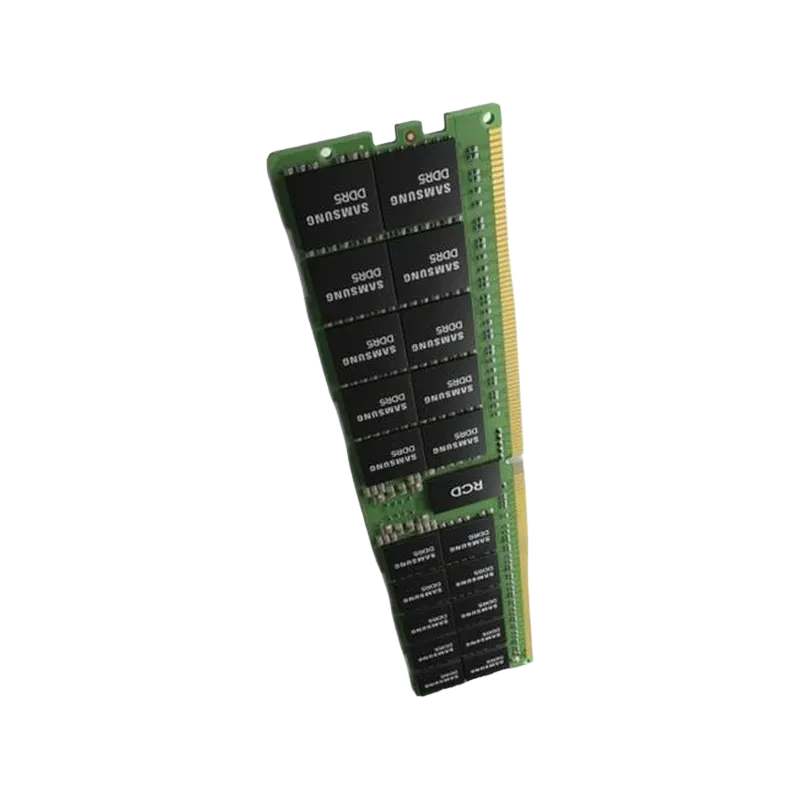
This DDR5-4800 Registered DIMM with ECC is engineered for server platforms, delivering the data integrity and reliability essential for virtualization, in-memory databases, and mission-critical enterprise workloads. Its single-rank x8 configuration enhances signal integrity at 4800 MT/s while the registered protocol stabilizes high-capacity memory channels, ensuring consistent performance under sustained heavy loads.
1. 16GB capacity per stick empowers dense server configurations, allowing hundreds of lightweight containers or dozens of VMs to run concurrently without memory starvation.
2. DDR5 technology accelerates in-memory computing and AI training pipelines by drastically raising internal bank groups, delivering consistent low-latency throughput under sustained parallel access.
3. ECC protection silently detects and corrects single-bit errors in real time, preserving data integrity for 24/7 transactional databases and long-running scientific computations.
4. Registered signal buffering stabilizes command and address lines across fully loaded memory channels, ensuring reliable operation even when all DIMM slots are populated in multi-socket servers.
5. 4800 megatransfers per second unlocks higher memory bandwidth, keeping fast-growing working sets of virtualized workloads and real-time analytics fed without stalling CPU cores.
The M321R2GA3BB0-CQKDG is a 16GB DDR5-4800 RDIMM engineered for enterprise servers, and its four key features address critical data center pain points. First, its 38.4GB/s bandwidth directly alleviates memory contention in virtualization clusters hosting hundreds of VMs. Second, the integrated ECC corrects single-bit errors in real time—indispensable for an in-memory database like Redis or SAP HANA, where a single bit flip can corrupt ledger data or cause an application crash. Third, the registered logic (RDIMM) buffers command and address lines, enabling the population of dense 16-DIMM configurations without signal degradation; this translates to unwavering uptime in a high-availability hypervisor farm. Finally, the 1.1V operating voltage and Single Rank x8 organization lower power draw and deliver predictable access latencies, which reduces cooling operating expenses and keeps response times consistent under mixed read-write loads. In short, every specification is purpose-built for resilient, scalable server performance.
General Virtualization
For dense virtualized workloads, balance capacity and bandwidth. Populate all memory channels with one 16GB RDIMM per channel (1DPC) to sustain full DDR5-4800 speed; a dual-socket server with 16 channels yields 256GB. For heavier overcommit, deploy two DIMMs per channel (2DPC) for 512GB, accepting a minor speed reduction. Registered DIMMs ensure signal integrity at these high densities.
In-Memory Database
Low latency and maximum capacity are critical. Start with a 1DPC configuration across all channels—eight 16GB modules yield 128GB at DDR5-4800—to minimize access times. Scale vertically by moving to 2DPC with 16 modules for 256GB; the slight frequency drop is offset by the larger working set. Always balance DIMMs symmetrically to enable channel interleaving.
High-Performance Computing
Maximum memory bandwidth is essential. Install one 16GB RDIMM per channel (1DPC) in every populated channel to sustain DDR5-4800; a dual-socket server with 16 channels provides 256GB. Add a second DIMM per channel only when per-core capacity limits are hit, and then upgrade all channels identically to preserve balance and uniform latency.
Rigorously tested, compatible with Dell PowerEdge R760, HPE DL380 Gen11, Lenovo SR650 V3, and more.
Q: Can I mix this M321R2GA3BB0-CQKDG with other memory modules of different brands or speeds?
A: No, mixing this module with other brands or speeds is not advised. It may cause instability or POST failures. For servers, always use identical part numbers to guarantee signal integrity and reliable performance.
Q: Is this memory compatible with my server?
A: This DDR5‑4800 Registered DIMM is built for servers with Intel Xeon Scalable or AMD EPYC platforms supporting DDR5 RDIMMs. Verify your system's QVL and BIOS revision to ensure validated compatibility.
Q: What is the recommended DIMM population order for optimal performance?
A: Follow your server's memory population guide. Typically, balance channels per CPU and populate the farthest slots first (e.g., A1, B1, C1). Consult the manual to maximize bandwidth and minimize latency.
Q: Does this module support overclocking or XMP profiles?
A: No, this server RDIMM does not support overclocking or XMP. It runs strictly at JEDEC DDR5‑4800 CL40 to ensure maximum stability and ECC integrity in mission‑critical enterprise environments.
Q: What warranty and typical failure rate can I expect?
A: This module includes a 1‑year warranty. Enterprise DDR5 RDIMMs typically deliver an annualized failure rate below 0.5% due to stringent testing and premium component selection. Contact us for extended support options.