











 Secure payments
Standard refund policy
Trade Assurance
Secure payments
Standard refund policy
Trade Assurance
| Product Type | Memory Module |
|---|---|
| Memory Capacity | 16 GB |
| Memory Technology | DDR5 |
| Product Voltage | 1.1 V |
| RAM Speed | 4800 MHz |
| RAM Standard | DDR5-4800/PC5-38400 |
| Error Identifying | ECC |
| Signal Type | Registered |
| Column Access Strobe (CAS) | CL40 |
| Rank | Single Rank x8 |
| Quantity of Pins | 288-pin |
| RAM Genre | RDIMM |
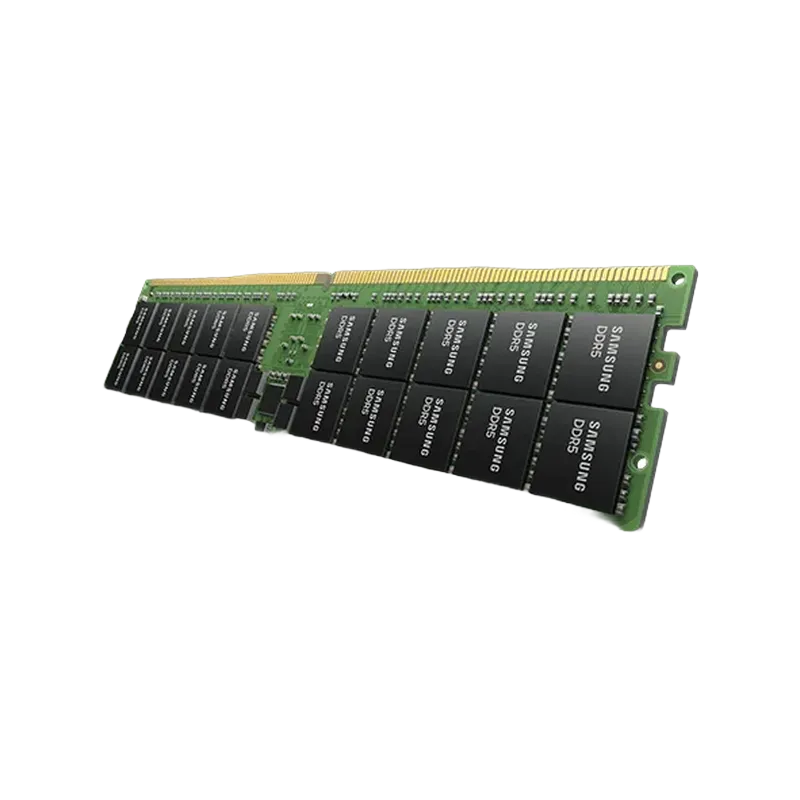
This Samsung M321R2GA3BB0-CQKMG is a 16GB DDR5-4800 Registered DIMM with ECC, specifically engineered for server platforms handling mission-critical workloads such as virtualization and in-memory databases. Its registered signal topology ensures robust signal integrity across densely populated memory channels, while the single-rank x8 configuration, combined with on-die ECC and CL40 latency, maximizes data reliability and throughput under sustained enterprise loads.
1. 16GB capacity per module provides the density needed to pack more virtual machines into each server, reducing hardware footprint while maintaining smooth multi-tenant performance.
2. DDR5 technology delivers higher burst lengths and bank counts, unlocking the memory parallelism required by real-time analytics and in-memory databases under heavy concurrent access.
3. PC5-38400 peak bandwidth keeps data-hungry enterprise workloads flowing, preventing memory bottlenecks during large-scale transactional processing and virtualization spikes.
4. ECC error correction safeguards financial, medical, and cloud service data from silent corruption, preserving integrity across always-on deployments where undetected bit flips are unacceptable.
5. Registered signaling buffers the command and address bus, enabling reliable population of all memory channels at scale—a prerequisite for building stable, high-capacity rack servers.
The M321R2GA3BB0-CQKMG is a server-grade DDR5 RDIMM whose four design pillars directly solve critical data-center pain points. First, its 4800 MT/s speed and 38.4 GB/s bandwidth fuel in-memory databases like Redis, where every nanosecond of latency saved boosts transactions per second and user experience. Second, ECC error correction continuously scrubs single-bit errors, preventing silent data corruption in virtualization clusters—an uncorrected bit flip can crash hypervisors or alter financial records undetectably. Third, the registered clock driver buffers command/address signals, allowing you to maximize capacity and populate multiple DIMMs per channel without signal degradation, a must for scaling hyperconverged systems to terabytes of RAM. Fourth, the single-rank x8 architecture and 1.1V operating voltage work together: the single rank minimizes access latency and optimizes command bus efficiency, while the low voltage cuts thermal load and energy costs in high-density deployments. This translates into uncompromised stability for your virtual machines and faster, more predictable performance for your data-intensive applications.
Server-class memory: 16 GB DDR5-4800 ECC Registered DIMM (single rank). Capacity planning:
General Virtualization
Populate one 16 GB module per memory channel to maintain full 4800 MT/s speed. A typical dual-socket server with eight channels per CPU yields 128 GB, sufficient for moderate VM density. To scale to 256 GB, add a second identical DIMM per channel; expect a slight frequency drop (e.g., 4400 MT/s) but stable operation.
In-Memory Database
Maximize capacity by installing two 16 GB DIMMs per channel (2DPC). A dual‑processor 8‑channel server holds 32 modules, providing 512 GB for large in‑memory datasets. The reduced 2DPC speed is acceptable when capacity is the priority, and ECC integrity remains essential.
High-Performance Computing (HPC)
Preserve peak bandwidth and low latency by using exactly one 16 GB DIMM per channel (1DPC), delivering 128 GB per socket at the rated 4800 MT/s. Avoid a second rank to keep latencies minimal. For memory‑intensive HPC, choose servers with more channels rather than adding second DIMMs.
Rigorously tested server memory, compatible with Dell PowerEdge R760, HPE ProLiant DL380 Gen11, Lenovo ThinkSystem SR650 V3.
Q: Can I mix this M321R2GA3BB0-CQKMG with other memory modules of different brands or speeds?
A: Mixing RDIMMs from different brands or speeds is not recommended. It may cause POST failures or instability, as servers require uniform rank, timing, and speed across all channels for validated performance.
Q: Is this memory compatible with my Intel or AMD server platform?
A: This DDR5-4800 RDIMM with ECC is compatible with most Intel Xeon Scalable (4th/5th Gen) and AMD EPYC 9004/8004 platforms supporting registered DDR5. Verify your system’s memory QVL for specific compatibility.
Q: What is the recommended DIMM population order for optimal performance?
A: Follow your server’s manual: generally populate identical DIMMs symmetrically per memory channel, starting from the farthest slot from the CPU. Balanced configuration across memory controllers maximizes bandwidth and reduces contention.
Q: Does this module support overclocking or XMP profiles?
A: No. This is a JEDEC-compliant server RDIMM operating at standard DDR5-4800 timings. It does not support overclocking or XMP, as enterprise memory prioritizes stability and data integrity over frequency adjustments.
Q: What warranty and typical failure rate can I expect?
A: This module includes a 1-year warranty. Annualized failure rate (AFR) is typically under 0.5% for enterprise RDIMMs, reflecting high reliability under specified operating conditions. Extended warranties may be available from resellers.