











 Secure payments
Standard refund policy
Trade Assurance
Secure payments
Standard refund policy
Trade Assurance
| Product Type | Memory Module |
|---|---|
| Memory Capacity | 16 GB |
| Memory Technology | DDR5 |
| Product Voltage | 1.1 V |
| RAM Speed | 5600 MHz |
| RAM Standard | DDR5-5600/PC5-44800 |
| Error Identifying | ECC |
| Signal Type | Registered |
| Column Access Strobe (CAS) | CL46 |
| Rank | Dual Rank |
| Quantity of Pins | 288-pin |
| RAM Genre | RDIMM |
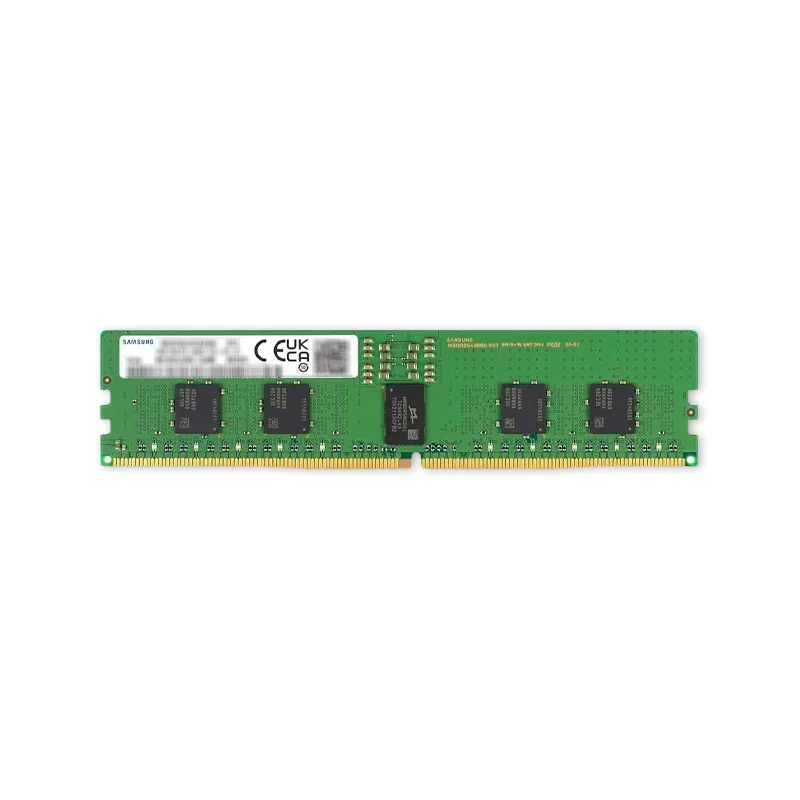
This DDR5-5600 Registered ECC RDIMM in a 16GB dual-rank configuration is engineered for enterprise server platforms running virtualization, in-memory databases, and data-critical workloads where sustained reliability is essential. The registered signal buffering stabilizes command/address lines under high-capacity populations, while ECC error correction and the dual-rank organization maximize data integrity and memory bandwidth for 24/7 operation.
1. ECC protection automatically detects and corrects single-bit errors, safeguarding transactional data integrity in mission-critical enterprise databases and financial workloads.
2. Registered signal buffering stabilizes command and address lines, enabling dense memory configurations essential for large-scale virtualization without compromising host reliability.
3. Dual Rank organization interleaves memory banks to maintain peak channel utilization, reducing latency spikes during concurrent virtual machine memory accesses.
4. High transfer speed elevates available memory bandwidth, directly accelerating in-memory analytics and real-time processing under heavy multi-tenant cloud environments.
5. DDR5 technology introduces on-die ECC and improved power architecture, bolstering overall subsystem resilience while sustaining the throughput demanded by next-generation server CPUs.
When your infrastructure runs mission-critical workloads, memory is never just a component — it is the foundation of uptime and performance. The Samsung M321R2GA3PB0-CWMKJ is a 16 GB DDR5-5600 RDIMM engineered precisely for this reality, and its four defining characteristics directly address the pain points of modern server environments. ECC is your silent safeguard against bit-flip errors that can corrupt financial transactions or silently degrade data in long-running in-memory databases like SAP HANA; it means the difference between catching a single-bit error in flight and uncovering corrupted records weeks later. The registered signal type uses an onboard buffer to stabilize command and address lines, enabling you to fully populate channels with high-density modules without risking signal integrity — a non-negotiable requirement in dense virtualization clusters where dozens of VMs compete for resources. Dual rank organization leverages rank interleaving so that while one rank completes a command, the other can already be accessed, visibly improving throughput in streaming analytics and large Redis caches. And the 1.1 V operating voltage, exceptionally low for DDR5 at 5600 MT/s with CL46 timing, cuts thermal load in rack after rack, reducing cooling costs and extending component lifespan in always-on deployments. This is not just a module; it is a reliability contract your data center can bank on.
General Virtualization
For a balanced virtualization host, deploy modules in multiples of 8 to populate all memory channels evenly and maximize bandwidth. A common configuration uses eight 16 GB RDIMMs (128 GB total) to comfortably run 20–30 moderate VMs, leaving room for memory overcommitment. Always pair identical dual‑rank DIMMs per channel to maintain reliable ECC and registered signal integrity.
In‑Memory Database
In‑memory databases demand both high capacity and low latency, making dual‑rank 16 GB RDIMMs an efficient building block. Install at least 16 modules (256 GB) in a two‑socket server to keep the entire dataset resident; scaling to 512 GB or 1 TB is straightforward using additional identical DIMMs. Populate all channels with uniform DIMMs to sustain the 5600 MT/s speed and avoid NUMA penalties.
High‑Performance Computing (HPC)
HPC nodes require peak memory bandwidth, so assign one 16 GB dual‑rank DIMM to each of the eight or twelve memory channels — yielding 128–192 GB per node. This one‑DPC (DIMM per channel) approach allows the bus to run at the full DDR5‑5600 rate, preventing clock downshifts. For memory‑capacity‑bound codes, expand to two DIMMs per channel while accepting a slight speed reduction, but keep all modules identical dual‑rank RDIMMs to preserve ECC and synchronous operation.
Rigorously tested, compatible with servers: Dell PowerEdge R760, HPE ProLiant DL380 Gen11, Lenovo ThinkSystem SR650 V3.
Q: Can I mix this M321R2GA3PB0-CWMKJ with other memory modules of different brands or speeds?
A: Mixing is not recommended. For server platforms, memory consistency is critical. Use identical modules with the same rank, speed, and timings to avoid stability issues and ensure reliable operation.
Q: Is this memory compatible with my system?
A: It is compatible with servers supporting DDR5 Registered ECC modules, such as Intel Xeon Scalable (4th Gen) or AMD EPYC 9004 series platforms. Verify your board's RDIMM support and memory QVL.
Q: What is the recommended DIMM population order for optimal performance?
A: Populate DIMMs evenly across all memory channels per CPU, following your server motherboard’s population guide. Typically, use blue slots first to maximize interleaving and bandwidth.
Q: Does this module support overclocking or XMP profiles?
A: No. As a JEDEC-compliant server RDIMM, this module runs at its standard DDR5-5600 specification. It does not support overclocking, XMP, or other non-JEDEC profiles.
Q: What warranty and typical failure rate can I expect?
A: This module comes with a 1-year warranty. Enterprise-grade RDIMMs like this exhibit very low failure rates due to rigorous validation and built-in ECC, ensuring high reliability.