











 Secure payments
Standard refund policy
Trade Assurance
Secure payments
Standard refund policy
Trade Assurance
| Product Type | Memory Module |
|---|---|
| Memory Capacity | 32 GB |
| Memory Technology | DDR5 |
| RAM Speed | 4800 MHz |
| RAM Standard | DDR5-4800/PC5-38400 |
| Error Identifying | ECC |
| Signal Type | Registered |
| Column Access Strobe (CAS) | CL40 |
| Rank | Dual Rank x8 |
| Quantity of Pins | 288-pin |
| RAM Genre | RDIMM |
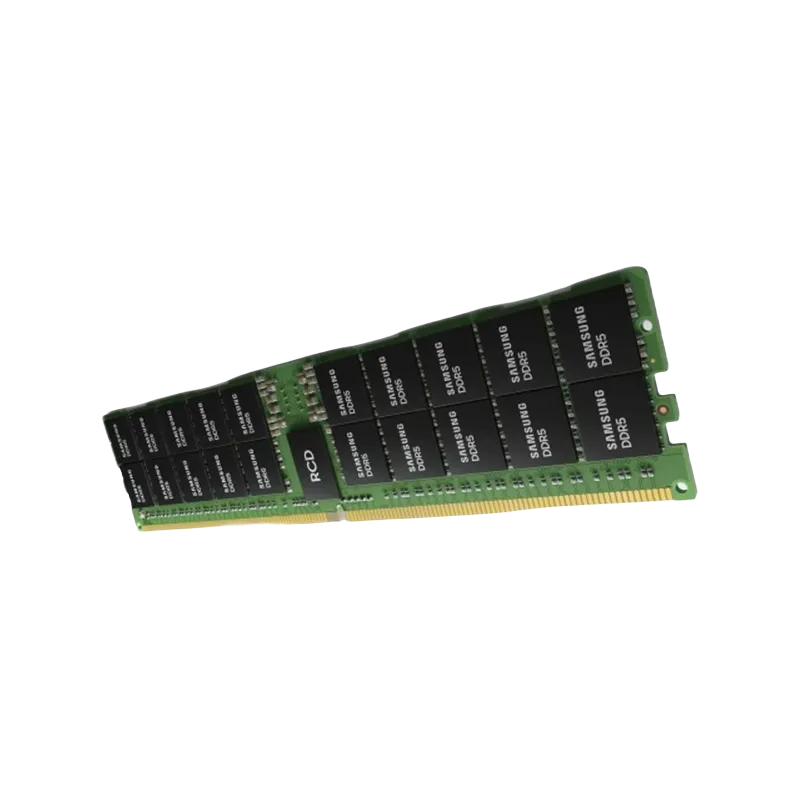
This Samsung 32GB DDR5-4800 Registered ECC RDIMM (M321R4GA3BB6-CQKMS) is engineered for enterprise servers and high-end workstations, excelling in virtualization, in-memory databases, and mission-critical workloads where data integrity is paramount. Its dual-rank x8 configuration maximizes interleaving efficiency for higher sustained bandwidth, while registered signaling and full ECC protection actively correct single-bit errors and ensure signal stability across densely populated memory channels.
1. A 32-gigabyte capacity per module provides ample headroom for virtual machine consolidation, allowing data centers to pack more workloads onto each server without sacrificing memory resources.
2. DDR5 technology doubles the burst length and delivers higher bandwidth per core, which directly accelerates in-memory databases and analytics in multi-socket server deployments.
3. 4800 megatransfers per second speeds elevate peak throughput, reducing latency in large-scale transactional applications and speeding data movement between processors and memory.
4. ECC error correction continuously detects and corrects single-bit flips, shielding mission-critical workloads from silent data corruption that could compromise financial or scientific results.
5. Registered signaling buffers clock and command buses, enabling server platforms to support massive memory populations with unwavering signal integrity and long-term reliability under continuous operation.
The Samsung M321R4GA3BB6-CQKMS is a 32GB DDR5-4800 Registered DIMM purpose-built for next-generation servers, and its four defining characteristics directly resolve the most critical pain points in enterprise data centers. First, the registered architecture places a clock driver on the module, stabilizing signal integrity when all memory channels are populated. In a dense virtualization cluster running dozens of VMs, this prevents the signal degradation that leads to mysterious hypervisor crashes and costly service outages. Second, on-die ECC corrects single-bit errors caused by cosmic radiation or electrical noise; a silent corruption that otherwise flips a financial transaction or poisons an in-memory database record will be transparently remedied. Third, the dual-rank x8 design enables rank interleaving, allowing the memory controller to access one rank while the other precharges. For an in-memory analytics engine like Redis or SAP HANA handling thousands of concurrent queries, this reduces latency and boosts effective bandwidth beyond what a single-rank DIMM can deliver. Finally, DDR5-4800 throughput ensures that these critical workloads operate at peak speed without compromise. For infrastructure managers, this module means uncompromised data integrity, scalability, and deterministic performance under the most demanding virtualized and data-intensive conditions.
General Virtualization
For a general-purpose virtualization host, install one 32GB DDR5-4800 RDIMM in each memory channel of a dual-socket server—16 modules provide 512GB. This 1DPC layout preserves the full 4800MT/s speed and low CL40 latency, ideal for dozens of VMs. ECC guards against data corruption, and you can expand later by adding a second DIMM per channel.
In-Memory Database
In-memory databases such as Redis and SAP HANA demand maximum capacity. Populate all 24 DIMM slots of a dual-socket server with 32GB RDIMMs to achieve 768GB. The dual-rank x8 design ensures lower latency through improved bank parallelism, while ECC maintains data integrity during constant writes. For more capacity, move to a four-socket node rather than mixing module sizes.
High-Performance Computing
HPC workloads thrive on bandwidth. Use one 32GB RDIMM per memory channel (16 sticks, 512GB) to sustain the full 4800MT/s data rate. The registered dual-rank design maintains signal quality and low latency for floating-point-intensive codes. Should capacity become a bottleneck, move to 2DPC, accepting the frequency reduction to approximately 4000MT/s.
Server RDIMM rigorously tested and compatible with Dell PowerEdge R760, HPE ProLiant DL380 Gen11, Lenovo SR650 V3.
Q: Can I mix this M321R4GA3BB6-CQKMS with other memory modules of different brands or speeds?
A: Mixing is not recommended for server environments. For guaranteed stability and signal integrity, always populate identical part numbers with matching rank, speed, and DRAM revision.
Q: Is this memory compatible with my system?
A: This DDR5 RDIMM with ECC requires a platform supporting Registered DIMMs, such as 4th Gen Intel Xeon Scalable or AMD EPYC 9004 series. Verify your motherboard's qualified vendor list.
Q: What is the recommended DIMM population order for optimal performance?
A: Follow your server board's manual. Typically, populate identical DIMMs per channel starting with the farthest slot from the CPU, balancing across all memory channels for maximum throughput.
Q: Does this module support overclocking or XMP profiles?
A: No. This is a JEDEC-compliant, registered server memory module. It operates exclusively at fixed standard speeds (DDR5-4800) without XMP or overclocking support to ensure data center reliability.
Q: What warranty and typical failure rate can I expect?
A: This module includes a 1-year warranty. Built with server-grade components and rigorous validation, its annualized failure rate (AFR) is typically below 0.5% under specified enterprise conditions.