











 Secure payments
Standard refund policy
Trade Assurance
Secure payments
Standard refund policy
Trade Assurance
| Product Type | Memory Module |
|---|---|
| Memory Capacity | 32 GB |
| Memory Technology | DDR5 |
| Product Voltage | 1.1 V |
| RAM Speed | 4800 MHz |
| RAM Standard | DDR5-4800/PC5-38400 |
| Error Identifying | ECC |
| Signal Type | Registered |
| Column Access Strobe (CAS) | CL40 |
| Rank | Dual Rank x4 |
| Quantity of Pins | 288-pin |
| RAM Genre | RDIMM |
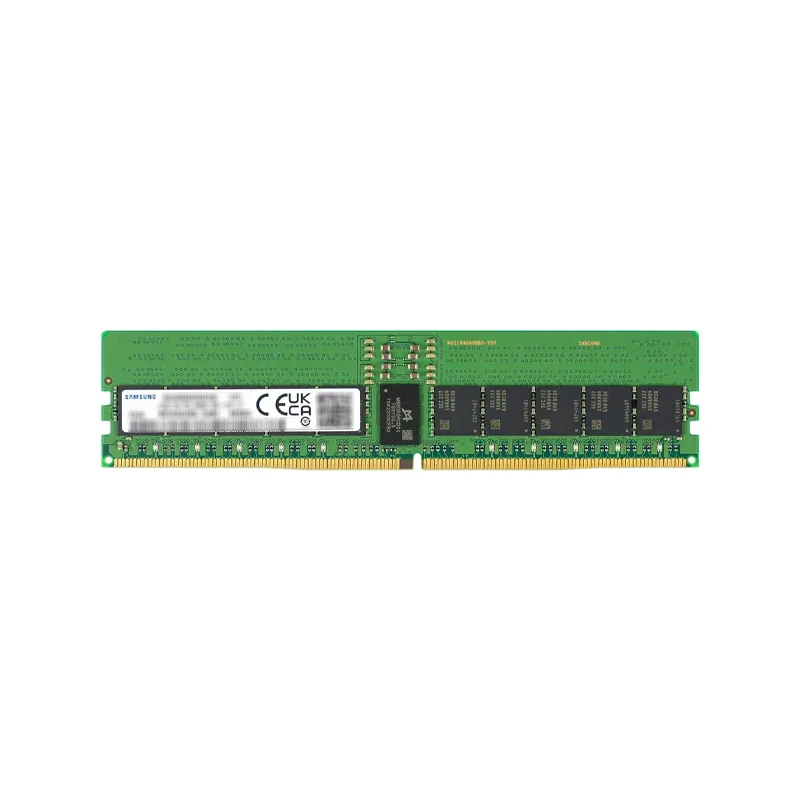
This DDR5-4800 Registered ECC module with a Dual Rank x4 configuration ensures robust data integrity and signal stability for mission-critical server platforms, making it an ideal choice for memory-intensive workloads like virtualization and in-memory databases. The 288-pin RDIMM leverages error correction and registered buffering to sustain reliable operation in high-density deployments, while the dual-rank design enhances bandwidth efficiency through rank interleaving.
1. DDR5 memory technology doubles the bank group count over previous generations, allowing simultaneous access to larger datasets and accelerating in-memory database operations under heavy enterprise workloads.
2. On-die ECC corrects single-bit errors transparently, preserving long-term data integrity and system uptime critical for virtualization clusters and financial transaction processing.
3. Registered signal buffering stabilizes address and command lines across fully loaded memory channels, enabling reliable operation at high capacities in multi-socket server deployments.
4. Dual Rank x4 organization interleaves data across two ranks of four-bit-wide DRAMs, keeping memory channels saturated to maintain predictable VM responsiveness during peak consolidation.
5. A base frequency of 4800MT/s delivers the headroom for sustained bandwidth in real-time analytics and AI inference, ensuring consistent throughput under concurrent tenant loads.
As a DDR5-4800 Registered DIMM with ECC, the M321R4GA3BB6-CQKVG is purpose-built for modern server infrastructures where stability and performance are non-negotiable. Its four defining traits directly confront the real-world struggles of scaling virtualized clusters and running in-memory databases. The 4800 MT/s speed provides a substantial 38.4 GB/s of bandwidth per module, so when a hypervisor hosts dozens of VMs, memory saturation no longer throttles your workloads—web front-ends and containerized microservices stay responsive during traffic spikes. ECC error correction adds a hard defense against silent data corruption caused by background radiation, which in a financial database or a Redis cache could mean the difference between an accurate transaction and a catastrophic, unreported fault. The registered signal buffer permits the server to fully populate all channels with high-capacity DIMMs without electrical loading issues, allowing you to confidently scale to hundreds of gigabytes for memory-hungry applications like SAP HANA. Finally, the dual-rank x4 organization interleaves banks, lowering effective latency and improving throughput for the heavy random-access patterns of real-time analytics. For your enterprise, these features mean hardened data integrity, higher virtual machine density, and faster query responses—ultimately protecting your revenue by eliminating avoidable downtime.
Server Memory Identified
The specifications—DDR5-4800, 1.1V, ECC, Registered (RDIMM), Dual Rank x4, 288-pin—clearly classify this as a server-grade module. Below is the capacity planning guidance for typical server workloads.
General Virtualization
For a consolidated virtualization host running multiple VMs, populate at least eight identical 32GB RDIMMs (256GB total) across all memory channels to maximize bandwidth and leave headroom for memory overcommit. A balanced dual-rank configuration per channel ensures high throughput and reliable ECC protection for mixed workloads.
In-Memory Database
In-memory databases like Redis or SAP HANA demand large, low-latency footprints and absolute data integrity. Deploy 16 or more of these modules per node (512GB+) to hold entire datasets in RAM, keeping all channels populated for peak bandwidth. Dual‑rank x4 RDIMMs deliver the required density and error correction without compromising access speed.
High-Performance Computing
HPC clusters benefit from high memory bandwidth and capacity per node to feed parallel processes. Equip each compute node with 16 or 24 modules (512GB–768GB), ensuring full channel population and a uniform dual-rank configuration for optimal interleaving. ECC registration is critical here to prevent silent data corruption during long-running simulations.
Rigorously tested for seamless compatibility with Dell PowerEdge R760, HPE ProLiant DL380 Gen11, Lenovo ThinkSystem SR650 V3.
Q: Can I mix this M321R4GA3BB6-CQKVG with other memory modules of different brands or speeds in my server?
A: Mixing modules is strongly discouraged for server environments. To ensure signal integrity and system stability, always populate channels with identical M321R4GA3BB6-CQKVG RDIMMs. Mismatched speeds or ranks can cause POST failures.
Q: Is this memory compatible with my Intel Xeon Scalable or AMD EPYC server platform?
A: This DDR5-4800 ECC RDIMM is designed for Intel Xeon Scalable (Sapphire Rapids) and AMD EPYC (Genoa) platforms. Verify your server's qualified vendor list (QVL) to confirm compatibility with these 32GB Dual Rank x4 modules.
Q: What is the recommended DIMM population order for optimal performance with these RDIMMs?
A: Follow your server motherboard’s population guide. Typically, balance identical modules across memory channels, filling the furthest slot per channel first. Symmetric configurations maximize bandwidth and maintain interleaving for dual-rank x4 RDIMMs.
Q: Does this module support overclocking or XMP profiles for increased performance?
A: No. This RDIMM strictly adheres to JEDEC DDR5-4800 standards. Server memory prioritizes data integrity and 24/7 stability over speed; overclocking or XMP is not supported and could compromise ECC protection.
Q: What warranty and typical failure rate can I expect with these enterprise memory modules?
A: This module includes a one-year warranty. As an enterprise-grade RDIMM with rigorous screening, it exhibits a typical annualized failure rate (AFR) well below 0.5% under specified operating conditions.