











 Secure payments
Standard refund policy
Trade Assurance
Secure payments
Standard refund policy
Trade Assurance
| Product Type | Memory Module |
|---|---|
| Memory Capacity | 64 GB |
| Memory Technology | DDR5 |
| Product Voltage | 1.1 V |
| RAM Speed | 5600 MHz |
| RAM Standard | DDR5-5600/PC5-44800 |
| Error Identifying | ECC |
| Signal Type | Registered |
| Column Access Strobe (CAS) | CL46 |
| Rank | Dual Rank x4 |
| Quantity of Pins | 288-pin |
| RAM Genre | RDIMM |
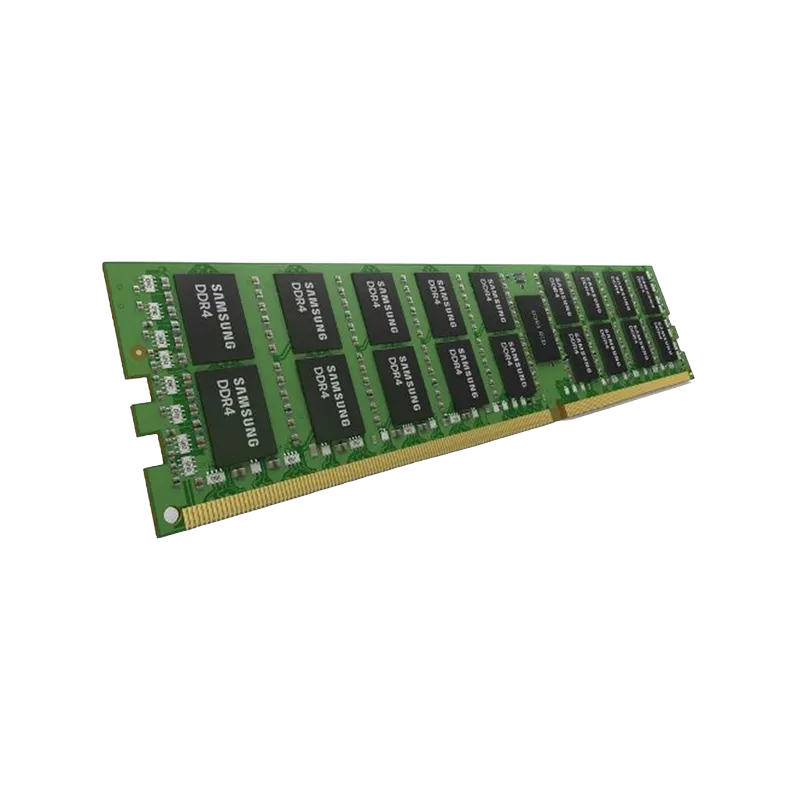
This 64GB DDR5-5600 Registered ECC module, configured as Dual Rank x4, is purpose‑built for server platforms running memory‑intensive workloads such as virtualization and in‑memory databases. Its dual‑rank organization boosts data access rates via rank interleaving, while full ECC and registered signaling ensure uncompromising data integrity and signal stability in dense multi‑DIMM configurations.
1. A 64GB density per module allows IT architects to dramatically increase memory capacity per server node, enabling more virtual machines and larger in-memory databases without sacrificing rack space.
2. The 5600MT/s DDR5 data rate delivers substantially higher bandwidth, accelerating real-time analytics, AI inference pipelines, and high-frequency transactional workloads across the data center.
3. On-die ECC and side-band error correction virtually eliminate silent data corruption, a non-negotiable safeguard for financial modeling, scientific computation, and long-running mission-critical services.
4. Registered signal topology strengthens signal integrity across multi-DIMM channels, making it feasible to populate all slots at maximum speed for massive scale-out memory configurations without stability penalties.
5. Dual Rank x4 organization interleaves access across internal banks to keep the memory channel fully utilized, yielding more predictable low-latency performance for heavily consolidated virtualized environments.
The module M321R8GA0EB0-CWMKJ is unmistakably a server-grade memory solution: a 64GB DDR5-RDIMM operating at 5600MT/s. For your data center, its four defining characteristics translate directly into operational resilience and performance. Start with ECC, which actively corrects single-bit errors. In large-scale virtualization clusters, a silent bit-flip in a hypervisor can crash dozens of virtual machines; this ECC scrubs those errors before they cascade into outages. Next, the registered buffer stabilizes signal integrity, enabling you to fully populate densely configured 24-slot servers without boot-time training failures. The 64GB capacity, built on a dual-rank x4 design, is critical for in-memory databases like Redis or SAP HANA. Dual-rank interleaving allows the memory controller to access data across multiple pages in parallel, significantly boosting bandwidth for real-time analytics where microsecond latencies impact revenue. Finally, the 1.1V operation reduces thermal load across entire racks, slashing power and cooling costs. This module does not just store data; it underwrites the stability and velocity of your mission-critical workloads.
Capacity Planning Guide for 64GB DDR5-5600 ECC RDIMM
This memory module is a server-class DDR5 Registered DIMM with ECC, designed for data-center reliability. Leveraging dual-rank x4 organization and CL46 latency, it balances density and performance. The following scenarios outline optimal configurations.
General Virtualization
Populate all memory channels evenly to maximize bandwidth while scaling capacity—in a dual-socket server with eight channels per CPU, install one 64GB module per channel for 512GB total. This configuration avoids performance penalties from mixed channel populations and provides ample headroom for dozens of virtual machines without oversubscribing host memory.
In-Memory Database
Aggregate capacity is critical for datasets that must reside entirely in RAM. Fully populate all 24 or 32 DIMM slots across two sockets with identical dual-rank x4 64GB modules to reach 1.5TB–2TB, ensuring massive working sets for applications like SAP HANA. Stick to a single module type and rank to maintain cache-line interleaving efficiency and eliminate signal integrity issues, preserving ultra-low latency access.
High-Performance Computing
Sustained memory bandwidth per core is paramount for HPC workloads. Install exactly one 64GB RDIMM per DDR5 channel (e.g., 8 modules in an 8-channel platform) to achieve the highest rated 5600MT/s throughput with no speed downgrade from mixed loads. If larger node-level capacity is required, move to high-memory platforms that support more channels while keeping one DIMM per channel, avoiding the bandwidth drop that comes with two DIMMs per channel in top-speed configurations.
Rigorously validated server memory: compatible with Dell PowerEdge R760, HPE ProLiant DL380 Gen11, Lenovo ThinkSystem SR650 V3, etc.
Q: Can I mix this M321R8GA0EB0-CWMKJ with other memory modules of different brands or speeds?
A: Mixing is not recommended for registered server DDR5. Differing brands, speeds, or ranks may cause instability, POST failures, or degraded performance. Always use identical, validated modules for guaranteed reliability in multi-DIMM configurations.
Q: Is this memory compatible with my system?
A: This DDR5 RDIMM is designed for servers using Intel Xeon Scalable (Sapphire Rapids) or AMD EPYC 9004 series processors. Confirm your platform supports 64GB DDR5 5600MT/s RDIMM with ECC and that a BIOS update may be required.
Q: What is the recommended DIMM population order for optimal performance?
A: Follow your server motherboard's population guide precisely. Typically, populate identical, balanced sets per memory channel, starting with the furthest slot from the CPU. Symmetrical, interleaved population maximizes bandwidth and ensures reliable ECC operation.
Q: Does this module support overclocking or XMP profiles?
A: No, this JEDEC-compliant server module does not support overclocking or XMP. It operates strictly at the standard DDR5-5600 speed with fixed latencies to maintain stability, data integrity, and 24/7 enterprise reliability under ECC.
Q: What warranty and typical failure rate can I expect?
A: This module includes a one-year warranty. Built with premium, screened components for enterprise workloads, it exhibits an extremely low annualized failure rate typically below 0.5%, ensuring mission-critical reliability and minimal operational disruption.