











 Secure payments
Standard refund policy
Trade Assurance
Secure payments
Standard refund policy
Trade Assurance
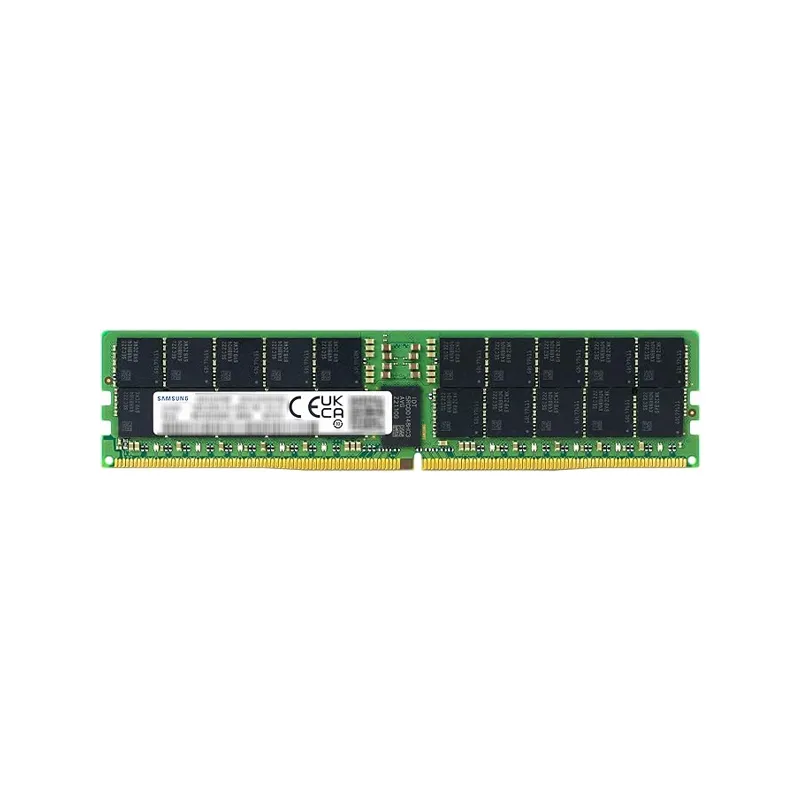
| Product Type | Memory Module |
|---|---|
| Memory Capacity | 128 GB |
| Memory Technology | DDR5 |
| Product Voltage | 1.1V |
| RAM Standard | DDR5-4800/PC5-38400 |
| Error Identifying | ECC |
| Signal Type | Registered |
| Column Access Strobe (CAS) | CL40 |
| Quantity of Pins | 288-pin |
| RAM Genre | RDIMM |
This 128GB DDR5-4800 Registered ECC RDIMM operates at a low 1.1V and delivers CL40 latency, purpose-built for data-intensive server workloads such as virtualization, in-memory databases, and enterprise analytics where registered signaling maintains signal integrity across high-density memory configurations. Its integrated ECC engine provides end-to-end data integrity protection, ensuring mission-critical reliability in rack and tower servers that demand non-stop operation.
1. High-density capacity enables massive virtualization workloads, allowing data centers to run more VMs per server and reduce footprint without sacrificing performance.
2. Next-generation DDR5 architecture doubles burst length and delivers superior bandwidth efficiency, accelerating in-memory databases and real-time analytics.
3. Headroom at 4800 megatransfers per second keeps CPU cores fed with data, smoothing out latency spikes in heavily consolidated environments.
4. End-to-end error correction detects and fixes bit flips in-flight, essential for preventing silent data corruption in financial transactions and long-running compute jobs.
5. Onboard registers buffer command and address signals, stabilizing multi-DIMM setups so that large memory footprints remain rock-solid under 24/7 operation.
The M321RAGA0B20 is a 128GB DDR5-4800 registered ECC module built for critical server workloads. Its four key traits solve real challenges. First, 128GB density lets a single node host far more virtual machines or consolidate large in-memory databases like SAP HANA, eliminating slow disk I/O and accelerating real-time analytics. Second, the Registered (RDIMM) buffer maintains signal integrity when populating all channels in dense virtualization clusters—this means you can scale to terabytes of RAM without stability issues. Third, integrated ECC silently corrects single-bit errors caused by cosmic radiation; in a financial transaction or healthcare database, this prevents silent data corruption that leads to application crashes and compliance failures. Fourth, operating at just 1.1V, the module delivers 38.4 GB/s of bandwidth with remarkable power efficiency, directly reducing energy costs in always-on data centers. For enterprise IT, this translates to higher VM density, absolute data integrity, and lower operational expenses.
General Virtualization
For virtualized environments, populate at least one 128 GB RDIMM per memory channel to balance capacity, bandwidth, and cost. In a typical dual-socket server with 16 channels, installing eight modules delivers 1 TB, while 16 modules provide 2 TB—ample for hosting dozens of virtual machines. Filling every channel with a single DIMM ensures optimal interleaving and avoids the latency penalties of two DIMMs per channel (2DPC).
In-Memory Database
In-memory databases thrive on maximum capacity and reliable data integrity. Equip all channels with one 128 GB module to reach 1–2 TB per node; for extreme datasets, move to 2DPC configurations, though the memory speed may drop. A four-socket server with 32 of these ECC registered DIMMs scales to 4 TB, keeping entire analytical workloads in DRAM and eliminating storage bottlenecks for Redis, SAP HANA, or similar engines.
High-Performance Computing
HPC workloads demand high sustained bandwidth per core. Populate every memory channel with one 128 GB RDIMM running at full DDR5-4800 speed—avoid 2DPC to maintain peak transfer rates. A dual-socket system built with 16 such modules yields 2 TB, supplying sufficient headroom for large-scale simulations, computational fluid dynamics, and weather modeling without sacrificing the low-latency, error-corrected performance that registered ECC memory provides.
Rigorously tested, compatible with Dell PowerEdge R760, HPE ProLiant DL380 Gen11, Lenovo ThinkSystem SR650 V3, and more.
Q: Can I mix this M321RAGA0B20 with other memory modules of different brands or speeds?
A: Mixing RDIMMs with different brands, speeds, or ranks is not recommended in servers. It often causes stability issues and defaults to the lowest common speed, undermining the reliability expected from registered ECC memory.
Q: Is this memory compatible with my Intel Xeon or AMD EPYC server platform?
A: This DDR5-4800 RDIMM is validated for mainstream Intel Xeon Scalable (Sapphire Rapids) and AMD EPYC (Genoa/Bergamo) platforms. Please confirm your board’s BIOS supports 128GB modules before purchase.
Q: What is the recommended DIMM population order for optimal performance?
A: Populate identical DIMMs in balanced configurations, starting with the farthest slot from the CPU per channel. Follow your server’s memory population guide to ensure all memory channels are utilized for maximum bandwidth.
Q: Does this module support overclocking or XMP profiles?
A: No. This is a JEDEC-compliant registered DIMM designed for server reliability. It does not support overclocking or XMP profiles; it runs at fixed DDR5-4800 with CL40 timings to ensure data integrity in enterprise environments.
Q: What warranty and typical failure rate can I expect?
A: This module carries a 1-year warranty. Designed with strict screening and error-correcting code (ECC), it exhibits an extremely low annualized failure rate (AFR) typically below 0.5% under normal operating conditions.