











 Secure payments
Standard refund policy
Trade Assurance
Secure payments
Standard refund policy
Trade Assurance
| Product Type | Memory Module |
|---|---|
| Memory Capacity | 16 GB |
| Memory Technology | DDR5 |
| Product Voltage | 1.1 V |
| RAM Speed | 4800 MHz |
| RAM Standard | DDR5-4800/PC5-38400 |
| Error Identifying | ECC |
| Signal Type | Unbuffered |
| Column Access Strobe (CAS) | CL40 |
| Rank | Single Rank x8 |
| Quantity of Pins | 288-pin |
| RAM Genre | UDIMM |
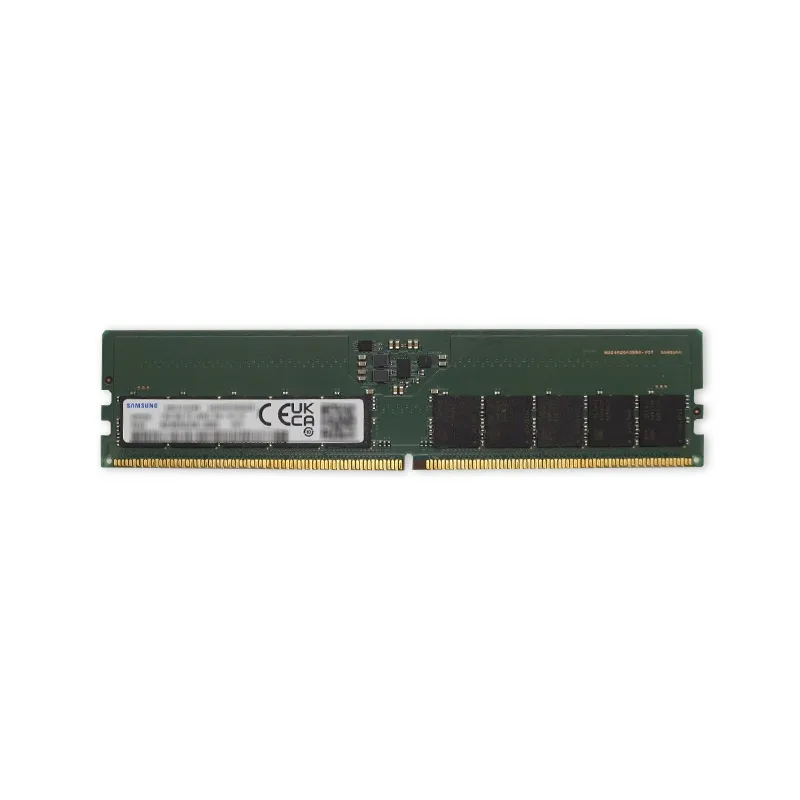
This DDR5-4800 UDIMM with on-die ECC is purpose-built for entry-level workstations and small-scale servers that demand data integrity without the cost of registered memory. Its single-rank x8 configuration and CL40 latency at a low 1.1V deliver reliable, power-efficient throughput, making it ideal for mission-critical workloads like financial modeling, code compilation, and content creation on platforms such as Intel W680-based systems.
1. ECC protection safeguards transactional data integrity in critical SMB and edge server workloads by detecting and correcting single-bit errors, dramatically reducing the risk of silent data corruption and unplanned downtime.
2. DDR5 memory technology doubles the burst length and bank count, delivering the elevated memory bandwidth required by modern software-defined storage and lightweight virtualization hosts.
3. 4800 MT/s transfer rate accelerates in-memory caching and database indexing operations, enabling faster query responses under concurrent user loads without scaling CPU count.
4. 16 GB capacity per module provides a dense memory footprint for hosting multiple containers or VMs on single-processor entry servers, balancing procurement cost with consolidation targets.
5. Unbuffered signal type eliminates the register clock latency found in registered DIMMs, yielding lower access delays that benefit latency-bound microservices and real-time analytics on compact server nodes.
When your virtualized server cluster is hosting dozens of VMs, a single undetected memory error can cascade into corrupted transactions or silent data loss across critical workloads. The M324R2GA3BB0-CQKOD module directly addresses this risk through its integrated ECC, which continuously detects and corrects single-bit memory errors caused by background radiation or electrical noise—keeping your financial database entries or customer records accurate to the last bit, not statistically clean most of the time. This unbuffered DDR5-4800 design skips the additional register latency found in registered DIMMs, so it delivers the low access delay that in‑memory databases like Redis demand, while the 4800 MT/s bandwidth ensures a single‑rank ×8 configuration feeds data fast enough to saturated 8‑core server CPUs without stalling. For a small to midsized business running multiple VMs on a virtualization host, the module’s 1.1 V operation cuts thermal load and energy cost over a 24/7 cycle compared to earlier DDR4 generations, and the standard 288‑pin UDIMM form factor simplifies consolidation into existing server boards that require unbuffered ECC memory—no proprietary validation gymnastics. What this means for you is fewer unexplained VM crashes, tighter data integrity, and server uptime that holds firm when the workload peaks, because your memory’s reliability is engineered, not just hoped for.
Gaming Build
For gaming on platforms that support ECC UDIMMs (e.g., Intel W680), a dual‑channel configuration is essential to maximize memory bandwidth for modern titles. Pair two of these 16 GB DDR5‑4800 modules for a balanced 32 GB kit (2×16 GB), which comfortably handles current games, streaming, and background applications without bottlenecking your CPU. Single‑rank x8 organization helps maintain good signal integrity when populating only two slots, keeping latencies tight in gear 1 or gear 2 modes.
Content Creation
Heavy content‑creation workloads such as 4K video editing, 3D rendering, and large simulation projects benefit from high total capacity. Populate four slots with these 16 GB UDIMMs to reach 64 GB – a sweet spot for timeline scrubbing, complex scene rendering, and running multiple professional applications simultaneously. While 4800 MT/s is a moderate DDR5 speed, the extra capacity prevents disk swapping far more effectively than a smaller, faster kit would. Ensure your motherboard supports 4‑DIMM configurations with ECC and that a modest airflow keeps the modules within thermal limits during prolonged, sustained loads.
General Productivity
For everyday office work, web browsing, email, and light multitasking, a single 16 GB module provides a cost‑effective starting point with the option to add a second identical stick later. If your workload frequently spans dozens of browser tabs, large spreadsheets, and video conferencing tools, upgrade directly to a 32 GB dual‑channel arrangement (2×16 GB) to avoid early memory pressure and enjoy smoother responsiveness. The low 1.1 V operating voltage helps keep power consumption and heat generation modest, which is ideal for compact or passively cooled business desktops.
Thoroughly tested ECC UDIMM for servers/workstations: fits Dell Precision 5860, Lenovo ThinkStation P3, HP Z4 G5, Supermicro X13SAE.
Q: Can I mix this M324R2GA3BB0-CQKOD with other memory modules of different brands or speeds?
A: Mixing is discouraged for server environments. Even modules with identical specs from different vendors can cause instability. Use identical Samsung M324R2GA3BB0-CQKOD modules of the same batch for assured compatibility and uptime.
Q: Is this memory compatible with my system? Which platforms support this DDR5 ECC UDIMM?
A: This module targets server and workstation platforms requiring DDR5 ECC UDIMMs, such as Intel Xeon E-2300/E-2400 series or AMD Ryzen PRO and EPYC 4000 series. Always consult your motherboard's QVL and CPU ECC support.
Q: What is the recommended DIMM population order for optimal performance?
A: Follow your server board manual. Typically, populate one DIMM per channel (1DPC) first, using the slots farthest from the CPU. This balances thermal and electrical load while maximizing signal integrity on a 288-pin UDIMM.
Q: Does this module support overclocking or XMP profiles?
A: No. This is a JEDEC-compliant DDR5-4800 ECC UDIMM running at 1.1V. It does not support XMP or overclocking. Designed for 24/7 mission-critical operation, it prioritizes data integrity over variable frequency.
Q: What warranty and typical failure rate can I expect?
A: This Samsung module includes a one-year warranty. The annualized failure rate (AFR) is typically well below 0.3%, owing to rigorous module testing and Samsung's mature DRAM fabrication process for sustained server reliability.