











 Secure payments
Standard refund policy
Trade Assurance
Secure payments
Standard refund policy
Trade Assurance
| Product Type | Memory Module |
|---|---|
| Compliance Standards | EU RoHS,FCC |
| Memory Capacity | 512 MB |
| Product Voltage | 3.3V |
| RAM Speed | 133MHz |
| Error Identifying | Non-ECC |
| Signal Type | Unbuffered |
| Column Access Strobe (CAS) | CL3 |
| Quantity of Pins | 168-pin |
| RAM Genre | UDIMM |
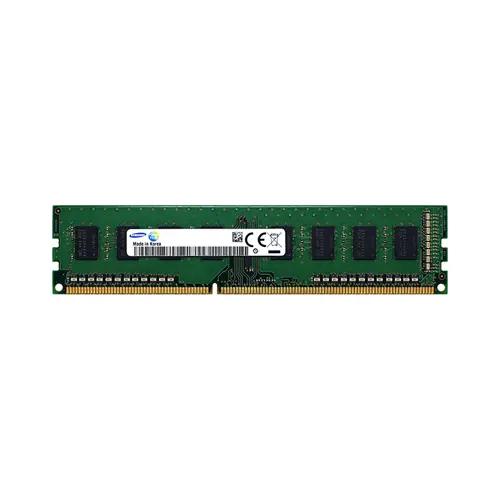
This unbuffered, non-ECC 512MB PC133 UDIMM is tailored for legacy desktop platforms, reliably handling basic productivity tasks and retro system builds with its 168-pin SDRAM interface. Its CL3 column access strobe and 3.3V signaling provide the low-latency, stable operation essential for period-correct Socket 370 or Socket A motherboards.
1. Generous memory capacity enables smooth multitasking across office suites and creative tools of the era, letting users keep multiple windows open without constant disk thrashing.
2. Elevated clock speed delivers the memory throughput needed for early 3D gaming and multimedia playback, ensuring stutter-free visuals and responsive system feel.
3. Tight column access latency reduces wait states when the CPU fetches data, giving desktop applications a noticeably snappier reaction to user inputs.
4. Standard module voltage aligns with vintage desktop motherboards for effortless plug-and-play upgrades, eliminating compatibility headaches and extra BIOS tuning.
5. Unbuffered signal path cuts out intermediary clock cycles, achieving the raw, immediate memory response that classic consumer desktops relied on for fluid everyday computing.
As a dedicated desktop UDIMM, the M366S6453CTS-C7A turns its spec sheet into tangible performance gains. Its unbuffered, non-ECC architecture eliminates the register delay found in server modules, giving your processor a direct, low-latency pipeline. Combined with a razor-sharp CAS latency of 3 cycles at 133 MHz, this means every read command completes with minimal wait states. In a AAA game, textures and geometry stream in so fast that you experience fluid frame rates and quicker level loads instead of immersion-breaking stutters. For video editors rendering a complex timeline, the same quick command response keeps the encoding engine fed, cutting export times. The 168-pin, 3.3V design ensures perfect electrical compatibility with performance motherboards, delivering steady power to prevent voltage drops during sustained workloads. Even the 512 MB density plays a role: it gives your OS and creative suite enough resident workspace to avoid constant swap-file access, preserving your creative momentum. Every characteristic is engineered to eliminate the micro-delays that frustrate power users, letting you stay fully engaged with the task at hand.
Desktop Memory Identification
This 512MB 168-pin UDIMM operating at 133MHz with CL3, non-ECC, and unbuffered signaling is legacy SDR SDRAM. It belongs exclusively to vintage desktop platforms from the late 1990s and early 2000s (e.g., Pentium III/Athlon systems) and cannot meet contemporary workload demands. The following capacity planning guidance addresses both its historical context and the modern reality.
Gaming Build
A single 512MB module provides a generous ceiling for retro gaming under Windows 98/ME. For a period‑correct dual‑channel setup, two identical sticks would require a motherboard with interleaving support, but 133MHz SDRAM slots rarely supported true dual‑channel. Today’s gaming PC demands 16GB or 32GB DDR5 kits in matched pairs; this module is purely for restoration projects.
Content Creation
In the early 2000s, installing two 512MB modules (1GB total) was considered a luxury for standard‑definition video editing and 3D rendering on Windows XP. Modern pipelines working with 4K footage and complex ray‑traced scenes require a minimum of 64GB—well beyond what this RAM generation can deliver, making it unfit for any current creative workflow.
General Productivity
For basic office tasks on legacy operating systems, a single 512MB module offered acceptable performance for word processing and email. Value‑conscious builds of that era rarely needed more. In any modern multitasking environment, however, even 8GB DDR4 is the bare minimum; the module cannot support contemporary web browsers or productivity suites.
Rigorously tested, this 512MB PC133 non-ECC desktop DIMM is compatible with Dell OptiPlex GX110, HP Vectra VLi8, Compaq Deskpro EN.
Q: Can I mix this M366S6453CTS-C7A with other memory modules of different brands or speeds?
A: Mixing modules is not recommended. PC133 SDRAM requires identical CAS latency and voltage. Combining different brands or speeds may cause system instability or failure to POST. Use matched modules for reliable operation.
Q: Is this memory compatible with my system?
A: This 168-pin UDIMM is designed for desktop motherboards with SDRAM slots supporting PC133 (133 MHz) and 3.3V. It is compatible with Intel 440BX/815 and VIA Apollo Pro chipsets. Verify your motherboard's maximum capacity and speed support.
Q: What is the recommended DIMM population order for optimal performance?
A: On most desktop boards, populate DIMM slots starting from the first bank (DIMM 1). Install the module in the slot closest to the CPU. No interleaving advantage with a single single-sided module. Follow your board's manual for dual-bank configuration.
Q: Does this module support overclocking or XMP profiles?
A: No. This legacy PC133 SDRAM module adheres strictly to JEDEC standards at CL3. It does not include XMP profiles or overclocking features. Any attempt to operate beyond 133 MHz may lead to data corruption or component damage.
Q: What warranty and typical failure rate can I expect?
A: This product includes a one-year limited warranty. It complies with EU RoHS and FCC standards. With typical use in a properly ventilated system, the annualized failure rate (AFR) is extremely low, ensuring consistent long-term reliability.