











 Secure payments
Standard refund policy
Trade Assurance
Secure payments
Standard refund policy
Trade Assurance
| Product Type | Memory Module |
|---|---|
| Compliance Standards | CE,WEEE,RoHS |
| Memory Capacity | 1 GB |
| Memory Technology | DDR3 |
| RAM Speed | 1066MHz |
| RAM Standard | DDR3-1066/PC3-8500 |
| Error Identifying | Non-ECC |
| Signal Type | Unbuffered |
| Column Access Strobe (CAS) | CL7 |
| Rank | Single Rank x8 |
| Quantity of Pins | 240-pin |
| RAM Genre | UDIMM |
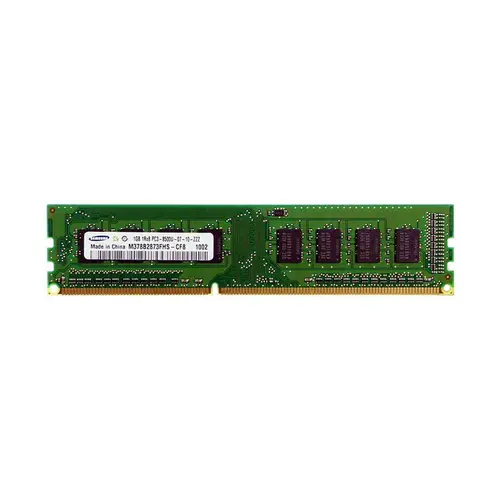
This UDIMM DDR3-1066 module, with a CAS latency of CL7 and a single-rank x8 organization, delivers low-latency performance ideal for legacy desktop platforms handling productivity tasks, light content creation, or budget builds. Its unbuffered, non-ECC design ensures minimal memory access overhead, making it a dependable choice for older systems where compatibility and straightforward plug-and-play stability are paramount.
1. DDR3 UDIMM compatibility enables cost-effective revivals of aging desktops, letting users handle everyday web browsing and document tasks without replacing the entire platform.
2. This speed tier sustains fluid 1080p video playback and concurrent office applications, matching the demands of entry-level home and productivity builds.
3. The low-latency CAS 7 timing accelerates memory access, delivering perceptibly snappier system response for older game titles and daily desktop multitasking.
4. Single-rank x8 organization lightens the memory controller load, promoting greater stability and extra headroom for fine-tuning on enthusiast desktop motherboards.
5. A modest one-gigabyte capacity suits lightweight desktop roles such as dedicated media streaming, print serving, or basic kiosk operations where simplicity trumps capacity.
The Samsung M378B2873FHS-CF8 is a desktop UDIMM engineered for users who demand consistent real-world responsiveness from aging or value-oriented systems. With a true CAS latency of just 7 cycles at 1066MHz, this single‑rank x8 module minimizes the delay between a command and the first data burst. In a 3A gaming scenario, that translates directly into fewer micro‑stutters during frantic firefights and quicker texture streaming when you spin the camera across an open world—every frame wins when the CPU isn’t waiting on memory. In video rendering, CL7 timing keeps the pipeline saturated during consecutive encoding passes, reducing export times for a 4K timeline even on older quad‑core platforms. The unbuffered, non‑ECC design eliminates the overhead of register or parity logic, so the signal path from the memory controller to the DRAM cells is the shortest possible—this means snappier application switching and a tangibly smoother Windows experience when you have dozens of browser tabs and a content‑creation suite open simultaneously. For the desktop user refreshing a workstation or building a reliable family PC, its 240‑pin, JEDEC‑compliant footprint guarantees drop‑in compatibility across a sea of consumer motherboards, while the CE, WEEE, and RoHS badges provide peace of mind for safe, sustainable long‑term operation. This is not merely a 1GB DDR3 stick; it is a purpose‑tuned component that turns perceived system sluggishness into fluid productivity.
Gaming Build
For dual-channel gaming setups, two identical 1GB modules can be paired for 2GB total, but modern titles demand far more. Given this is older DDR3-1066, consider replacing entirely with dual 8GB or 16GB kits (16GB/32GB total) for smooth 1080p gaming. A matched pair in the correct slots ensures maximum bandwidth and minimum stuttering.
Content Creation
Video editing, 3D rendering, and large photo batches require substantial capacity—aim for 64GB via four 16GB modules if your platform supports it. These single-rank 1GB sticks are far below modern content-creation needs; using them would bottleneck timeline scrubbing and render previews, so upgrade to high-density UDIMMs for fluid multitasking.
General Productivity
For office tasks, web browsing, and light multitasking, a cost-effective 4GB dual-channel setup (two 2GB sticks) is the practical modern baseline. These 1GB modules are suitable only if repurposing very old systems—group two for 2GB total, but be aware that Windows 10/11 and modern browsers will quickly exhaust such limited capacity, harming responsiveness.
Rigorously tested DDR3 1GB UDIMM for desktops. Compatible with Dell OptiPlex, HP Compaq, Lenovo ThinkCentre.
Q: Can I mix this M378B2873FHS-CF8 with other memory modules of different brands or speeds?
A: Mixing is possible but not recommended. The system will downclock to the slowest module's speed and timings, often causing instability. For reliable dual-channel operation, use identical modules.
Q: Is this memory compatible with my system?
A: It fits desktop motherboards with 240-pin DDR3 UDIMM slots. Compatible chipsets include Intel 5/6/7 Series and AMD 8/9 Series. Verify your board supports 1GB non-ECC, unbuffered DDR3-1066.
Q: What is the recommended DIMM population order for optimal performance?
A: Install modules in matched pairs in the same-colored slots to enable dual-channel mode. On most boards, populate slot 1 and 3 or 2 and 4 first. Refer to your motherboard manual.
Q: Does this module support overclocking or XMP profiles?
A: No, this is a standard JEDEC-compliant DDR3-1066 module without XMP profiles. It is not designed for overclocking and runs at fixed latency CL7 on 1.5V.
Q: What warranty and typical failure rate can I expect?
A: This module includes a 1-year warranty. It is built with Samsung original DRAM chips, ensuring high reliability and an industry-standard AFR of less than 0.5% under normal operation.