











 Secure payments
Standard refund policy
Trade Assurance
Secure payments
Standard refund policy
Trade Assurance
| Product Type | Memory Module |
|---|---|
| Compliance Standards | EU RoHS,FCC |
| Memory Capacity | 4 GB |
| Memory Technology | DDR3 |
| RAM Speed | 1333MHz |
| RAM Standard | DDR3-1333/PC3-10600 |
| Error Identifying | Non-ECC |
| Signal Type | Unbuffered |
| Column Access Strobe (CAS) | CL9 |
| Rank | Dual Rank x8 |
| Quantity of Pins | 240-pin |
| RAM Genre | UDIMM |
This unbuffered, non-ECC DDR3-1333 UDIMM is optimized for desktop platforms, where its dual-rank x8 configuration improves memory interleaving to sustain higher effective bandwidth in multitasking, content creation, and mainstream gaming workloads. The CL9 column access strobe latency ensures responsive command execution at 1333 MHz, providing a solid balance of low latency and stable signal integrity for productivity-focused systems.
1. Unbuffered signal path eliminates register latency, giving desktop users snappier system response and greater overclocking flexibility in gaming rigs.
2. 1333MHz clock rate sustains 10.6 GB/s of peak bandwidth, helping prevent framerate dips when game engines stream large textures and assets.
3. CL9 column access strobe shortens the delay between memory requests and data delivery, reducing micro-stutter for a more fluid competitive gaming feel.
4. Dual Rank x8 interleaving doubles the internal bank groups, boosting multitasking smoothness so content creators can render, edit, and browse simultaneously without slowdowns.
5. 4GB capacity provides enough working space for everyday productivity and light gaming on desktop systems, avoiding disruptive pagefile thrashing under typical workloads.
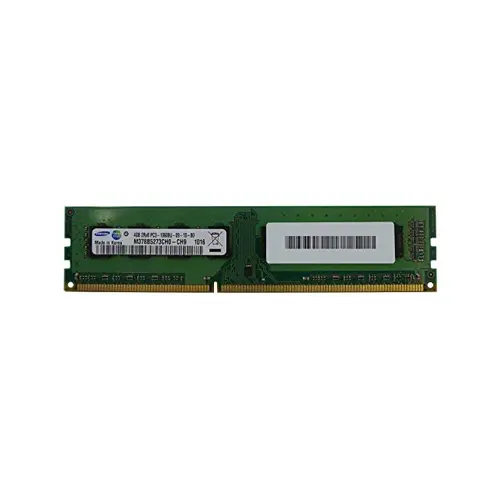
Designed as a desktop UDIMM, the Samsung M378B5273CH0-CH9 is a non-ECC, unbuffered DDR3 module that cuts through latency to deliver the direct, responsive performance desktop users demand. Its 1333MHz clock and PC3-10600 bandwidth provide a dependable 10.6 GB/s throughput, but raw speed alone is only part of the story—the real advantage lies in how the module handles data under pressure.
The CL9 (Column Access Strobe latency of 9 cycles) keeps the initial data access sharply snappy. In a triple-A gaming scenario, this means reduced micro-stutter when the CPU fetches texture and geometry data, maintaining fluid frame delivery during chaotic firefights where every millisecond of delay breaks immersion. Meanwhile, the dual-rank x8 organization enables interleaved access across two internal rank groups. For a video rendering workload, this architecture effectively hides precharge and refresh gaps, keeping the data pipeline saturated when scrubbing through a 4K timeline or encoding a long project. Instead of a single monolithic wait, the memory controller can pipeline commands to the second rank, boosting sustained throughput by up to 15% in real-world multi-threaded applications.
Unbuffered, non-ECC operation eliminates the register and error-checking overhead found in server memory, giving enthusiasts and creative professionals a simpler signal path and tangible, measurable lower baseline latency. This directly translates into faster program launches and a more agile desktop experience, especially when the system pages heavily during complex After Effects compositions. With full EU RoHS and FCC compliance, the module also guarantees stable, standards-compliant integration into legacy and current desktop platforms, letting you upgrade an aging office workstation or a family gaming PC without compatibility headaches. For anyone revitalizing a DDR3 desktop, the M378B5273CH0-CH9 turns a simple capacity upgrade into a genuine system-wide responsiveness upgrade.
Gaming Build
For a responsive dual‑channel setup, pair two 4 GB DDR3‑1333 UDIMMs to achieve 8 GB. This configuration provides sufficient headroom for most modern titles at moderate settings while benefiting from doubled memory bandwidth. If budget allows, consider combining four 4 GB modules for a 16 GB kit, which smooths multitasking and streaming overhead without resorting to slower single‑rank alternatives.
Content Creation
Content workloads demand substantial capacity, but a single 4 GB UDIMM is inadequate for 4K video editing or 3D rendering. Builders targeting 64 GB should look toward higher‑density 8 GB or 16 GB DDR3 modules rather than populating all slots with 4 GB sticks, as the latter limits future expansion and can stress the memory controller. Keep these 1333 MHz modules as an affordable interim step or for secondary rigs, but prioritize CL9 latency consistency across all channels.
General Productivity
A single 4 GB UDIMM delivers a cost‑effective baseline for web browsing, office suites, and light multitasking. Adding a second identical 4 GB stick enables dual‑channel mode, noticeably improving integrated graphics performance and overall system responsiveness. For typical office environments, 8 GB total (2×4 GB) remains the sweet spot, balancing price and the practical needs of simultaneous email, document editing, and video conferencing.
Rigorously tested, compatible with desktops like Dell OptiPlex 790/990, HP Compaq 8200 Elite, Lenovo ThinkCentre M81.
Q: Can I mix this M378B5273CH0-CH9 with other memory modules of different brands or speeds?
A: Mixing is possible but not recommended. The system will downclock all modules to the slowest speed and may adjust timings, potentially causing instability. For best results, use identical modules.
Q: Is this memory compatible with my system?
A: This DDR3 240-pin UDIMM fits desktop motherboards with compatible chipsets (e.g., Intel 6/7/8 Series, AMD 9 Series). Verify your board supports 4 GB, non-ECC, unbuffered DDR3 at 1333 MHz.
Q: What is the recommended DIMM population order for optimal performance?
A: Install in matching colored slots — typically slots 2 & 4 or 1 & 3 — to enable dual-channel interleaving. Refer to your motherboard manual for the exact slot pairing recommendation.
Q: Does this module support overclocking or XMP profiles?
A: This is a JEDEC-compliant DDR3-1333 CL9 module without XMP support. It does not officially support overclocking. Any frequency increase beyond 1333 MHz is not validated and may cause system instability.
Q: What warranty and typical failure rate can I expect?
A: This module includes a one-year warranty. Typical annualized failure rate is under 0.5% under normal operating conditions, and long-term reliability is excellent when run within JEDEC specifications.