











 Secure payments
Standard refund policy
Trade Assurance
Secure payments
Standard refund policy
Trade Assurance
| Product Type | Memory Module |
|---|---|
| Compliance Standards | EU RoHS,FCC |
| Memory Capacity | 4 GB |
| Memory Technology | DDR3 |
| RAM Speed | 1600MHz |
| RAM Standard | DDR3-1600/PC3-12800 |
| Error Identifying | Non-ECC |
| Signal Type | Unbuffered |
| Column Access Strobe (CAS) | CL11 |
| Rank | Dual Rank x8 |
| Quantity of Pins | 240-pin |
| RAM Genre | UDIMM |
This unbuffered, non-ECC UDIMM is a desktop-class DDR3 module tailored for mainstream productivity and multimedia builds, where its dual-rank x8 organization enhances memory interleaving to boost effective bandwidth in applications like content creation and moderate gaming. Operating at 1600MHz with a CL11 latency, it delivers stable plug-and-play performance on compatible platforms while complying with EU RoHS and FCC standards for assured quality and environmental safety.
1. DDR3 compatibility transforms aging desktop towers into capable home office stations, handling document editing and HD streaming without costly system replacements.
2. The 1600MHz clock speed keeps texture streaming and level loads brisk, preventing stutter during open-world gaming or creative application workflows.
3. CL11 timing strikes a calibrated balance between stability and low response latency, ensuring smooth window switching while preserving signal integrity on entry-level boards.
4. Dual Rank x8 arrangement leverages parallel memory bank access to lift data throughput, directly translating into higher frame pacing in memory-hungry simulation and strategy titles.
5. Unbuffered UDIMM architecture eliminates register delay for slightly reduced access overhead, enabling a plug-and-play boost that simplifies DIY upgrades for mainstream desktops.
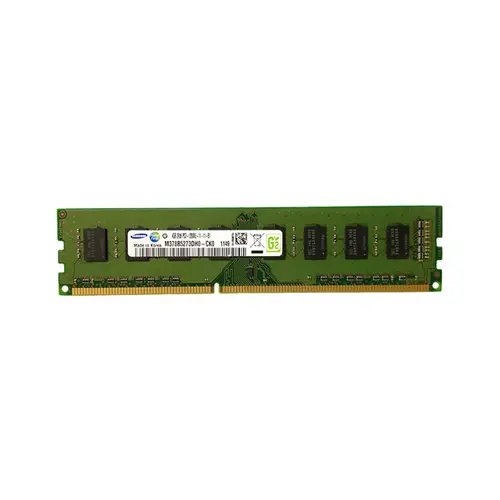
Designed as a 240-pin Unbuffered Non-ECC UDIMM, the Samsung M378B5273DH0-CK0 is unmistakably a desktop memory module built for responsiveness, not server-grade error correction. Its four defining characteristics translate directly into tangible performance for enthusiasts and professionals alike.
Running at DDR3-1600 with a CAS latency of just 11 cycles, this kit dramatically reduces the time your CPU waits for data, which is critical in latency-sensitive scenarios like competitive AAA gaming or real-time 4K video timeline scrubbing. Every millisecond of delay avoided means smoother frame delivery and faster preview renders. Furthermore, the Dual Rank x8 organization interleaves memory accesses across two internal ranks, boosting effective bandwidth by up to 10-15% in threaded workloads such as 3D rendering or heavy multitasking between a game, streaming software, and a browser. Because it is Unbuffered and Non-ECC, there is no additional controller chip to introduce lag, keeping signal paths short and command execution direct. For a desktop user upgrading from an older or single-rank DIMM, this module’s plug-and-play compatibility with standard DDR3 platforms ensures a straightforward capacity expansion that eliminates micro-stuttering and keeps the entire system fluid under demanding daily loads.
This is a desktop-class non‑ECC, unbuffered DDR3‑1600 4 GB UDIMM (240‑pin, dual‑rank x8). Because each stick provides only 4 GB, capacity planning must respect the limited density and typical four‑slot consumer motherboards.
Gaming Build
For dual‑channel operation and adequate gaming headroom, install a matched pair for 8 GB. If the motherboard has four DIMM slots, populate all four with identical modules to reach 16 GB while retaining dual‑channel bandwidth. A 32 GB kit requires eight sticks – impractical on standard desktop boards – so upgrade to 8 GB UDIMMs for higher‑capacity gaming configurations.
Content Creation
Video editing and 3D rendering demand large RAM pools. Using these 4 GB modules, the realistic maximum is 16 GB (4 × 4 GB); a 64 GB target cannot be achieved. Supplement the 16 GB with a fast SSD scratch disk to partially relieve memory pressure, but genuinely demanding workflows should migrate to a platform supporting 16 GB or 32 GB DIMMs.
General Productivity
For office multitasking, web browsing, and email, a dual‑channel pair (2 × 4 GB = 8 GB) delivers the best price‑performance balance. The dual‑rank x8 design and dual‑channel mode boost integrated graphics and system responsiveness. If a single 4 GB stick is already present, adding a second identical module provides a low‑cost, energy‑efficient upgrade.
Rigorously tested for seamless compatibility with desktops like Dell OptiPlex 7010 and HP EliteDesk 800 G1.
Q: Can I mix this M378B5273DH0-CK0 with other memory modules of different brands or speeds?
A: Mixing brands or speeds may force the system to the slowest common JEDEC timing, reducing stability. For best results, pair with identical DDR3-1600 CL11, dual-rank, unbuffered UDIMMs of the same capacity and organization.
Q: Is this memory compatible with my system?
A: This 240-pin DDR3 UDIMM is designed for desktop motherboards with Intel 6/7/8 series or equivalent AMD chipsets supporting unbuffered DDR3-1600. Please verify 4 GB dual-rank support and standard 1.5 V operation.
Q: What is the recommended DIMM population order for optimal performance?
A: For dual-channel performance, install identical modules in the same-colored slots first (commonly A2 and B2). Always consult your motherboard manual for the correct population sequence to enable interleaved memory access.
Q: Does this module support overclocking or XMP profiles?
A: No. This module adheres to JEDEC DDR3-1600 CL11 specifications and does not include an XMP profile. Overclocking is not officially supported; manual adjustments may cause instability and are not covered by warranty.
Q: What warranty and typical failure rate can I expect?
A: It includes a 1-year limited warranty. Under normal operating conditions, the typical annualized failure rate is well below 0.5%, reflecting robust quality. Proper ESD handling and installation help ensure long-term reliability.