











 Secure payments
Standard refund policy
Trade Assurance
Secure payments
Standard refund policy
Trade Assurance
| Product Type | Memory Module |
|---|---|
| Compliance Standards | EU RoHS,FCC |
| Memory Capacity | 1 GB |
| Memory Technology | DDR2 |
| RAM Speed | 800MHz |
| RAM Standard | DDR2-800/PC2-6400 |
| Error Identifying | Non-ECC |
| Signal Type | Unbuffered |
| Column Access Strobe (CAS) | CL6 |
| Rank | Single Rank x8 |
| Quantity of Pins | 240-pin |
| RAM Genre | UDIMM |
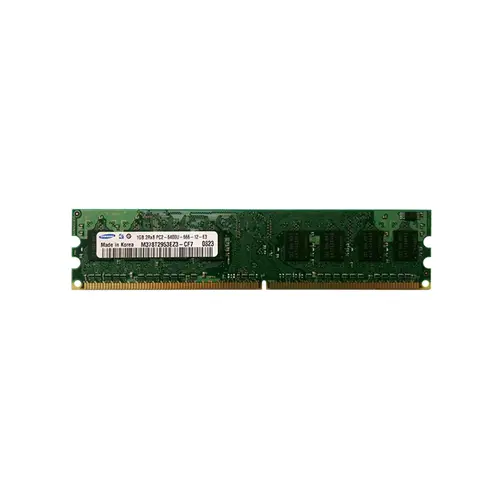
This unbuffered, non-ECC DDR2-800 UDIMM is a standard desktop memory module ideally suited for aging mainstream platforms handling everyday productivity and casual gaming. Its single-rank x8 organization ensures clean signal integrity for stable operation, while the CL6 latency delivers tangible responsiveness improvements over higher-latency alternatives in legacy systems.
1. Unbuffered signaling strips away intermediary hardware, allowing the memory controller to communicate directly with DRAM chips for noticeably lower access latency during split-second gaming actions and rapid desktop multitasking.
2. The module’s elevated clock speed supplies generous memory bandwidth, keeping frame times steady in casual gaming and preventing stutter when switching between creative applications.
3. Tight column access latency shortens data retrieval gaps, giving the processor critical instructions faster and making the entire system feel more immediate in everyday workflows.
4. Single Rank organization reduces electrical loading on the motherboard’s memory controller, offering cleaner signal integrity and greater overclocking headroom for performance-tuned desktops.
5. Entry-level density provides sufficient headroom for the host operating system and light productivity suites, reducing reliance on slower virtual memory for smooth routine computing.
The M378T2863QZS-CF7 is a desktop memory module, designed as an unbuffered, non-ECC DDR2 UDIMM with a 240-pin layout, ideal for older performance towers and legacy gaming systems. Its four defining traits directly solve real-world frustrations for enthusiasts who keep these machines alive. First, the unbuffered, non-ECC architecture means the memory controller talks straight to the DRAM chips without any registering chip or error-correction overhead. In a classic 3A title where every frame depends on rapid asset streaming, that direct path shaves off subtle latencies, reducing stutter and keeping minimum framerates solid. Second, the PC2-6400 speed paired with a tight CL6 latency delivers the responsive burst performance that older CPUs demand during video rendering—scrubbing through a 1080p timeline feels snappier because data fetches complete faster. Third, the single-rank x8 organization presents a lighter electrical load to the motherboard, dramatically improving stability when you finally populate all four DIMM slots for a memory-hungry editing suite. This means fewer blue-screens and more confidence while handling large project files. Ultimately, for a vintage gaming rig or a budget workstation tasked with daily creative work, this module replaces guesswork with dependable, low-latency compatibility.
Gaming Build
For a dual-channel DDR2 gaming rig, install matched pairs of these 1 GB UDIMMs in symmetrical slots — two modules (2 GB total) for light titles, or four modules (4 GB) to reduce stuttering in older AAA games. Keep the same PC2‑6400 speed and 6‑6‑6 timings across all sticks to avoid timing conflicts. This non‑ECC, unbuffered design keeps latency low, which suits single‑rank x8 configuration for stable overclocking on legacy platforms.
Content Creation
Video editing and 3D rendering on a DDR2 workstation demand the maximum supported capacity, typically 8 GB using four 2 GB DIMMs; however, when only 1 GB modules are available, populate all four slots for 4 GB and pair with a fast scratch disk. Large projects quickly exhaust this ceiling, so treat the setup as a preview or asset‑prep station and schedule final renders on a modern system.
General Productivity
A single 1 GB module handles web browsing and office documents, but dual‑channel with two 1 GB sticks (2 GB total) dramatically improves multitasking responsiveness on Windows XP or lightweight Linux. For cost‑effective office fleets, standardize on 2×1 GB kits — it meets email, spreadsheet, and video‑conference demands without overspending on DDR2 inventory.
Rigorously tested, guaranteed compatible with desktops like Dell Optiplex 755, 760, 780, and other DDR2 UDIMM systems.
Q: Can I mix this M378T2863QZS-CF7 with other memory modules of different brands or speeds?
A: Mixing is not recommended. The system will default to the slowest module’s speed and timings, and mismatched ranks or ICs may cause instability or prevent boot.
Q: Is this memory compatible with my system?
A: It is a standard DDR2-800 UDIMM for desktops. Compatibility depends on your motherboard’s chipset (e.g., Intel 965/3-series, AMD 690/7-series). Verify 240-pin DDR2 support and consult the board’s QVL.
Q: What is the recommended DIMM population order for optimal performance?
A: For dual-channel operation, install identical modules in the same-colored slots (typically slots 1 and 3, or 2 and 4). Always refer to your motherboard manual for the correct population sequence.
Q: Does this module support overclocking or XMP profiles?
A: No. This JEDEC-compliant DDR2 module does not support XMP or overclocking. It is validated to run reliably at its rated CL6-6-6-18 timings and 1.8V.
Q: What warranty and typical failure rate can I expect?
A: This module includes a 1-year warranty. Typical annualized failure rate (AFR) for compliant DDR2 UDIMMs is below 0.5% under normal operating conditions, ensuring long-term reliability.