











 Secure payments
Standard refund policy
Trade Assurance
Secure payments
Standard refund policy
Trade Assurance
| Product Type | Memory Module |
|---|---|
| Compliance Standards | EU RoHS,FCC |
| Memory Capacity | 512 MB |
| Memory Technology | DDR2 |
| RAM Speed | 667MHz |
| RAM Standard | DDR2-667/PC2-5300 |
| Error Identifying | Non-ECC |
| Signal Type | Unbuffered |
| Column Access Strobe (CAS) | CL5 |
| Rank | Single Rank x16 |
| Quantity of Pins | 240-pin |
| RAM Genre | UDIMM |
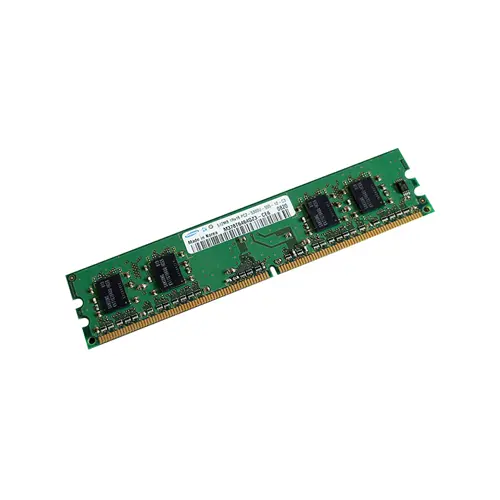
This DDR2-667 UDIMM is a desktop-class memory module best suited for upgrading legacy systems to extend productivity and multitasking with basic office applications. Its single-rank x16 configuration and CL5 latency ensure stable, unbuffered operation at 667MHz, delivering consistent responsiveness for aging platforms without overclocking.
1. Unbuffered DIMM architecture strips away register delays, giving desktop systems faster command-to-data turnaround and a more responsive feel in everyday multitasking.
2. Non-ECC memory skips error-correction overhead, allowing the memory controller to focus on raw speed which benefits frame consistency in classic gaming and real-time applications.
3. A 667 MHz clock pushes enough bandwidth to handle office productivity suites and older content-creation software without bottlenecking the processor.
4. CL5 latency tightens the gap between a request and the first data burst, delivering snappy interface reactions during rapid alt-tab switching and light creative workflows.
5. The 512 MB capacity is a sweet spot for legacy desktop platforms, running period-appropriate operating systems and retro workloads comfortably without excessive disk swapping.
Designed specifically for desktop platforms, the Samsung M378T6464QZ3-CE6 is a 512MB DDR2-667 UDIMM that turns its technical specifications into real-world performance gains where responsiveness is non-negotiable. Its unbuffered, non-ECC architecture eliminates the extra clock cycle delays found in registered server memory, giving the memory controller direct, low-latency access to DRAM cells. With a CAS latency of just CL5 and a single-rank x16 organization, this module minimizes electrical loading on the memory bus, which directly translates to snappier command execution and reduced page-fault stutter in demanding desktop workloads. In a rig running the latest AAA game of its era, that means smoother texture streaming and faster level loads because the CPU spends fewer cycles waiting for data. For a video rendering or photo-editing power user, the 667MHz bandwidth paired with low latency keeps the pipeline fed when manipulating large raw files, preventing timeline lag and dropped frames. Built on a 240-pin UDIMM standard, it drops effortlessly into mainstream desktop boards, offering a cost-effective path to restore system fluidity without the overhead of server-grade hardware—every nanosecond shaved from latency keeps the creative flow or competitive edge intact.
Gaming Build
For a legacy DDR2 gaming system, start with a dual‑channel kit of two 512 MB modules (1 GB total) to enable 128‑bit memory access and reduce stuttering in older titles designed for Windows XP. Most DDR2 motherboards offer four slots; installing four identical 512 MB UDIMMs provides 2 GB, which is sufficient for classic games and light modern indie titles. Because 16 GB or 32 GB kits are impossible on this platform, aim for the maximum 4 × 512 MB configuration—it balances cost and performance while keeping dual‑channel interleaving active.
Content Creation
Content creation on a DDR2‑based workstation is severely constrained, but you can still maximize capacity by populating all available slots with 512 MB modules. A 4 × 512 MB setup yields 2 GB, enough for light photo editing and SD‑resolution video work under a 32‑bit operating system. For 3D rendering or HD timelines, this amount is insufficient; consider migrating to a newer platform. If you must stay, ensure the modules have identical CL5 latency and single‑rank x16 organization to avoid timing mismatches that can cause rendering crashes.
General Productivity
A single 512 MB UDIMM is acceptable for basic office tasks, email, and web browsing on lightweight Linux distributions or older Windows versions. Adding a second module for 1 GB dual‑channel provides smoother multitasking and is a cost‑effective upgrade for legacy PCs. Avoid mixing different ranks or CAS latencies—use matching M378T6464QZ3‑CE6 sticks to maintain system stability during everyday work. For spreadsheet‑heavy users, 2 GB (four modules) offers the most comfortable headroom without overspending on obsolete hardware.
Rigorously tested desktop memory, compatible with systems like Dell OptiPlex 745 and HP Compaq dc7700.
Q: Can I mix this M378T6464QZ3-CE6 with other memory modules of different brands or speeds?
A: Mixing is not recommended. Even with identical specs, different brands or speeds may cause instability. For best results, use identical modules to ensure consistent timing and voltage tolerance on your desktop platform.
Q: Is this memory compatible with my desktop motherboard?
A: It is compatible with desktop boards supporting DDR2-667/PC2-5300 UDIMMs. Please verify your chipset supports 512MB non-ECC unbuffered modules and 240-pin slots. Check your board’s Qualified Vendor List for confirmation.
Q: What is the recommended DIMM population order for optimal performance?
A: For dual-channel performance, install pairs of identical modules in the same-colored slots as indicated in your motherboard manual. Single module operation is supported but will only run in single-channel mode.
Q: Does this module support overclocking or XMP profiles?
A: This JEDEC-standard DDR2-667 module does not support XMP or overclocking profiles. It operates reliably at the rated 667MHz with CL5 latency, offering stable performance without tuning.
Q: What warranty and typical failure rate can I expect?
A: This module includes a 1-year warranty. Typical annualized failure rates are very low under normal operating conditions. Premature failures are rare and covered by the manufacturer’s replacement policy.