











 Secure payments
Standard refund policy
Trade Assurance
Secure payments
Standard refund policy
Trade Assurance
| Model | M383L6420DTS-CA0Q0 |
|---|---|
| Product Type | Memory Module |
| Compliance Standards | EU RoHS,FCC |
| Memory Capacity | 512 MB |
| Memory Technology | DDR |
| Product Voltage | 2.5V |
| RAM Speed | 200MHz |
| RAM Standard | DDR-200/PC1600 |
| Error Identifying | ECC |
| Signal Type | Registered |
| Column Access Strobe (CAS) | CL2 |
| Rank | Single Rank x4 |
| Quantity of Pins | 184-pin |
| RAM Genre | RDIMM |
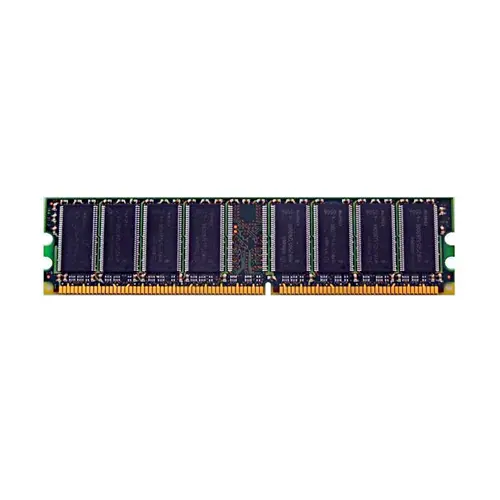
This is a legacy server memory module featuring ECC and Registered signaling, making it suited for aging enterprise servers and memory-intensive workloads like early virtualization or small-scale in-memory databases where data integrity is critical. Its Single-Rank x4 configuration with a low CL2 latency ensures minimal access delay, while the Registered design stabilizes signal integrity in multi-DIMM setups.
1. End-to-end error correction provides a safety net against silent data corruption, preserving transactional integrity in database and financial processing.
2. The registered clock driver stabilizes signal integrity across heavily loaded memory channels, allowing fully populated servers to run reliably without command deterioration.
3. Sufficient capacity for hosting lightweight enterprise services ensures stable performance for DNS, firewall, or dedicated management controllers without wasteful overprovisioning.
4. Ultra-low CAS latency reduces the fetch-to-use delay, accelerating random access patterns typical of real-time analytics and critical server response loops.
5. A single-rank layout with narrow DRAM organization curbs electrical stress and thermal buildup, contributing to consistent operational stability in dense rack configurations.
In server environments like virtualization clusters and in-memory databases, the Samsung M383L6420DTS-CA0Q0 RDIMM turns technical specifications into real-world dependability. Its ECC capability silently corrects single-bit memory errors, preventing the silent data corruption that could crash dozen virtual machines or poison financial records inside a Redis or SAP HANA instance. The registered buffer isolates the memory controller from heavy electrical loading, allowing you to fully populate all DIMM slots without signal degradation—essential when scaling to hundreds of gigabytes for dense VM hosts and memory-hungry data caches. Its Single Rank x4 configuration combined with a CL2 column access strobe delivers deterministic low-latency access, keeping query response times predictable even under sustained thrashing loads. While DDR-200 clock speeds look conservative, in legacy industrial control, telecom infrastructure, or certified medical platforms this module’s true value is unwavering stability. Every design choice from ECC to registered signaling directly protects uptime and transactional accuracy, ensuring that your critical workloads run continuously and correctly around the clock.
General Virtualization
For light virtualization hosts, this legacy DDR-200 Registered ECC module offers reliability but severely limits density. With only 512 MB per DIMM, even populating all available memory slots on older servers typically yields 4–8 GB maximum, which is inadequate for modern hypervisors. Use only for single-purpose, low-resource virtual appliances; plan to deploy at least four identical modules to enable memory interleaving and ECC multi-bit protection.
In-Memory Database
In-memory databases demand large, low-latency memory pools, making this 512 MB Registered ECC module unsuitable for production datasets. Even fully populating a server would provide only a few gigabytes, far below the capacity needed for caching or real-time analytics. Consider this memory solely for legacy test environments running lightweight instances where dataset size stays under 1 GB, and always install modules in matched pairs or sets to maintain single-rank x4 signal integrity.
High-Performance Computing
HPC workloads require high bandwidth and capacity, neither of which this DDR-200 RDIMM can deliver. The 200 MHz clock and single-rank x4 organization create a severe bottleneck for parallel computation or MPI tasks. If repurposing very old nodes, configure all memory channels symmetrically with identical modules—typically six or eight pieces per node—to maximize stable throughput, but expect significant performance limitations compared to any DDR3- or DDR4-era HPC system.
Rigorously tested server compatibility: Dell PowerEdge 2650, 4600, HP DL380 G3, IBM x345.
Q: Can I mix this M383L6420DTS-CA0Q0 with other memory modules of different brands or speeds?
A: Mixing modules is not recommended for server environments. Different brands or speeds may cause signal integrity issues with Registered ECC DDR, potentially compromising system stability and data reliability.
Q: Is this memory compatible with my server platform (Intel or AMD)?
A: This DDR-200/PC1600 Registered ECC module is designed for legacy server platforms using 184-pin sockets. Verify your motherboard supports 2.5V RDIMMs and specific chipset compatibility, typically found in early 2000s Intel/AMD server boards.
Q: What is the recommended DIMM population order for optimal performance with this module?
A: Always populate identical RDIMMs in matched pairs or sets as specified by your server manual. Typically, install in the first bank corresponding to CPU0, following slot numbering, to enable dual-channel and ECC functions.
Q: Does this module support overclocking or XMP profiles?
A: No. As a server-grade Registered ECC DDR module, it adheres to strict JEDEC standards for reliability. Overclocking and XMP are not supported, as they can compromise data integrity and system stability in mission-critical environments.
Q: What warranty and typical failure rate can I expect for this product?
A: This module includes a one-year warranty. As legacy server memory, it has a mature design with a typical annualized failure rate (AFR) below 0.5% under proper operating conditions, ensuring dependable long-term use.