











 Secure payments
Standard refund policy
Trade Assurance
Secure payments
Standard refund policy
Trade Assurance
| Model | M386A2G40DB0-CPB2Q |
|---|---|
| Product Type | Memory Module |
| Compliance Standards | EU RoHS,FCC |
| Memory Capacity | 16 GB |
| Memory Technology | DDR4 |
| Product Voltage | 1.2V |
| RAM Speed | 2133MHz |
| RAM Standard | DDR4-2133/PC4-17000 |
| Error Identifying | ECC |
| Signal Type | Registered |
| Column Access Strobe (CAS) | CL15 |
| Rank | Dual Rank x4 |
| Quantity of Pins | 288-pin |
| RAM Genre | RDIMM |
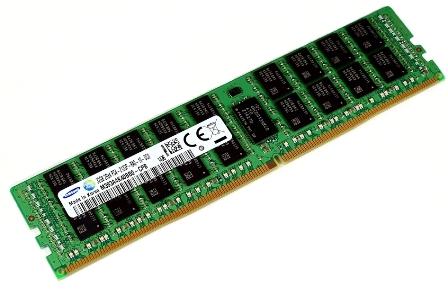
This Samsung 16GB DDR4-2133 RDIMM (M386A2G40DB0-CPB2Q) is a server-grade module ideally suited for virtualization, in-memory databases, and enterprise workloads where data integrity is paramount. Its registered ECC design, combined with a dual-rank x4 organization and CL15 latency, delivers reliable signal integrity and enhanced memory bandwidth in dense, multi-DIMM server configurations.
1. ECC error correction continuously detects and corrects single-bit memory faults, safeguarding virtualized transactional databases against silent data corruption that could lead to costly downtime.
2. Registered signal buffering maintains command and address integrity across fully loaded memory channels, making large-scale terabyte-class server deployments reliable without signal degradation.
3. Dual rank x4 organization interleaves data access across internal banks, sustaining higher bandwidth and minimizing latency spikes during intense VM consolidation or in-memory analytics.
4. Generous per-module density allows deep memory configurations in dual-socket servers, increasing VM density per physical host and improving data center cost efficiency.
5. A time-tested DDR4 data rate paired with low-voltage operation delivers thermally stable throughput for always-on cloud services, balancing consistent performance with rack-level power budgets.
The Samsung M386A2G40DB0-CPB2Q is a server DDR4 RDIMM purpose-built for enterprise workloads. Its four decisive characteristics—ECC correction, registered buffering, dual-rank organization, and 1.2V operation—deliver tangible reliability where it matters most. In a dense virtualization cluster hosting dozens of VMs, ECC silently corrects single-bit errors caused by background radiation or electrical noise, preventing silent data corruption that would instantly crash hypervisors and corrupt critical databases. The registered buffer preserves clean signal integrity even when every DIMM slot is populated, enabling you to scale to massive capacities without boot failures or random lockups—vital for platforms like VMware ESXi. For in-memory databases such as SAP HANA or Redis, the dual-rank x4 architecture leverages rank interleaving to raise sustainable bandwidth, accelerating real-time transaction processing and analytics queries that directly impact revenue. Meanwhile, the 1.2V operating voltage reduces power draw by over 20% compared to legacy DDR3, slashing thermal load and operating costs in crowded data center racks. This module translates into continuous uptime and faster insight from your data.
General Virtualization
For moderate-density VM hosts, deploy six or eight identical M386A2G40DB0-CPB2Q modules in a dual-socket platform to achieve 96 GB or 128 GB total capacity. This provides ample headroom for running 20–30 typical virtual machines and takes advantage of registered ECC stability. Populate one DIMM per channel to preserve balanced memory access while leaving room for future expansion.
In-Memory Database
Maximize capacity per server by fully populating all available DIMM slots—typically 16 or 24 modules across two sockets for 256 GB or 384 GB. Dual-rank x4 construction yields strong bandwidth and reliable error correction, both critical for in-memory datasets. Stick to a symmetrical configuration across memory controllers to avoid NUMA latency penalties and ensure consistent transaction throughput.
High-Performance Computing
Configure at least eight modules per node (128 GB total) arranged to saturate all memory channels; this delivers the bandwidth needed for simulation and modeling codes. When parallel I/O is crucial, consider half-population across two sockets to maintain channel balance without wasting capacity. The 1.2 V operation and CL15 latency help control power consumption in dense multi-node clusters while keeping error rates ultra-low with ECC.
Rigorously tested server RAM, compatible with Dell PowerEdge R740, HPE DL380 Gen10, Lenovo SR650, and more.
Q: Can I mix this M386A2G40DB0-CPB2Q with other memory modules of different brands or speeds?
A: Mixing is not recommended. For server stability, use identical modules. Different brands or speeds can cause compatibility issues, reduced performance, or unexpected system errors in mission-critical environments.
Q: Is this memory compatible with my system?
A: This DDR4-2133 Registered ECC DIMM is compatible with Intel Xeon E5-2600 v3/v4 and select AMD EPYC platforms. Confirm your server's qualified vendor list (QVL) to ensure validated compatibility before purchase.
Q: What is the recommended DIMM population order for optimal performance?
A: Populate identical DIMMs in matching slots across memory channels, typically starting with the first slot per channel. Refer to your server's memory population guide for balanced interleaving and maximum throughput.
Q: Does this module support overclocking or XMP profiles?
A: No. As a server-grade RDIMM, it operates strictly at JEDEC-standard DDR4-2133 with CL15 timings. Overclocking and XMP are not supported, as reliability and ECC data integrity are prioritized.
Q: What warranty and typical failure rate can I expect?
A: This module includes a 1-year warranty. With infrequent failures, the annualized failure rate for server RDIMMs typically ranges from 0.1% to 0.3%, thanks to strict testing and integrated ECC error correction.