











 Secure payments
Standard refund policy
Trade Assurance
Secure payments
Standard refund policy
Trade Assurance
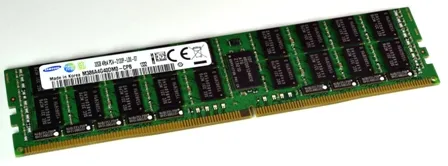
| Product Type | Memory Module |
|---|---|
| Memory Capacity | 64 GB |
| Memory Technology | DDR4 |
| Product Voltage | 1.2 V |
| RAM Speed | 2133 MHz |
| RAM Standard | DDR4-2133/PC4-17000 |
| Error Identifying | ECC |
| Signal Type | Registered |
| Column Access Strobe (CAS) | CL15 |
| Rank | Quad Rank x4 |
| Quantity of Pins | 288-pin |
| RAM Genre | RDIMM |
This 64GB DDR4-2133 RDIMM is purpose-built for enterprise server platforms running memory-hungry workloads such as virtualization farms and in-memory databases, where high capacity per slot and rock‑stable operation are non‑negotiable. Its quad‑rank x4 organization maximizes density while the registered buffer and ECC combine to enforce signal integrity and end‑to‑end data protection, all at a conservative CL15 latency that keeps response times predictable under sustained load.
1. A 64 GB capacity per module maximizes memory density in dual-socket servers, allowing far more virtual machines to run on a single host without costly node expansions.
2. ECC protection silently corrects single-bit errors, preventing silent data corruption in financial transactions and critical database operations that demand absolute accuracy.
3. Registered signal buffering stabilizes command and address lines, enabling the mainboard to support fully populated memory channels even under sustained heavy memory access loads.
4. DDR4 technology delivers 1.2 V low-voltage operation, reducing datacenter power consumption and active cooling requirements at scale while ensuring headroom for burst workloads.
5. Quad Rank x4 organization interleaves four internal ranks per DIMM, saturating the memory bus with concurrent transactions and boosting throughput for in-memory analytics.
The M386A8K40BM1-CPB is a 64GB DDR4-2133 Registered DIMM engineered specifically for enterprise servers, where unplanned downtime simply is not an option. Its ECC technology silently detects and corrects single-bit memory errors—a critical safeguard in virtualized clusters running dozens of VMs, where a cosmic-ray-induced bit flip could otherwise corrupt a hypervisor state and cascade into system-wide instability. The registered signal buffer decouples the memory bus from the DIMM’s electrical load, allowing a single server to reliably populate all 24 or more slots with 64GB modules. This means you can scale to terabytes of RAM for in-memory databases like SAP HANA or Redis without sacrificing signal integrity at the memory controller. The quad-rank x4 organization further benefits database performance: it increases bank-level parallelism, sustaining higher throughput under the random, high-queue-depth access patterns common in OLTP workloads. Combined with a low 1.2V operating voltage that reduces thermal stress across densely packed server racks, this module turns raw capacity into genuine platform resilience—keeping your virtual infrastructure and data-intensive applications accurate, responsive, and continuously available.
General Virtualization
For dense virtualization hosts, populate at least four modules per CPU to balance memory channels and maximize bandwidth. With 64GB RDIMMs, a dual-socket server can comfortably reach 512GB to 1TB, supporting dozens of moderate VMs without oversubscribing memory. Avoid mixing quad-rank DIMMs at speeds above 2133 MT/s, as this may force the memory controller to downclock; stick to identical M386A8K40BM1-CPB sticks for stable 2133 MT/s operation.
In-Memory Database
In-memory databases like SAP HANA or Redis demand large, contiguous memory spaces with rock‑solid data integrity. Deploy six or eight 64GB quad‑rank RDIMMs per socket to reach 384–512 GB, leaving headroom for dataset growth. The ECC and registered signaling of this module are critical — they prevent single‑bit errors from corrupting in‑flight transactions, ensuring ACID compliance under constant write pressure.
High-Performance Computing (HPC)
HPC clusters benefit from maximum capacity per node to hold large working sets in memory. Equip each 2‑socket node with a full population of 16 such 64GB RDIMMs (1 TB total) for weather simulation or CFD workloads. The 2133 MT/s speed, while modest, is sufficient when paired with balanced memory interleaving across all channels, and the registered buffer allows stable quad‑rank operation across dozens of nodes without signal integrity loss.
Factory-tested server RDIMM compatible with Dell R730/R630, HPE DL380 Gen9, Lenovo x3650 M5.
Q: Can I mix this M386A8K40BM1-CPB with other memory modules of different brands or speeds?
A: Mixing this Registered ECC RDIMM with different brands or speeds is strongly discouraged. Conflicting ranks, timings, or protocols often cause POST failures or data integrity errors in server environments. Uniformity is critical.
Q: Is this memory compatible with my system?
A: It is a 64GB DDR4-2133 ECC Registered DIMM (PC4-17000). Compatible with Intel Xeon E5-2600 v3/v4 and select AMD EPYC platforms. Always confirm your motherboard or server vendor’s qualified vendor list (QVL) for support.
Q: What is the recommended DIMM population order for optimal performance?
A: Follow your server board's population guide. Generally, populate identical DIMMs symmetrically per CPU memory channel, starting with channel-1 slots (often furthest from CPU). This ensures balanced interleaving and maximum memory bandwidth.
Q: Does this module support overclocking or XMP profiles?
A: No. As a server-grade Registered ECC DIMM, it adheres only to JEDEC standard DDR4-2133 at 1.2V. Overclocking and XMP are disabled to maintain the deterministic reliability required by enterprise workloads.
Q: What warranty and typical failure rate can I expect?
A: This module includes a one-year warranty. Built for mission-critical servers, it delivers very low annualized failure rates (typically under 0.3%). ECC and rigorous screening minimize operational downtime and data corruption risks.