











 Secure payments
Standard refund policy
Trade Assurance
Secure payments
Standard refund policy
Trade Assurance
| Model | M386A8K40BMB-CPB4Q |
|---|---|
| Product Type | Memory Module |
| Compliance Standards | EU RoHS,FCC |
| Memory Capacity | 64 GB |
| Memory Technology | DDR4 |
| Product Voltage | 1.2V |
| RAM Speed | 2133MHz |
| RAM Standard | DDR4-2133/PC4-17000 |
| Error Identifying | ECC |
| Signal Type | Registered |
| Column Access Strobe (CAS) | CL15 |
| Rank | Quad Rank x4 |
| Quantity of Pins | 288-pin |
| RAM Genre | RDIMM |
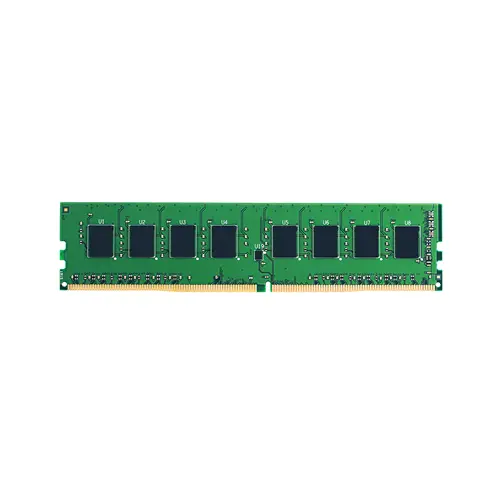
This 64GB DDR4-2133 Registered ECC RDIMM (quad-rank x4) is a server-class memory module engineered for enterprise platforms that demand maximum capacity and data integrity, making it ideal for virtualization hosts, in-memory databases, and dense multi-socket systems. Its registered signal architecture stabilizes high-capacity configurations, while full ECC and the quad-rank organization ensure reliable operation and maintain consistent performance under heavy, sustained workloads.
1. A dense 64GB per module maximizes memory footprint in limited DIMM slots, enabling higher virtual machine density without sacrificing performance.
2. Hardware-level error correction safeguards transactional data integrity, essential for financial databases and mission-critical enterprise workloads.
3. Registered signal buffering stabilizes command and address lines, allowing fully populated server boards to operate reliably under maximum load.
4. Quad Rank x4 organization interleaves multiple internal banks, boosting effective memory bandwidth for parallel analytics and large in-memory caches.
5. DDR4-2133 provides a balanced 17 GB/s per channel throughput, ensuring consistent low-latency access for latency-sensitive enterprise applications.
This Samsung M386A8K40BMB-CPB4Q is a 64GB DDR4-2133 registered DIMM engineered for the server environment, and its four defining characteristics translate directly into business continuity and performance. The ECC technology corrects single-bit memory errors before they can corrupt transactional data or cause silent data corruption in an in-memory database like SAP HANA—an absolute requirement where a flipped bit could mean a financial discrepancy or a crashed instance. The registered signal buffer stabilizes the command and address buses, which allows a single server to support quad-rank, 64GB modules across all 24 slots without signal degradation; in a dense virtualization cluster running dozens of VMs, this means you can confidently scale to 1.5TB per host without random reboots. The quad-rank x4 organization maximizes capacity per channel while interleaving accesses to deliver sustained bandwidth under heavy load. Finally, operating at a low 1.2V, this module helps keep the thermal and power footprint in check across a fully populated rack, reducing cooling costs in a 24/7 data center. Together, these features make it a cornerstone for memory-centric workloads where uptime and data fidelity are non-negotiable.
General Virtualization
For a typical virtualization host, deploy at least two M386A8K40BMB-CPB4Q modules per server to enable dual-channel operation and provide 128GB of baseline capacity. This configuration comfortably supports 20–30 moderate virtual machines, balancing density and cost. Populate identical modules in pairs to maintain balanced memory access and avoid performance penalties from mismatched ranks.
In-Memory Database
Maximize capacity by installing eight modules for 512GB total, leveraging the RDIMM’s registered ECC to safeguard in-memory datasets. The quad-rank x4 organization delivers strong chip-level parallelism, which benefits large working sets in databases like SAP HANA or Redis. Distribute modules evenly across all memory channels to sustain high throughput under demanding transactional loads.
High-Performance Computing
Use a fully populated configuration—eight or more modules per dual-socket node—to reach terabyte-scale memory, critical for simulations and large-scale modeling. The 2133MHz speed with CL15 latency offers a stable foundation, though pairing with higher-frequency parts in the same channel causes downclocking to the lowest common speed. Validate QPI/UPI bandwidth and populate equivalent ranks per channel for optimal numerical computation throughput.
Rigorously tested, compatible with Dell PowerEdge R760, HPE ProLiant DL380 Gen10, Lenovo ThinkSystem SR650.
Q: Can I mix this M386A8K40BMB-CPB4Q with other memory modules of different brands or speeds?
A: Mixing with different brands or speeds is strongly discouraged. This registered ECC module requires homogeneous configurations. Mismatched timings, ranks, or vendor-specific SPD data may compromise signal integrity and cause system instability on server platforms.
Q: Is this memory compatible with my Intel Xeon Scalable or AMD EPYC server platform?
A: This DDR4-2133 ECC RDIMM is compatible with platforms supporting Registered DIMMs, such as Intel Xeon E5-2600 v3/v4 and select AMD EPYC 7001 series. Always verify supported speeds and maximum capacity against your specific server board’s memory QVL.
Q: What is the recommended DIMM population order for optimal performance?
A: Install identical quad-rank DIMMs in matched sets per memory channel, following the platform’s balanced population guidelines. Typically, this means populating slots furthest from the CPU first and spreading modules across all available memory channels for maximum interleaving.
Q: Does this module support overclocking or XMP profiles?
A: No, this is a server-grade Registered ECC module operating at JEDEC-standard DDR4-2133. Overclocking and XMP profiles are not supported, as platform stability and data integrity under persistent workloads take precedence over adjustable frequency or latency.
Q: What warranty and typical failure rate can I expect?
A: This module comes with a one-year warranty. As a rigorously tested enterprise component, it exhibits an extremely low annualized failure rate (AFR) under normal operating conditions, making it suitable for 24/7 mission-critical deployments.