











 Secure payments
Standard refund policy
Trade Assurance
Secure payments
Standard refund policy
Trade Assurance
| Model | M386A8K40CM2-CRC4Q |
|---|---|
| Product Type | Memory Module |
| Compliance Standards | EU RoHS,FCC |
| Memory Capacity | 64 GB |
| Memory Technology | DDR4 |
| Product Voltage | 1.2V |
| RAM Speed | 2400MHz |
| RAM Standard | DDR4-2400/PC4-19200 |
| Error Identifying | ECC |
| Signal Type | Registered |
| Column Access Strobe (CAS) | CL17 |
| Rank | Quad Rank x4 |
| Quantity of Pins | 288-pin |
| RAM Genre | RDIMM |
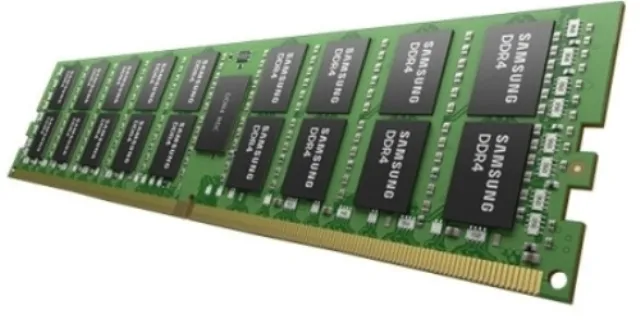
Registered ECC DDR4-2400 RDIMM with quad-rank x4 configuration and CL17 latency ensures robust data integrity and high memory density, making it ideal for virtualization clusters and in-memory databases. Its 288-pin registered design buffers command and address signals to maintain signal stability across large-scale server deployments under continuous 1.2V operation.
1. 64GB capacity per module enables dense memory footprints, allowing virtualization hosts to run more concurrent VMs without resorting to costly chassis expansions.
2. ECC protection corrects single-bit errors in real time, preserving transactional integrity in financial databases and eliminating silent data corruption risks.
3. Registered signal type buffers the command and address buses, stabilizing signal integrity across fully loaded channels for massive in-memory analytics deployments.
4. Quad Rank x4 organization maximizes gigabyte-per-slot density, safeguarding future upgrade headroom for memory-hungry enterprise applications without sacrificing existing DIMM slots.
5. DDR4-2400 transfer rate provides consistent bandwidth delivery per channel, preventing memory throughput bottlenecks during simultaneous heavy query processing on multi-socket servers.
The M386A8K40CM2-CRC4Q is a server-grade DDR4 Registered DIMM, purpose-built for enterprise data centers where uptime and data integrity are non-negotiable. Its four defining characteristics directly address the real-world pain points of IT infrastructure managers. First, the Error Correcting Code, or ECC, is a non-negotiable safeguard. In a dense virtualization cluster hosting dozens of virtual machines, a single bit-flip caused by cosmic radiation can crash a critical application or silently corrupt a financial database record. ECC detects and corrects these errors in real time, transforming a potential silent data corruption crisis into a non-event.
Second, the Registered, or buffered, signal type solves the electrical loading challenge that occurs when populating multiple DIMMs per memory channel. For an in-memory database like SAP HANA where you need massive 64GB modules, this buffering stabilizes the command bus, ensuring rock-solid signal integrity across all four quad ranks, even under maximum configurations. Third, the Quad Rank x4 architecture maximizes density per channel, allowing you to extract the full capacity from high-core-count processors in a virtualized host without sacrificing memory speed. This delivers the voluminous, low-latency footprint that memory-hungry analytics workloads demand. Finally, while performance is critical, power costs scale across an entire server farm. The 1.2V low-voltage design of this module directly reduces thermal load and cumulative power consumption, lowering your total cost of ownership while maintaining the relentless 2400MHz throughput required for consolidated, mission-critical operations.
This 64GB DDR4-2400 Registered ECC RDIMM is intended for server environments. Proper capacity planning ensures optimal performance for each workload type.
General Virtualization
Balance capacity with memory bandwidth per core. Install one 64GB DIMM per channel to sustain throughput; on a dual-socket server this commonly means 8 to 16 modules (512 GB to 1 TB). This configuration supports dense VM consolidation while preserving NUMA efficiency and leaving expansion room.
In-Memory Database
Maximize capacity by populating every DIMM slot with identical 64GB modules. A fully loaded 24-slot system provides 1.5 TB, ideal for large in-memory datasets. Distribute DIMMs evenly across all memory channels and CPU sockets to enable interleaving and minimize latency for real-time analytics.
High-Performance Computing (HPC)
Prioritize bandwidth. Use one DIMM per channel to avoid clock speed reduction that can occur with multiple quad-rank modules. For memory-capacity-hungry simulations, upgrade to two identical DIMMs per channel, but verify the platform can sustain 2400 MT/s. Balanced population across channels is essential for peak floating-point throughput.
Compatible with servers like Dell PowerEdge R740, HPE ProLiant DL380 Gen10, Lenovo SR650; rigorously tested.
Q: Can I mix this M386A8K40CM2-CRC4Q with other memory modules of different brands or speeds?
A: Mixing is not recommended. This RDIMM is engineered for uniform configurations. Different brands, speeds, or ranks may cause instability and invalidate platform validation. Use identical modules for guaranteed performance and reliability.
Q: Is this memory compatible with my system?
A: Compatibility requires a server board supporting DDR4-2400 Registered ECC memory. It's validated for Intel Xeon E5-2600 v3/v4 and select AMD EPYC platforms. Always consult your server's Qualified Vendor List (QVL) to confirm.
Q: What is the recommended DIMM population order for optimal performance?
A: Populate identical modules per channel, starting with the primary slot (often DIMM A1). Follow the server's memory configuration guide to balance channels and ensure proper ECC and rank interleaving for maximum throughput.
Q: Does this module support overclocking or XMP profiles?
A: No. This is an enterprise-grade Registered ECC DIMM built strictly to JEDEC DDR4-2400 standards. It does not support overclocking or XMP profiles, prioritizing data integrity and 24/7 stability over adjustable timings.
Q: What warranty and typical failure rate can I expect?
A: This module includes a one-year warranty. As an enterprise RDIMM, it achieves a very low annualized failure rate (AFR), typically under 0.5% under specified conditions, ensuring high uptime for mission-critical workloads.