











 Secure payments
Standard refund policy
Trade Assurance
Secure payments
Standard refund policy
Trade Assurance
| Product Type | Memory Module |
|---|---|
| Memory Capacity | 128 GB |
| Memory Technology | DDR4 |
| Product Voltage | 1.2 V |
| RAM Speed | 2933 MHz |
| RAM Standard | DDR4-2933/PC4-23400 |
| Error Identifying | ECC |
| Signal Type | Registered |
| Column Access Strobe (CAS) | CL21 |
| Rank | Quad Rank x4 |
| Quantity of Pins | 288-pin |
| RAM Genre | RDIMM |
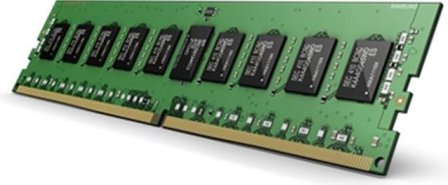
This is a server-grade DDR4-2933 RDIMM designed for enterprise platforms requiring high-capacity memory with data integrity, ideally suited for virtualization, in-memory databases, and mission-critical workloads. Its registered signal type and ECC ensure stable operation under heavy loads, while the quad-rank x4 configuration maximizes capacity density up to 128GB per module at a 1.2V low-power envelope.
1. 128GB capacity enables massive memory footprint per DIMM, maximizing VM density per server node for heavy virtualization workloads.
2. ECC protection ensures end-to-end data integrity, eliminating silent memory errors that could corrupt financial transactions or critical databases.
3. Registered signal type stabilizes command/address lines across high-density memory configurations, preserving signal integrity in fully loaded 24-DIMM server boards.
4. Quad Rank x4 architecture exploits all bank groups to sustain high throughput, keeping memory bandwidth consistent under concurrent accesses from numerous cores.
5. 2933 MT/s speed delivers substantial memory bandwidth, accelerating in-memory analytics and large-scale data processing with reduced latency.
The M386AAG40MMB-CVFBQ is a 128GB DDR4-2933 Registered ECC RDIMM engineered for modern data centers, where every bit of uptime and throughput directly impacts revenue. For virtualization clusters running dozens of mission-critical VMs, its massive 128GB capacity lets you pack far more workloads onto a single physical host, slashing licensing costs and power consumption without sacrificing VM isolation. However, raw density alone is meaningless if signals degrade under load: the Registered architecture buffers command and address lines, preserving rock-solid signal integrity even when all 24 DIMM slots in a dual-socket server are fully populated with quad-rank modules. That stability becomes non-negotiable in in-memory databases like SAP HANA, where ECC actively corrects single-bit errors caused by cosmic radiation or electrical noise—preventing silent data corruption that could otherwise cascade into flawed financial transactions or analytics. At 2933MT/s with a Quad Rank x4 organization, the module also balances latency and bandwidth through interleaved bank accesses, accelerating large in-memory queries and enabling real-time insight extraction without memory bottlenecks. In essence, this RDIMM transforms your server into a denser, safer, and faster data engine, safeguarding your most critical workloads around the clock.
General Virtualization
This 128GB DDR4-2933 Registered ECC RDIMM is purpose‑built for dense virtualization hosts. A dual‑socket server can accept multiple modules per channel, and populating all memory channels symmetrically with these quad‑rank DIMMs maximizes total capacity while maintaining balanced NUMA access. For typical mixed‑VM workloads, installing two or four of these 128GB modules per socket provides ample headroom for memory overcommit without compromising stability.
In‑Memory Database
ECC protection and registered signaling make this module ideal for in‑memory databases where data integrity is paramount. Because quad‑rank DIMMs can impose slightly higher latency under heavy load, populate only one DIMM per channel if microsecond response times are critical, or use two per channel to prioritize sheer capacity for large datasets. A six‑or‑eight‑channel configuration with these 128GB sticks easily supplies the terabyte‑scale footprint demanded by Redis clusters or SAP HANA instances.
High‑Performance Computing
HPC clusters benefit from the module’s high density and error correction to sustain long‑running simulations. To maximize memory bandwidth, distribute identical 128GB RDIMMs uniformly across all available memory channels—typically six or eight per CPU—and avoid mixing ranks unequally. For memory‑capacity‑bound workloads like computational fluid dynamics or genome assembly, fully populating each channel with one DIMM delivers both the required aggregate capacity and consistent CL21 latency, while leaving future expansion slots free.
Rigorously tested server RAM, compatible with Dell PowerEdge R740, HPE ProLiant DL380 Gen10, Lenovo ThinkSystem SR650.
Q: Can I mix this M386AAG40MMB-CVFBQ with other memory modules of different brands or speeds?
A: Mixing is not recommended. This 128GB quad-rank RDIMM requires matched configurations for signal integrity. Mismatched speeds or ranks may cause BIOS errors and system instability, especially in registered server environments.
Q: Is this memory compatible with my Intel Xeon Scalable server?
A: It is compatible with platforms supporting DDR4-2933 ECC Registered DIMMs, such as Intel Xeon Scalable (Cascade Lake/Cooper Lake) and AMD EPYC 7002/7003 series. Verify your motherboard supports 128GB quad-rank x4 RDIMMs.
Q: What is the recommended DIMM population order for optimal performance?
A: Populate identical DIMMs per channel, starting with the slot farthest from the CPU socket (often blue/white). Follow your server’s memory population guide to maintain balanced interleaving and avoid performance penalties with high-capacity quad-rank modules.
Q: Does this module support overclocking or XMP profiles?
A: No. This is a JEDEC-compliant server-grade RDIMM operating at fixed 1.2V DDR4-2933 with CL21. Overclocking and XMP are not supported, as enterprise memory prioritizes data integrity and stability over frequency tuning.
Q: What warranty and typical failure rate can I expect?
A: This module includes a one-year warranty. Typical field failure rates for Samsung enterprise RDIMMs are extremely low (AFR well below 0.5%), reflecting rigorous component screening and long-term reliability under 24x7 workloads.